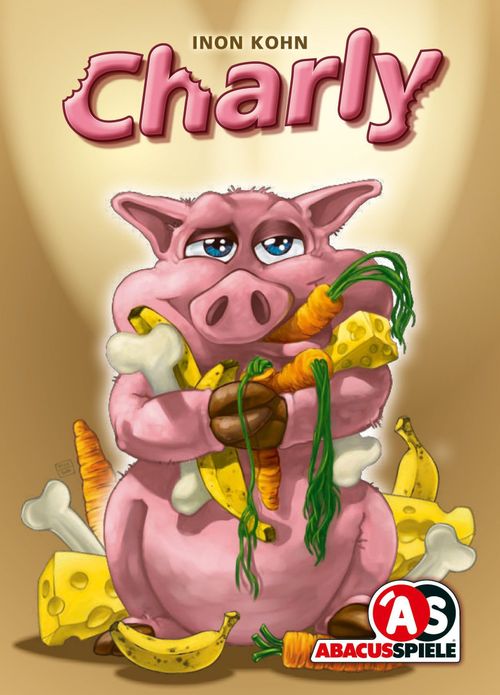
Charly
Charly Rulebook
Table of Contents
Table of Contents
About the Game
The game lasts several rounds. Each round is divided into two phases: card selection and the feast.
In the first phase you SELECT CARDS IN YOUR HAND so that in the second phase you can feed as many of the animals you have been dealt as possible. As a rule, holding many animals in hand is not advantageous; it is much more important to collect animals of different kinds. When selecting animal cards, pay attention to the revealed food cards and to the food card in your hand.
The second phase of the round is the FEAST. The players reveal all their food cards, and then in turn lay animal cards on the table if there is enough food for them there.
After this, the players must feed the animals remaining in their hands with honey from their personal supplies, because everyone likes honey! The game ends as soon as at least one player runs out of honey. The player who has more honey left at that moment than any other opponent becomes the winner.
Components
- 66 animal cards: 15 cards each of dogs, mice, rabbits and monkeys (each set contains 5 cards with 1 animal, 6 cards with 2 animals and 4 cards with 3 animals), and 6 pig cards with 2 animals each.
- 20 food cards: 5 each of bananas, bones, carrots and cheese (each set contains cards with values from 4 to 8).
- 6 "Gourmet Pig" cards, each with 1 pig, needed for the extended variant of the game.
- 90 drops of honey.
Setup
- Give each player 15 drops of honey. Each player places them in front of themselves as a personal supply. Return any extra drops to the box. Place the box at the edge of the table; during the game, players will discard honey from their personal supplies into it.
- Separate the cards into a food deck and an animal deck.
- For a simplified game, remove the 6 "Gourmet Pig" cards from the animal deck. It is advised to do this the first time you play. Afterwards you can play with or without these cards.
- Shuffle the animal deck and deal 7 cards to each player. Players take them into their hand without showing them to opponents.
- Place the remaining animal cards face down in the middle of the table. Reveal the top card of the deck and place it face up next to the deck; this is the first card in the discard pile.
- Depending on the number of players, remove some food cards:
- for 2 players, remove all cards with value 7 and 8;
- for 3 and 4 players, remove all cards with value 8;
- for 5 players, remove all cards with value 4;
- for 6 players, do not remove any cards.
- Shuffle the remaining food cards.
- Deal each player 1 food card. Players also take these cards into their hand without showing them to opponents.
- Finally, depending on the number of players, take several random cards from the food deck and place them face up on the table:
- 1 card with 2 players;
- 2 cards with 3–5 players;
- 3 cards with 6 players.
- Place the remaining food cards face down to the side; they will not be needed this round.
Playing the Game
I. Card Selection
On your turn, choose one of two actions: REPLACING A CARD or INVITING TO THE FEAST.
Replacing an Animal Card
If you do not like the cards in your hand, you may replace one animal card. First you take the top card either from the animal deck or from the discard pile. Then you must choose an animal card in your hand and place it face up on the discard pile.
Inviting to the Feast
If the cards in your hand suit you, you may invite your animals to the feast instead of replacing a card. Loudly call out: "Dinner is served!" All your opponents, starting with the player to your left, each take one more turn, during which they may replace one card. After this, the FEAST begins.
IMPORTANT: if at the start of your turn there are no cards left in the deck, you are obliged to invite your animals to the feast. In this case none of your opponents has the right to replace cards: the feast begins immediately!
II. The Feast
Each player reveals to everyone the food card they held in hand. These cards are placed next to those that were revealed at the start of the round.
Depending on the number of players, a total of 3, 5, 6, 7 or 9 food cards will be revealed.
Starting with the player who invited the guests to the feast, players take turns (clockwise) placing one animal card from their hand onto a food card of the corresponding food.
FOLLOW TWO RULES:
- An animal card may be placed only on a food card of its favourite food: dogs like bones, mice like cheese, monkeys like bananas, rabbits like carrots. Only pigs eat everything: a card with two pigs may be placed on any food! Exception: the "Gourmet Pig" card may be placed only on one of the two food types shown in the corners of that card. With the help of pigs you can take away the favourite food of other animals!
- The amount of food on a card shows how many animals it can feed. What counts is not the number of animal cards, but the total number of animals depicted on those cards (a card may have from one to three animals). When all the food on a card has been eaten, turn it face down.
IMPORTANT: each food card must have its own row of animal cards. Cards must be laid out so that all players can see how many animals are already being fed from each food card. Each corner of an animal card shows how many and which food the animals on that card need.
If a player cannot place an animal card, they pass. The others continue placing cards in turn until their options are exhausted too.
Example
On a food card with value 4 (bones), you can place only one more card with 1 dog.
On a food card with value 5 (carrots), you can place: a card with 3 rabbits; or a card with 1 rabbit and a card with 2 rabbits; or 3 cards with 1 rabbit each; or a card with a rabbit and a card with 2 pigs.
End of the Round
The round ends when no one can place any more animals from their hand.
Feeding the Hungry
Now each player who still has animals in their hand must feed them with honey from their personal supply. Discard into the box 1 drop of honey for each dog, mouse, monkey and rabbit, and 2 drops of honey for each pig remaining on your cards in hand.
Preparing for the Next Round
If every player still has at least one drop of honey in their supply, the game continues. Gather all the animal cards and all the food cards into separate decks and shuffle them. Then deal the cards exactly as at the start of the game.
End of the Game
The game ends at the end of the round in which any player runs out of honey.
You are obliged to feed your animals with honey while you still have it, even if some opponent has already run out. If you do not have enough honey to feed at least one animal from a card, place that card face up on the table in front of you.
The player who has more honey left in their supply becomes the winner. If no one has any honey left, the winner is the player in front of whom fewer hungry animals are placed. In case of a tie, the winning contender is the one sitting farther from the player who announced the feast (counting clockwise).