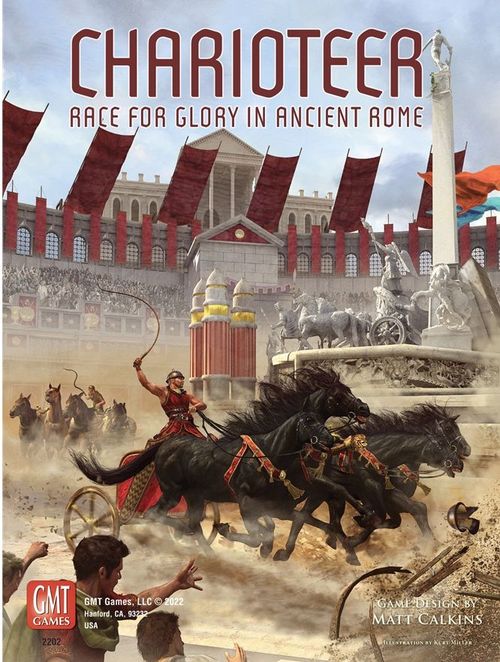
Charioteer
Charioteer Rulebook
Table of Contents
Table of Contents
Components
- Two 17" x 22" Mounted Mapboards
- Six Player Chariot Pieces (wood)
- 147 Card Charioteer Deck
- 24 Card Skills Deck
- Six player Displays
- 1 Draw Bag
- 40 Damage Cubes
- 24 Skill Markers in 6 colors
- One wooden Round Marker
- 60 Fan Tokens (screen printed wooden blocks)
- 30 Player Tokens (screen printed wooden blocks)
- Rule Book
- One Custom D6 Die
Set Up
Each player takes a set of five white, 8-sided player tokens (one each of the five types). Tilt them so that only the owner can see their identity.
Fan tokens begin the game in the draw bag. After a great move, players will draw a fan token from the bag. Fan tokens grant players special abilities.
Damage cubes begin in a pile near the board. They're used to mark the damage done to each chariot.
The primary deck in this game is labelled 'Charioteer'. Shuffle and place it face down to form a draw pile. If the stack is too tall, keep half of it on the side of the board.
The lap counter begins the game on side 1.
Each color makes a different kind of move. Icons (on cards and tokens) can offer bonuses. Regular spaces and outer spaces make up the track.
Shuffle the deck and deal 8 cards to each player.
Draw three cards and place them face up in the three slots of the crowd card track. The card in the rightmost slot is the active crowd card, and the cards in slots 2 and 3 will become the crowd card, in later turns.
Roll the emperor die and place it on the board. The die announces the kind of move the emperor wishes to see this turn.
Place a chariot for each player in the start space, pointing counterclockwise.
Each player selects a display to match the color of their chariot.
The skill track shows a charioteer's skill in each of the four types of move. The damage boxes show how much damage is done to the chariot. The damage box contains damage cubes, which represent the damage the chariot has sustained. The attack boxes contain new damage.
Each player draws one skills card before the game begins. It tells what skills a charioteer is good at: speed, cornering, or even attacking other players! After everyone has drawn and marked their skill levels, put all of the skills cards away for the rest of the game.
Each player takes four skill markers. Place the skill markers on the start spaces of the skill track, in the order specified on the card.
Turn Cycle
Charioteer is played in a series of turns in this order:
- Select moves
- Move chariots & collect rewards
- Check for end of lap (or game)
- Set up the next turn
Select Move Cards
Charioteer is a game about moving forward. Every turn offers a new opportunity to move chariots around the track. Moves are made by playing matching sets of cards. The better the set, the farther the move will travel.
Every turn, each player selects up to three cards from their hand that share a common symbol.
In the center of the board is a card designated the crowd card. Players may include the crowd card in their move, if it has their symbol on it. Every player may use the crowd card, if they wish.
Moves must include at least two matching cards. Counting the crowd card, a move can have up to four cards.
All players choose their cards at the same time and place them face down on the table. Once every player has selected their move, reveal the moves simultaneously.
Symbols
Symbols appear on cards. Every symbol is a color-and-number combination. These are the twelve symbols in Charioteer:
- Green: 2, 4, 6
- Red: 1, 3, 5
- Yellow: 0, 2, 4
- Black: 0, 1, 2
Every move features exactly one of these twelve symbols. That symbol must appear on every card in the move, and all other symbols on the cards will be ignored. The more matching symbols, the better the move.
Example. For this turn, Elaine plays three cards with red-5s along with some other symbols. Elaine's move has a total of six matching red-5 symbols. The other symbols (green-2, yellow-4, black-2) are ignored.
Play a Token
Players may add a token to their move by placing it face-down on top of the face-down cards they play. Only one token can be placed on each move. If the token has a color, it must match the color of the move.
Some tokens add to the distance of the move. Others offer special abilities or protection.
Calculating Movement
Calculate the base distance of a move by counting the number of matching symbols. Add this count to the number printed on the symbol to find the base rate of movement.
Example. Continuing to use Elaine's cards as an example: she has 6 matching symbols and the number on the symbols is a 5. This gives her a base move of 11 for the turn. A set of three 4s would move 7 (3 matching symbols + 4 is the number on the symbol = 7). A set of six 2s would move 8.
Final movement distance is also affected by three other factors: the token played, the charioteer's skill, and the current damage to the chariot.
If the token played grants a bonus to movement, add that bonus now.
Add the skill bonus from the player's Skills Track in the color corresponding to the move.
Subtract one point of movement for each cube in the player's Damage Box.
Count total movement like this: CARDS + TOKEN + SKILL - DAMAGE.
Movement can never be less than zero.
Example. To understand how Skills and Damage affect the move, we have to look at the player display. Continuing the example from above, imagine that Elaine played a +3 red token with her move, and that her Player Display looked like this: her red skill marker is in the +1 zone (the broad middle of the Skills Track is all '+1'), and there are two cubes in her Damage Box.
Look first at the top part of the display, labelled 'Skills'. Find the octagonal skills marker of the color that matches the move, and add its bonus to the length of the move. Elaine played a red move, and her red skill marker is in the +1 zone. Add one point to her movement for skill in red moves.
Next look to the lower part of the display. In the large rectangular box labelled 'Damage Box' there are two cubes. Subtract two points of movement for these two points of damage. (There is another cube in the Attack Boxes, but this doesn't count against the move.)
Her total move is the sum of all these factors: 11 points of movement from the cards, +3 for the token, +1 for skill in red, -2 for damage. The total move is 13. Elaine has 13 points of movement.
Moving the Chariot
The chariot in the lead moves first, followed by the chariot in second place, and so on until every chariot has had a chance to move.
For each point of movement, a chariot moves forward one space on the board. When a chariot has used all of its movement points, it stops moving.
The two curved sections at each end of the track feature an additional set of outer spaces in between the regular spaces. The outer spaces are colored darker than the regular spaces. Most of the time, chariots will have to enter every space as they proceed around the corner, both the regular spaces and the outer spaces. Each space should be entered in order. (Only chariots making a cornering move, explained below, will skip the outer spaces.)
Passing Another Chariot
Each space on the track can hold multiple chariots. When this happens, arrange the chariots in a row from the inside of the space to the outside. A chariot closer to the inside of the track is always considered ahead of one to the outside.
When a moving chariot enters a space occupied by one or more other chariots, place it on the outside of the others, furthest from the center of the track. If the moving chariot has more movement points, it spends them to move ahead of its rivals in the same space, at the cost of one movement point per rival. If the chariot passes all rivals in its space and has movement points remaining, it can continue its movement to the next space.
Example. David has a movement of 5 with two rival chariots a few spaces ahead. David starts his move by advancing into an empty space. As David enters his second space, he moves to the outside of the green chariot. He needs to pass both rivals before moving to the next space, so he spends his third point to move to the inside of the green chariot and then a fourth point to move to the inside of the yellow. David has one more movement point and so he moves forward to the next space.
A chariot cannot leave its space until it has pulled ahead of all other chariots in the space.
Chariots that don't need to enter an outer space (because they are making a cornering move) don't need to spend movement points passing the chariots in those outer spaces. (See the cornering section for an example.)
Reset Move
A player may choose to bring their chariot to a halt on the track in order to calm their horses and regain their bearings. This is called a reset move. It removes all damage from a chariot. In hectic races it can sometimes be necessary.
To make a reset move, play 1-3 cards face-down as normal, except that the cards need not match and will not be counted for movement.
When revealing cards, announce that this is a reset move. When it is time to move the chariot, do not move it. Simply discard all cards played and remove all cubes from the damage box and attack boxes on the display. Do not accumulate cubes in the attack boxes this turn for any reason.
Rewards for a Move
After every move (except a reset move) the player can gain rewards. There are two kinds of rewards: skill can increase, and a fan token can be earned.
Increase Skill Level
Each player has four skill markers, to indicate their degree of skill in each of the four colors. Each marker advances along the skills track during the course of the game.
After making a move, increase skill in the color of the move played by advancing the corresponding skill marker one space forward on the skills track. For more detail, see the 'Skills Track' section below.
Gaining a Fan Token
Impressive moves win the support of new fans. Any move that matches six or more symbols (including those on the crowd card) awes the spectators and earns the player a new fan token. The player draws a fan token at random from the bag and places it in front of themselves so that other players cannot see its front side.
There is no limit to how many fan tokens a player can have.
Example. David's move matches a total of seven symbols: five in the three cards he played and two more on the crowd card. After the move, David will draw a new fan token.
Colors of Movement
Symbols come in four colors, representing four kinds of move. When a move is made, the color of the matching symbol determines the kind of move.
Green Is a Sprint
Sprint moves have the highest numbers but no special abilities.
Red Is an Attack
Attack moves cause damage to rival chariots. Every possible kind of disruption is considered an 'attack': making distractions, jostling chariots, throwing things, shouting, leaving obstacles on the track, etc. All other players (not just one) are affected when a player makes an attack.
A move that matches red symbols across three cards is considered a minor attack. All rival chariots must place one damage cube in an empty attack box on their display, if possible.
A move that matches red symbols across four cards is considered a major attack. All rival chariots must place two damage cubes in empty attack boxes on their display, if possible.
Example. Eliot plays a move of four matching red cards (three from his hand plus the crowd card) to execute a major attack. All other chariots place two damage cubes on empty spaces in their attack boxes.
Yellow Is a Recovery
Recovery moves reduce the damage that has been done to a chariot. When making a yellow move, reduce by half the number of damage cubes in the player's damage box. Make this reduction before counting damage points against the length of the move. If there is an odd number of cubes in the damage box, round in the player's favor. (For example, if there are five cubes in the damage box, remove three.) A recovery move does not affect cubes in the attack boxes.
Black Is for Cornering
A cornering move travels more quickly around the ends of the track. When making a cornering move, do not enter any outer spaces. (Outer spaces are darker than regular spaces and do not extend to the inner ring of the track.) Instead move only through the regular spaces around the corners.
Skipping outer spaces makes a cornering move twice as fast through the corners.
Example. Alec makes a cornering move and enters only regular spaces around the corner. He skips the darker outer spaces.
It is possible for a cornering move to begin in an outer space, but it does not enter any more of them during the course of the move.
Example. Emily and Eliot are rounding the corner. Emily makes a 5-space cornering move using black symbols. She starts on an outer space but does not enter another one for the length of her move. During her move she enters only regular spaces. Eliot makes a green move of 8 spaces and must enter each regular and outer space along the way.
Crowd Card
The crowd card is the card in slot 1 of the crowd card track. This card is available to all players as part of their moves.
Two more cards are visible in the crowd card track. These will be the crowd card in the next two turns. Players can see them in advance and plan ahead, but these future crowd cards are unavailable for matching in the current turn.
At the end of every turn, discard the crowd card and slide the two remaining cards forward on the crowd card track. Deal a new card into slot 3.
Example. A turn is ending. Discard the crowd card (from slot 1 at the right) and move the other cards forward on the track. The card in slot 2 moves to slot 1 and the card in slot 3 moves to slot 2. Draw a new card to fill the empty slot 3.
The Emperor Die
Every turn, the emperor makes a new request of the players. Roll the emperor die before each turn to determine that request.
If the result is a color, this is the type of move the emperor wants to see. Racers who make this color of move will advance an extra space on their skills track. The four colors are Sprint, Attack, Recovery, and Corner.
If the result is "All" (all four symbols), the players will get an extra skill advancement for whichever color of move they make.
If the result is "Disrupt" the emperor tries to damage the players. He is not literally attacking them, of course, but rather inciting the crowd to throw things, make noise, scare the horses, etc. Add damage cubes to each player's attack boxes, according to the number of players:
| Number of Players | Damage |
|---|---|
| 2 | 3 |
| 3 | 2 |
| 4 | 1 |
| 5 | None |
| 6 | None |
In games with more than four players, the emperor's attacks do not inflict any damage.
Displays
Each player has a display to track their skills and the damage done to their chariot. The color of the display should match the color of the player's chariot for easier coordination. Displays have two major sections: the skills track and the damage boxes.
Skills Track
The skills track measures the player's abilities in each of the four types of move. The advancement of these skills is represented by skill markers, one in each of the four colors.
The skills track begins with the start spaces, proceeds through the middle section (where every space is worth '+1') and finishes in the bonus box.
Before the game begins, each player draws a skills card and places their four skill markers on the four start spaces of the skills track, accordingly. The higher start spaces are more advanced, so the skills listed higher on the skills card will be better developed when the game begins.
Example. David has drawn this skills card. It indicates that his charioteer is stronger at sprinting but weaker at cornering. He will place his green (sprint) marker highest on the start spaces, followed by red, yellow, and black (cornering) in that order.
When a player makes a move, they gain skill in that kind of move. After the move is complete, advance the skill marker of the corresponding color to the next space on the skills track. (After a red move, advance the red marker; after a green move, advance the green marker, etc.)
If the color of move played matches the color requested by the emperor (on the emperor die) move the skills marker forward a second space.
The bonus box is the end of the skills track. When a skill marker reaches the bonus box, place it in the lowest unoccupied space in that box. It does not move again for the rest of the game. Each space in the bonus box holds only one skill marker.
The first skill marker to arrive in the bonus box will remain at +3 for the remainder of the game, the second marker to arrive in the bonus box will remain at +5 for the remainder of the game, etc.
Every space on the skills track prior to the bonus box can hold multiple skill markers at once. This includes the starting spaces.
Example. Emily's yellow skill marker advances and moves into the bonus box. Her green skill marker is already in the +3 space, so the yellow marker is placed in the +5 space. When Emily makes another yellow or green move, her yellow and green skill markers will not advance.
Applying a Skill Bonus
Skill bonuses increase the length of a move. The skill bonus added to any given move is indicated by the skill marker in the color of the move. (For a yellow move, check the location of the yellow skill marker; for a black move, check the location of the black skill marker, etc.)
In the starting spaces, the skill bonus is zero. In the main body of the skills track, the bonus is +1. In the bonus box, the bonus ranges from +3 to +9.
Example. This is Alec's Skills Track. If he makes a red move, he will get no skills bonus. If he makes a yellow or green move, he will get +1 to the length of his move. If he makes a black move, he will get a bonus of +3.
Damage Box
The damage box tracks the amount of damage a chariot has sustained. (This 'damage' includes anything that might slow movement, including all forms of disruption, as well as physical damage.)
The damage box (one large rectangle) is separate from the attack boxes (three small squares). Only cubes in the damage box affect movement.
Effect of Damage on Movement
Every damage cube in the damage box reduces the chariot's rate of movement by one. (Cubes in the attack boxes have no effect.) The rate of movement cannot drop below zero.
Attack Boxes
The three spaces to the left of the damage box are called the attack boxes. When a chariot sustains damage, place the incoming damage cubes into the attack boxes.
New damage does not affect the distance of a move on the turn it arrives. At the end of each turn, all players move the contents of their attack boxes into their damage box.
A chariot cannot take more than three points of new damage in a turn. To emphasize this limit, there are only three attack boxes. Ignore all new damage beyond the third in a turn.
Reducing Damage: Recovery & Reset
Cubes in the damage box remain there until removed. A player can remove damage by making a recovery move or a reset move.
Recovery moves (yellow moves or moves that include recovery icons) remove half of the cubes in the damage box.
Reset moves remove all damage cubes and prevent new ones from being collected that turn.
Icons
Icons are shapes that can be found on player tokens, fan tokens, and cards. Icons convey a special advantage when played.
Icons and symbols are completely different! (Symbols are color/number combinations played in matching sets to move the chariot. Icons are played individually, for a bonus or special effect.)
Here are the icons of Charioteer, and where they are found:
- Player token: discard (-3), movement (+5)
- Card & fan token: whip, shield, recovery
- Fan token: learning (+1), wild, movement (+3), discard (-2)
Color may vary. (For example, the green +5 player token also comes in red, yellow, and black.)
Icons on Cards
An icon is part of the move when it appears on a card that is part of the move. If there are symbols on the card, the symbols must match the move in order for the card to be played.
Example. David plays these three cards, matching the red-1 symbols. The shield icon is part of the move. If he had chosen to match black-1 symbols, he could not have played the card with the shield as part of his move.
Icons on Tokens
There are two kinds of tokens. Player tokens are given to each player at the start of the game, and are never replenished. Fan tokens are earned every time a player makes a 6-symbol move. Both kinds of tokens are played the same way.
To play a token, place it face down on top of the move cards before moves are revealed. When all players show their moves, reveal cards and token together.
Icons on a token can be played only when they match the color of the move. Uncolored icons (with a white background) may be played with any color of move.
Example. This black token can be played with this move (a set of black-1 symbols) because both are the same color.
When the move is complete, discard any tokens played in the move.
Shield
A card or token showing a shield icon blocks all new damage for that turn, whether from the emperor or other charioteers. It does not affect cubes in the damage box.
When the shield is revealed, empty the attack boxes on the display and don't add to them during the course of the turn.
A shield token is colorless and can be played with any move.
Example. When Eliot attacks, all players are instructed to add two cubes to their attack boxes. Alec has a shield, however, so he does not. Alec's attack boxes will remain empty throughout the turn in which he has the shield. At the end of the turn, he discards the shield.
Whip
A card or token showing a whip adds up to 5 extra spaces after the end of the regular move with some restrictions:
- A whip adds no benefit to a chariot that is leading the race or that passed another chariot during the current move.
- A whip cannot be used to pass another chariot. If the next movement point would carry the moving chariot past a rival, the whip stops working at that moment.
- When a cornering (black) move is augmented by a whip, the whip's additional movement skips the outer spaces, just as the regular move did. However, if there is a chariot in the outer spaces, and the next step forward would cause the moving chariot to pass that rival, whip-based movement must instead stop.
A player can benefit from multiple whips in the same turn.
Example. Emily is 2 spaces behind David when she finishes her regular move. She has not passed anyone so far in the move. She played a whip, which allows her to move up to 5 additional spaces, but not to pass another racer. She advances 2 spaces, into the space with David's chariot, but must stop before pulling ahead of him.
Note: Whips appear alone on cards, without symbols. Whip cards can be played as part of any move.
Recovery
A recovery icon removes half of the damage cubes from the damage box. (Round in the player's favor in case of an odd number.) Remove the damage cubes before calculating movement for the turn.
If more than one recovery applies to the same move, remove all cubes from the damage box. (Recovery can be triggered by a yellow move, an icon on a card, or an icon on a token, so it's possible to have multiple recoveries on the same move.)
Example. Elaine plays a recovery token (face-down) on her two card move, and a discard token face-up on her discard stack.
Wild
A wild icon changes any one card into a matching card. The card that is changed loses every characteristic it had beforehand (all symbols and icons). Instead, it now counts for two of whichever symbol the player chooses.
The two symbols created by the wild icon contribute toward the six symbols needed to earn a fan token.
Example. David plays two cards with red-3s, another card that does not contain a red-3 (but has a shield) and a red wild token. He uses his wild token to change the third card to match the red-3 symbols. The shield is lost.
+3 or +5
A token showing +3 or +5 adds that number to the length of the move.
Learning
After making a move with a learning icon, advance the corresponding skill marker an additional step.
This bonus is in addition to the bonus granted by the emperor die.
Never advance a skill marker that is already in the bonus box.
Discard Tokens
Discard icons appear only on tokens. They allow the discard of up to 2 or 3 cards, depending on the number written on the icon.
To play a discard token, place the cards to be discarded in a face-down stack separate from the cards that will be used for movement. Place the discard token face-up on the stack of discards.
Discard these cards and the token at the end of the turn and draw back to 8 cards.
Discard tokens are the only kind of token that is not played on move cards. When playing a discard token on discards, it is still possible to play a different kind of token on the cards used for movement. This is the only way a player can play two tokens on the same turn.
Check for End of Lap or Game
There are three laps in the race. Use the lap marker to indicate the current lap. In the third lap, remove the lap marker -- the board beneath it reads "Lap 3".
After all players have moved, check to see if the leading chariot has completed a lap. A lap is complete if the lead chariot has finished a circuit of the track and crossed the finish line. (The first lap is slightly longer than the others, because the start line is a few spaces behind the finish line.)
When the third lap is complete, the race ends. Read the 'Last Turn' section below to understand how to finish the game.
Prepare for Next Turn
At the end of the turn, discard all cards and tokens used by each player.
All players move any cubes in their attack boxes into their damage box and refill their hands to 8 cards.
Discard the crowd card and slide the cards in slot 2 and 3 forward. Draw a new card and place it face-up in slot 3.
Re-roll the emperor die for the new turn.
Reshuffle
When the draw deck runs out, shuffle the discard pile to make a new draw deck.
If the fan token bag runs out, place all discarded fan tokens into the bag to form a new draw bag. (Do not include player tokens in the new draw bag.)
Special Rules for First Turn
Place all chariots on the 'Start' space, pointing forward. All movement around the track will be counterclockwise.
Before the first turn begins, deal cards to each of the three crowd card slots on the board and roll the emperor die.
Choose a first player at random. On the first turn, play will proceed from that player clockwise around the table. On all future turns, players will move in racing order, beginning with the leader.
On the first turn only, passing rival chariots costs no movement points and whips have no effect.
Special Rules for Last Turn
The first chariot to pass the finish line after completing the third lap triggers the end of the game. Each player finishes their movement for that turn before determining the winner.
Chariots do not stop at the finish line but complete their full movement.
Any chariot crossing the finish line and entering the corner beyond skips all outer spaces (as if making a black move) regardless of the color of move it is making.
If only one player crossed the finish line, that player is the winner. If more than one player crossed the finish line, the winner is whichever player moved the furthest beyond it.
If multiple players finish in the same space, the player on the inside is the winner.
Designer Notes
Charioteer is my fourth game and the second, after Sekigahara, to be published by my friends at GMT Games.
I invented Charioteer while hiking in the Alps. In the summer of '17, I walked from Meiringen to Mürren over several beautiful days. As I walked, I imagined a racing game with four types of moves and tradeoffs for each decision. I thought about it on the trail and recorded my ideas every evening. I returned home with great hopes, but when I tested the design, it didn't work. I abandoned it until the next summer, when again I found myself hiking through Switzerland, and there made a second draft, which eventually became Charioteer.
My goal was to design something substantive that could be played in an hour. I wanted it to be full of decisions, with more than 20 moves for each player per game. I hoped players would experience situations that were interesting and memorable. I intended a game of strategy rather than one of mere optimization. It was not important that it be a racing game, but I like how intuitive the racing format can be. The premise is so clear, and the success of different moves so easily evaluated, that players can quickly learn how to play the game well.
Once I decided on a racing game, I realized I had a few complaints with most racing games I'd played. The game situations were too simple, and the decisions too obvious. Maximizing your movement, turn after turn, was usually the best way to win. Finally, and strangely, most racing games were slow.
The essential action in a racing game is the forward move. Determining the distance and capability of that move is the most important part of the design. So why do many racing games determine that move with a die roll, or the play of a single card? We designers should let the players get 'inside' the act of movement. We should allow each player to build their capability to make the moves they want to make. This will be the difference between feeling like a spectator and feeling like a charioteer.
Each move should offer hard choices. I like the idea of melding a move from a set of potential actions in a hand of cards. Other games often have one card for every action, and one action for every card. Charioteer is just the opposite: it takes multiple cards to do something, and each card is good for more than one thing.
An easy decision is no decision at all. Players should feel they're the authors of the game experience, not merely the objects of it. In Charioteer, you cannot win without creativity. Try playing a 'dummy hand' that always chooses the highest-distance move: you'll see it is not a winning strategy.
Attacks in Charioteer are generalized, which is to say they target all other racers rather than a specific opponent. This was a controversial decision for some playtesters. I did it this way for a few reasons. First, I wanted to reduce the advantage of being in the lead. The leader is likely to be out of range of any realistic player-on-player attack. I sought mechanisms that allowed the followers to catch the leader (like whips) and didn't want to make it any more difficult. Second, the consequence of a directed attack would fall on one player who couldn't do much to avoid it. Even in a short game I'm reluctant to introduce this kind of injustice. (I don't like games where players are harmed arbitrarily. Random negative events diminish the likelihood that good play will win the game.) Third, attacking is supposed to be a powerful part of the game -- it's one of just four colors. Attacks that hurt only one opponent aren't important enough to justify specializing in red.
Strategy is not often featured in a racing game. Most show it only in small ways: resource husbandry (players choose when to use their speed boost) or mean-variance balancing (players choose when their odds of winning are low enough to attempt a dangerous move). I wanted strategy to be an important element in all decision-making.
The primary 'strategy' mechanism in Charioteer is the skills track, where investments are made throughout the game for a payoff that happens toward the end. The bonus-box mechanism offers sharply escalating rewards, continually tempting players to deviate from simple distance-optimization.
Racing games are often considered ideal for larger groups (perhaps because so few non-racing games are). This design can scale up to six, but it also plays well at two or three. The game is just as tense and unpredictable, and it finishes more quickly. Two experienced players can complete a game in half an hour.
Weight (or complexity) is always a negative in games, redeemed only by what the designer does with it. Weight costs time, and this design had no time to spare. All of the weight that didn't go toward making the decisions interesting and strategic, I did my best to remove.
All decision-making is simultaneous, to make the most efficient use of the playtime. I think simultaneous movement is underutilized in game design. Much effort went into simplifying the method for counting the length of a move, and for translating that count into board movement.
In my experience, the most important skills in game design are leaping forward and walking back. The first takes imagination, the second humility. Many times I've looked at a broken design and asked myself "What things do you really love about this game?" I try to save only those things and reimagine the rest. Charioteer went through several such reimaginings, before becoming what it is now.