Charge at the Alamo
Charge at the Alamo Rulebook
Table of Contents
Table of Contents
- 1.0 Components
- 2.0 Map
- 3.0 Sequence of Play
- 4.0 Stacking
- 5.0 Alamo Walls
- 6.0 Command Roll
- 7.0 Moving
- 8.0 Types of Movement
- 9.0 Regular Movement
- 10.0 Advance after Combat
- 11.0 Oblique Movement
- 12.0 Entering Buildings
- 13.0 Entering the Map
- 14.0 Attacking
- 15.0 Combat Results
- 16.0 Advance after Combat
- 17.0 Artillery
- 18.0 Winning the Game
- 19.0 Starting
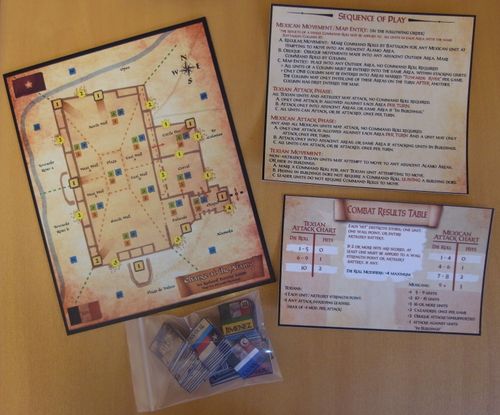
- Sequence of Play
- Combat Results Table
1.0 Components
a. 32 Mexican unit pieces and Oblique markers b. 10 Texian units and 10 Building markers c. 8 artillery units d. 1 map e. 1 charts sheet
Playing pieces — the ¾ inch sized Mexican and Texas units, plus artillery, that make up the opposing armies. Each unit, even artillery units of 2 and 3 strength points, is destroyed by a single hit result from the Combat Results Table.
Diagram labels (as printed):
- Mexican Unit — Column number; Battalion name and color; Color stripe also indicates Column affiliation.
- Oblique Marker.
- Texian Units — Leaders have red stripe.
- Building Marker.
2.0 Map
2.0 MAP — the playing surface is made up of the following:
a. the "Alamo" structure outline
b. Areas — the map is separated into 11 Alamo and 6 "Outside" Areas. Alamo Areas are divided by brown dashed lines, Outside Areas by green lines. The wall sections of the Alamo structure may also provide Area outlines/boundaries. An italicized name for each Area has also been provided.
c. Red colored Arrows — shown to mark adjacent Areas that cannot be attacked or moved into by Mexican units.
d. Wall Strength Numbers — yellow, star shaped icons showing starting wall strength for a given wall section or Area.
e. Artillery Positions — large, numbered tan boxes along walls of Alamo Areas. An artillery counter corresponding to that number is placed on top of each box.
g. Stacking Limits — colored, boxed numbers in each Area, read clockwise as Texian (green box), Mexican (blue box), and Building (brown box) stacking limits. Note: Outside Areas have only blue-colored Mexican stacking limits.
3.0 Sequence of Play
I. Mexican Movement/Map Entry — in the following order: A) Regular Movement B) Oblique Moves C) Mexican units enter map II. Texian Attack Phase — any and all Texian units and artillery may attack III. Mexican Attacks — any and all Mexican units may attack IV. Texian Movement — Texians attempt to move into any adjacent area, or hide in buildings.
4.0 Stacking
Stacking limits for each area may never be exceeded. Each stacking point allows one non-artillery unit within that Area. Units of the opposing armies may never occupy the same Area, unless all Texian units are under "building" markers. Artillery is ignored for stacking purposes. One artillery unit is set up on each like numbered artillery position.
4.1. Building Stacking limits — the maximum number of Texian units that may enter buildings in that Area. Place a "building" marker atop, or flip over if double-sided, any unit wishing to hide within an Alamo building.
4.2 Positioning of Units — the position or facing of units within each Area is unimportant. Only artillery units are allowed to straddle two Areas. Non-artillery units may not be placed on top of artillery units, or in the tan-boxed artillery positions. Non-artillery units can be placed on top of other non-artillery units (stacked) or spill slightly into other Areas if overcrowding becomes a problem.
4.3. All units within an Area not under "Building" markers, regardless of their position within the Area, may be attacked by units in adjacent Areas. There is no need to place units onto specific Alamo buildings as in other Alamo games. Note: Of course, it's fun to line up the Texans along the walls, if only for dramatic effect.
4.4. Stacking Limits apply at all times.
5.0 Alamo Walls
The physical structures of the Alamo. Mexican units may not be moved into adjacent Alamo Areas until any intervening wall sections have first been reduced to zero strength. Texian units ignore this restriction.
5.1. Wall Strength Number — each "wall section" is marked with a star-shaped, yellow number called the Wall Strength Number. This represents the number of hit points required to reduce a section of wall to zero strength. If only one section of wall is marked for an Area, consider the wall strength number to apply to the entire Area perimeter (for example, the Chapel).
5.2. Attacks on Walls — The Mexican CRT is used to attack both wall sections AND enemy units. Attacks on walls represent combat, the effects of lower level leadership, and the actual process of placing scaling ladders/breaking down doors, etc. Keep track of wall strengths/hits using spare markers, which players will have to provide for themselves (using "heads or tails" of a cent piece works well for this).
6.0 Command Roll
A command roll is performed for each unit or groups of units attempting to undertake several forms of movement. A successful Command Roll requires rolling the numbers 1-4 on a single six-sided die (1d6). Failure means the unit or group of units may not move that turn. Players must immediately move a unit that passed a Command Roll — no waiting to see how other units will react.
6.1. Actions that require Command Rolls: a) Regular movement b) Oblique moves (Mexican units) c) Leaving "In Building" status (Texian units)
6.2. Actions NOT requiring a Command Roll: a) Entering the map b) Attacking c) Advance after combat d) Entering buildings (Texian units) e) Movement by Texian leaders
6.3. Any number of Command Rolls can be performed each turn, so long as only one roll is made PER unit. Mexican Command Rolls are performed for groups of units within a single Area.
6.4. Texian Command Rolls — one Command Roll is performed for EACH Texian unit wishing to move into an adjacent Alamo Area or leave "in building" status. Leader units Travis and Crockett do not require Command Rolls for movement.
6.5. Organization of Mexican Units — Mexican units are identified with the Battalion name and color along the lower half of the counter. The parent Column of each unit is identified with a Roman numeral/letter designation and a colored stripe along the center of the counter.
6.6. Allocation of Mexican Command Rolls — A Command Roll is performed for each GROUP of Mexican units occupying the same Area that the player wishes to move into ONE OTHER adjacent Area. Mexican Command Rolls are applied by Battalion OR Column formation, depending on which part of the map a player is trying to move:
a. Moving into Outside Areas (by Oblique Move): the results of a single Command Roll are applied to ALL units within one Area, bearing the same Roman numeral COLUMN designation/color stripe, that are to be moved together into another adjacent Outside Area.
b. Moving into Alamo Areas: the results of a single Command Roll are applied to ALL units within one Area bearing the BATTALION designation/color band (along the lower half of the unit counter) that are to be moved together into another adjacent Alamo Area.
6.61. A player may earmark Command Roll attempts for any number of units within a Battalion/Column. The units of each Battalion and Column are not required to move and attack together.
7.0 Moving
A player may move as many or as few of his units through Map Entry, Regular Movement, Oblique Movement, Entering Buildings, and Advance after Combat. Some forms of movement require a Command Roll, though Texian Leaders never need to make a Command Roll.
7.1 Movement Restrictions: a) the Movement Rate for all non-artillery units is one adjacent Area per turn, or into/out of buildings b) stacking applies at all times c) Mexican units may not move between Areas separated by a red arrow d) Mexican and Texian non-artillery units may not occupy the same Area, unless all Texian units are hiding in buildings. e) Outside Areas — Texians may not enter Outside Areas. Mexicans may only do so by Map Entry or Oblique Movement f) Mexican units are not required to move together after their entry onto the map g) Artillery may not move, nor can non-artillery units enter artillery positions. Artillery units do not prevent movement of enemy units h) Alamo Walls — Mexican units may not cross walls that have a Wall Strength Number greater than zero. Texian units may ignore this restriction. To put it another way, Mexican units may move into adjacent Areas ONLY IF INTERVENING WALLS BORDERING THE TWO AREAS HAVE BEEN REDUCED TO ZERO STRENGTH.
Note: These restrictions are cumulative and in effect throughout the turn. For example, a Mexican unit may not move by Advance after Combat into an Area containing Texian units (not in buildings), over an unreduced section of wall, and/or in excess of stacking limits.
8.0 Types of Movement
There are five types of movement: a. Regular b. Advance After Combat c. Oblique d. Entering/Leaving buildings (Texians) e. Entering the map
9.0 Regular Movement
Performed by units already on the map wishing to move into an adjacent Alamo Area, even if currently occupying Outside Areas. This form of movement always requires a successful Command Roll, except for Texian Leader units.
10.0 Advance after Combat
A voluntary movement for all units that participated in an attack. This does not require a Command Roll.
a. Mexican Units — any Mexican unit which participated in an attack that cleared an adjacent Area of Texan units (except those in buildings and artillery) may move into that adjacent Area. Note: If an attack was launched from multiple Areas, some attackers might be unable to advance, due to the presence of unreduced wall sections.
b. Texian Units — any non-artillery Texian unit which participated in an attack that cleared an adjacent Area of enemy units may advance into that adjacent Area, ignoring intervening walls. Texian units may never enter Outside Areas.
11.0 Oblique Movement
Process by which Mexican units of a Column, occupying the same Outside Area, may move together into an adjacent Outside Area. Units moving by Oblique into an area NOT already containing Mexican units will gain a one time +2 die roll modifier during the subsequent attack phase. That attack is referred to as being "unsupported." Mark such attacks with an "arrow" marker. Note: Oblique movements represent a sudden shift by Mexican troops toward a new axis of attack.
11.1. Oblique procedure: A) choose all units in one Outside Area with the same Column affiliation that will attempt the oblique move. B) Make a Command Roll.
* If successful — move those units to one adjacent Outside area.
* If unsuccessful — those units are finished moving
11.2. Any number of Oblique attempts may be performed per turn, but only one Command Roll may be performed for units of a Column in the same Area that are to Oblique move together into another Area. If units of a single Column are to be oblique into separate Areas, then two Command Rolls must be performed. The Mexican player may attempt to Oblique Move with some or all of the units of a Column
12.0 Entering Buildings
Texian units may freely, without a Command Roll, enter buildings during their movement phase. A "building" marker is placed on top of the unit. Attacks against units in buildings suffer a -1 die roll modifier. Units must make a successful Command Roll to leave a building.
13.0 Entering the Map
Process by which off-map Mexican units are placed onto the map in any one Outside Area. This is voluntary, and can be done in any order, with as few or as many Columns entered per turn at the player's discretion. ALL units of a Column must be entered onto the map during the same turn AND in the same area.
13.1. A maximum of ONE Mexican Column may be Entered into Outside Areas labeled "Toward River A or B" of the map PER GAME (that's one total, not one in each Area), though any number of units may Oblique into those Areas. The Column may only enter one of these Areas on the turn AFTER another Column has first entered the map, i.e. the earliest a Column may enter into one of the two "River" areas is on the second turn of the game.
14.0 Attacking
Attacks are voluntary, and a player may attack with as many or as few of his units in any order desired. Attacks may not be made between Areas separated by a red-colored arrow (red arrows prevent Mexican movement, and attacks by both Mexican AND Texan units).
14.1. Attacks are directed against adjacent Areas, though hits may be applied to unreduced wall sections intervening between the attacker and targeted Area. If no Texian units occupy the targeted adjacent Area, the Mexican player may state that an attack is being made "against the wall."
14.2. Only one attack against each Area is allowed per turn (all units attacking into an Area must combine their strength). Units may not participate in more than one attack per turn, nor may a unit be attacked more than once a turn.
14.3. Attacks are only allowed if at least one unit/artillery counter can take part.
14.4. Attacks against units in buildings may only be performed by units occupying the same Area. Of course, this also means units in buildings may only attack enemy units in the same Area.
14.5. Process of Attacking: A) Player chooses an adjacent Area containing an enemy unit, or an intervening wall not reduced to zero strength, B) Roll one six-sided die, C) add modifiers to the die roll, D) compare the result to the Combat Results Table and inflict the specified number of "hits" against enemy units, or artillery, or intervening wall section. E) Advance after combat (voluntary).
14.6. Modifiers — each unit/artillery strength point (for the Texians) or each group of units (for the Mexicans) will count as positive modifier to the attack die roll (check CRT for Mexican modifiers). The maximum modifier allowable for each attack is +4. All modifiers are cumulative.
14.61. Cazadores ("chasseurs" or light infantry) Attack Bonus — ONCE per game the Mexican player may choose to use a special +2 die roll modifier for any attack involving a Cazadore unit (the all blue units of Column IV). This bonus may only be used if units from other Columns do not occupy the same Area as the Cazadores.
14.62. "In Building" status — attacks against Texian units hiding in buildings suffer a -1 die roll modifier.
14.63. Unsupported Oblique — a one time +2 die roll modifier is applied to any "unsupported" attack marked with an Oblique marker (the Attacking units moved into the Area using Oblique Movement in the preceding Movement Phase). "Unsupported" means that units from only ONE Column may occupy the Area at the start of the Attack Phase.
14.64. Texian attacks involving either Travis or Crockett receive a +1 modifier. Leaders may not combine their modifiers in a single attack.
15.0 Combat Results
Each numbered result on the Combat Results Table generates the specified number of "hits". Use spare counters to mark current wall strength, or remove units from the map. Each hit will eliminate either: A) one Texian/Mexican unit or, B) one intervening Wall Strength Point bordering the attacker's and targeted Area or, C) one ENTIRE artillery unit.
15.1. Each player has freedom to apply the results of their attacks against either enemy units/artillery in the target area, or against an adjacent intervening wall section bordering the attackers and targeted Areas (but see 15.2-15.4 below).
15.2. The "Placing the Ladders" rule — the FIRST hit scored by Mexican units against an adjacent Alamo Area MUST be applied against an undamaged, intervening wall section, if any. This rule may be ignored if any part of the attack was directed over an Area boundary not containing a wall section (benefits of flanking fire). In effect, Texian units separated from Mexican units by an undamaged wall section are immune from attacks by those Mexican units until the intervening wall has taken at least one "point" of damage.
15.3. If two or more hits are scored on the Combat Results Table by the Mexican player, at least one hit must be applied against an intervening Wall Strength Point OR artillery battery within the target Area.
Note: These rules sound a little strange, I know. But they were added to keep the Mexican player from completely ignoring enemy units to engage in "unit hunting."
15.4. Texan Order of Casualties — The Texan player may choose which of his non-artillery units are to be destroyed in each Area by successful Mexican attacks.
15.5. Chapel Artillery Position: owing to the strength of the famous Alamo Chapel, the three point artillery unit is NOT destroyed with a single hit from the Combat Results Table. Two hits are needed to destroy the unit.
16.0 Advance after Combat
ALL units that took part in an attack which cleared an Area of enemy non-artillery units may be moved to occupy the now empty Area before the next attack is performed. Artillery and units in buildings may be ignored. Remember stacking limits.
17.0 Artillery
Artillery units may not move, do not count for stacking purposes, and do not prevent Mexican movement into their Area. Artillery units have an attack range of one adjacent Area (a simplification, yes).
17.1. Artillery units with an Area border running through their position may contribute their attack into any one adjacent Area. Artillery units that straddle the border of two Alamo Areas are considered to be occupying both Areas.
17.2. Artillery units may only be set up in a like-numbered artillery position. Non-artillery units may not enter the tan-boxed artillery positions or stack with artillery units.
17.3. At the end of the Mexican Movement Phase, the Mexican player may destroy ONE artillery battery which is occupying or touching (straddling) each Alamo Area containing Mexican units. i.e. if two artillery units are in or straddling ONE Area occupied by Mexican units, then only one of those artillery batteries may be destroyed. If Mexican units occupy TWO Areas containing artillery units, then those two artillery units may be destroyed at the end of the phase.
17.4. Artillery units occupying Areas with Mexican units may still contribute a die roll modifier to Texian attacks.
18.0 Winning the Game
The Mexican player wins by destroying all the Texian units, not counting artillery. The Texian player wins by eliminating 16 Mexican units. There is no set number of turns.
19.0 Starting
Stacking limits apply at all times.
19.1. Texian Player: may set up anywhere within Alamo Areas. A "central reserve" area has been provided in the middle of the Alamo to allow maximum flexibility. Texian units may begin the game already hiding in buildings. A matching artillery unit is placed into each like numbered artillery position.
19.2. Mexican: all Mexican units begin the game off-map. Any number of Mexican Columns may be entered per turn at the player's discretion. During Map Entry, a maximum of one Mexican Column may be placed onto Outside Areas of the map labeled "Toward River a and b" PER GAME, though any number of units may later Oblique into those Areas. On their chosen turn of entry, ALL units of a Mexican Column must be placed into the same Area.
Sequence of Play
From the charts sheet.
Mexican Movement/Map Entry (in the following order)
The results of a single Command Roll may be applied to all units in each Area with the same Battalion/Column ID.
A. Regular Movement: Make Command Rolls by Battalion for any Mexican unit attempting to move into an adjacent Alamo Area.
B. Oblique: Oblique movements made into any adjacent Outside Area. Make Command Rolls by Column.
C. Map Entry: place into any Outside Area, no Command Roll required. - All units of a Column must be entered into the same Area, within stacking limits. - Only ONE Column may be entered into Areas marked "Towards River" per game. The Column may only enter one of these Areas on the turn AFTER another Column has first entered the map.
Texian Attack Phase
All Texian units and artillery may attack, no Command Roll required. A. Only one attack is allowed against each Area per turn. B. Attack only into adjacent Areas, or same Area if "In Buildings." C. All units can attack, or be attacked, once per turn.
Mexican Attack Phase
Any and all Mexican units may attack, no Command Roll required. A. Only one attack is allowed against each Area per turn and a unit may only attack once per turn. B. Attack only into adjacent Areas, or same Area if attacking units In Buildings. C. All units can attack, or be attacked, once per turn.
Texian Movement
Non-artillery Texian units may attempt to move to any adjacent Alamo Areas, or hide in buildings. A. Make a Command Roll for any Texian unit attempting to move. B. Hiding in buildings does not require a Command Roll, LEAVING a building does. C. Leader units do not require Command Rolls to move.
Combat Results Table
From the charts sheet.
Texian Attack Chart (die roll → hits)
- 1-5 → 0
- 6-9 → 1
- 10 → 2
Mexican Attack Chart (die roll → hits)
- 1-4 → 0
- 4-6 → 1
- 7-8 → 2
- 9+ → 3
Each "hit" destroys either: one unit, one wall point, or entire artillery battery.
If 2 or more hits are scored, at least one must be applied to a wall strength point or artillery battery, if any.
Die Roll Modifiers: +4 maximum.
Texians:
- +1 each unit/artillery strength point.
- +1 any attack involving Leaders.
- (max of +1 mod. per attack)
Mexicans:
- +1 — 5-9 units
- +2 — 10-15 units
- +3 — 16 or more units
- +2 — Cazadores, once per game
- +2 — Oblique attacks (unsupported)
- -1 — attacks against units "In Buildings"
Note on the printed charts: the Texian Leader modifier is printed here as "+1 any attack involving Leaders (max of +1 mod. per attack)", while section 14.64 reads "Texian attacks involving either Travis or Crockett receive a +1 modifier. Leaders may not combine their modifiers in a single attack." Both are transcribed as printed; the Mexican Attack Chart's 4-6 and 4 die-roll bands overlap as printed.