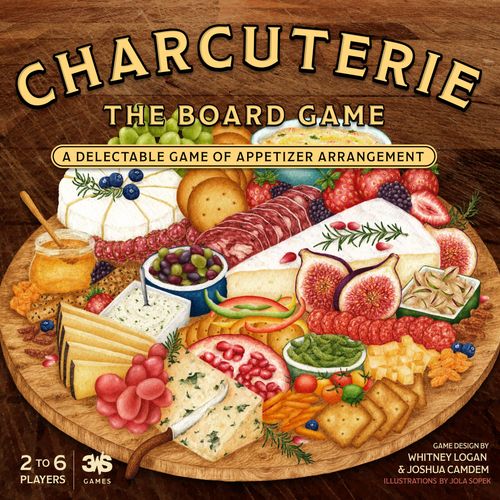
Charcuterie: The Board Game
Charcuterie: The Board Game Rulebook
Table of Contents
Table of Contents
Components
- 1 Serving Board
- 1 Draw Bag
- 6 Player Charcuterie Boards
- 18 Objective Cards
- 13 Recipe Cards
- 1 Objective Board
- 12 Double-Sided Scoring Markers
- 6 Player Aids
Bread Tiles (4 types)
- 6-Round Crackers
- 6-Square Crackers
- 5-Baguettes
- 5-Ciabatta
Cheese Tiles (6 types)
- 4-Parmesan
- 4-Swiss
- 4-Cheddar
- 4-Gouda
- 4-Colby
- 4-Bleu
Meat Tiles (3 types)
- 6-Salami
- 6-Soppressata
- 2-Meat Roses
Fruit Tiles (5 types)
- 3-Blackberries
- 3-Dates
- 4-Grapes
- 4-Strawberries
- 2-Oranges
Veggie Tiles (5 types)
- 4-Tomatoes
- 4-Cucumbers
- 3-Carrots
- 3-Olives
- 2-Broccoli/Cauliflower
Dip Tiles (4 types)
- 4-Tapenade
- 4-Ranch
- 4-Hummus
- 4-Fig Jam
Shapes
- wedge
- cluster
- round
- square
How to Win
After the final round, players compare their completed charcuterie boards with the objective cards on the objecive board. Points are awarded to players whose food arrangements meet those objectives. The player with the highest score wins!
Setup
-
Give each player a charcuterie board.
-
Place the objective board in view of all players.
-
Randomly choose 1 objective card for each food category and place them on the corresponding objective board locations. (For your first game, we recommend using only the base objective cards.)
Base Objective Card, Gourmet Objective Card
-
Place the serving board in view of all players, scoreboard side down.
-
Shuffle the recipe cards and deal 2 to each player. Each player chooses 1 to keep face-down so the other players cannot see, then discards the other. Players can earn additional points during final scoring if they fulfill their recipe card's goals.
-
5- & 6-player game only: deal each player 6 food tiles at random from the draw bag. Players may place those tiles on their boards.
-
Draw a random food tile from the draw bag. The player who has most recently eaten that food takes the draw bag and the serving board, then returns the drawn food tile to the bag. The player holding the draw bag is now the first host!
(Example 6-player setup)
How to Play
1. Draw
The host draws food tiles from the draw bag and separates them into multiple food tile stacks. The total number of stacks and the quantity of food tiles in each stack varies based on the number of players. Refer to the table below to determine the correct amount.
| Players | Stacks | Food Tiles |
|---|---|---|
| 2 | 4 | 3 |
| 3 | 3 | 4 |
| 4 | 4 | 3 |
| 5 | 5 | 3 |
| 6 | 6 | 2 |
2. Choose
Starting with the player to the left of the host and continuing clockwise, each player chooses one stack of food tiles to keep. (In a 2-player game, each player will then choose a second stack in player order.) Players should review the food tiles carefully before choosing a stack. Hopefully the host has prepared multiple appetizing combinations, because they will receive the last food tile stack!
Chef's note: there are 6 different food types: breads, cheeses, dips, meats, fruits and veggies. And for those of you following along at home, for the purposes of Charcuterie: The Board Game, tomatoes are a veggie.
3. Arrange
Each player places the food tiles from their stack onto their own charcuterie board, following the game's food tile placement rules (see Food Tile Placement on page 5).
Chef's note: at any time during the game, players may rearrange the food tiles on their charcuterie board. As players receive more food tiles, they will see new opportunities for scoring. Rearranging your board from round to round is not only expected, but likely necessary to win.
4. Refresh
Once all the players have arranged their food tiles, the current host passes the draw bag and serving board clockwise to the next player. That player becomes the host for the next round.
Ending the Game
The game ends once every player has taken two complete turns as the host (or one turn each in a 5- or 6-player game). In the final round, after all players have received their final set of food tiles, they have one minute to finish arranging their boards. The party guests are at the door!
Scoring
When time is up, flip the serving board over to the scoreboard side. Give each player a scoring marker. Proceed to scoring each of the objective cards, then score each player's recipe card. Use the "+50" side of the scoring token and the "+100" 5-Star Chef marker as needed.
- Scoring marker: 50+ points
- 5-Star Chef marker: 100+ Points
Food Tile Placement
Players may place food tiles anywhere on their charcuterie board - even on top of other food tiles! However, all food tiles:
- must touch the charcuterie board directly
- must NOT hang off the charcuterie board
- must be at least half-visible (i.e., no more than half of the food tile is covered by other food tiles)
- and, in a 6-player game, it must be within the inner ring (see example 4 below)
IMPORTANT: During the game players may freely move food tiles on, off, and around their boards. All food tiles must be placed on players' boards for final scoring.
- This food tile is placed properly because it is on the board and less than half covered by another food tile.
- This food tile is placed illegally because more than half of it is covered by another tile.
- This food tile is placed illegally because it is hanging off the charcuterie board.
- In a 6-player game, food tiles must be placed within this inner ring.
Group
Most scoring objectives refer to "groups of." A group is two or more food tiles of the specified type(s) that are adjacent or connected in an unbroken series of adjacent tiles.
Example: Group of Food Tiles — In this example, there are 3 groups of food tiles.
Example: Group of Cheese Tiles — In this example there is one large group of food tiles, and there are two smaller groups of cheese. The cheeses count as two groups because the pepperoni and crackers disrupt their adjacency.
Example: Group of ONLY… — Some scoring calls for a group of ONLY certain things, such as "group of only 1 bread, 1 cheese, and 1 meat". In order to count for scoring, no other tile can touch the group.
Pair
Some scoring objectives refer to pairs of items (i.e., a cracker and cheese pair). A pair is a set of exactly two tiles. Each food tile only counts once per scoring objective. For food tiles to be considered a pair, they do not have to touch, nor do they need to be in a group; they can be located anywhere on a player's board.
Example: for each pair of 1x square and 1x circle — 1 Pair.
Adjacent
Many food tiles score points when they are adjacent to another food tile. Food tiles must be touching to be considered adjacent. A food tile is adjacent to every food tile it touches directly.
- Food tile A is adjacent to food tile B because they are touching. Food tile A is not adjacent to food tile D because they are not touching.
- Food tiles E and C are not adjacent to any food tiles.
Unique
Some scoring objectives refer to groups or pairs of unique food tiles (i.e. "For each unique cheese in a group of cheese"). A tile is unique if it has different art.
Example A: If Samuel has 2 swiss tiles, 1 cheddar tile, and 1 colby tile in a group of cheese tiles, that group has 3 unique cheeses (swiss, cheddar, and colby).
Recipes
Every good host has their own special recipe that's sure to win their guests over. At the beginning of the game, every player is dealt 2 recipe cards; they choose one card and keep it face-down, then return the other card back to the box. At the end of the game, after all public objectives have been scored, each player reveals their recipe and scores any additional points.
Example recipe card — "The Vegetarian": The fewer meat tiles you collect, the more points you score.
| Tiles | 0-2 | 3-5 | 6-8 | 9+ |
|---|---|---|---|---|
| Points | 15 | 10 | 5 | 0 |
Base Objective Scoring
This section of the rulebook explains the scoring conditions for the Base Objectives of each food tile category: bread, cheese, dip, fruit, meat, & veggie.
Bread
In Charcuterie, carbs are your friends! Make sure your board has a great selection of breads and fancy crackers.
Objective card: For each pair of 1x square and 1x circle — 2 points.
Example: 1 Pair of Bread — 2 POINTS. The third baguette does not have a pair, since the square baguette is only counted once. This baguette does not count towards scoring the objective.
Cheese
Cheese has the honor of having its very own knife. So never fail to present it with respect and abundance.
Objective card: For each unique cheese in a group of cheese.
| Tiles | 1 | 2 | 3 | 4 | 5 | 6+ |
|---|---|---|---|---|---|---|
| Points | 1 | 3 | 6 | 10 | 15 | 20 |
Example: 2 Unique Cheeses in a Group — 3 POINTS. The second Swiss cheese wedge does not count as unique.
Dip
Dips allow your guests to personalize their experience. Make sure you give them lots of choices!
Objective card: For each unique dip on your board.
| Tiles | 1 | 2 | 3 | 4+ |
|---|---|---|---|---|
| Points | -3 | 3 | 9 | 15 |
Example: 3 Unique Dips — 9 POINTS. These hummus and fig jam food tiles are not unique, because they are duplicates of other food tiles on the board. These tiles do not score for this objective.
Fruit
Present a delicious variety of sweet fruits alongside your savory to score big points.
Objective card: For each unique fruit in a group of fruit.
| Tiles | 1 | 2 | 3 | 4 | 5 | 6+ |
|---|---|---|---|---|---|---|
| Points | 1 | 3 | 6 | 10 | 15 | 20 |
Example: 4 Unique Fruits — 10 POINTS. Players score points for each group of fruit tiles on their charcuterie board. The more unique fruit tiles there are within a group, the higher that group scores.
Meat
Sandwich meat between crackers to make a visual sandwich of deliciousness.
Objective card: For each bread adjacent to meat — 2 points (max 4 points per meat tile).
Example: 4 Adjacent Breads and Meats — 8 POINTS. Only 2 breads score points in this group. There is a 4-point maximum per meat tile.
Veggie
Veggies aren't just good for you, they are good for your final score!
Objective card: For each adjacent pair of 1x veggie and 1x cheese — 4 points.
Example: 2 Adjacent Veggie and Cheese — 8 POINTS.
Gourmet Objective Scoring
This section of the rulebook explains the scoring conditions for using the Gourmet Objectives of each food tile category: bread, cheese, dip, fruit, meat, & veggie.
Bread
Objective card: For each bread of the same shape.
| Tiles | 1 | 2 | 3 | 4 | 5+ |
|---|---|---|---|---|---|
| Points | 1 | 2 | 4 | 5 | 8 |
Example: 4 POINTS.
Objective card: For each group of only 1x bread, 1x cheese, and 1x fruit — 10 points.
Example: 10 POINTS.
Cheese
Objective card: For each matching cheese in a group of cheese.
| Tiles | 1 | 2 | 3 | 4+ |
|---|---|---|---|---|
| Points | 1 | 4 | 9 | 12 |
Example: 9 POINTS.
Objective card: For each neighboring player who has fewer cheese than you — 10 points.
Example (Player A / Player B): 10 POINTS.
Dip
Objective card: For each group of only dip and bread that has 5+ bread — 21 points.
Example: 21 POINTS.
Objective card: For each dip — Ranch or Hummus: 1 point per adjacent veggie. Jam or Tapenade: 1 point per adjacent bread.
Example: 2 POINTS.
Fruit
Objective card: For each pair of matching fruit — 7 points.
Example: 7 POINTS.
Objective card: For each pair of 1x fruit and 1x veggie — 6 points.
Example: 6 POINTS.
Meat
Objective card: For each adjacent pair of 1x meat and 1x cheese — 3 points.
Example: 3 POINTS.
Objective card: For each group of only 1x meat, 1x cheese, and 1x bread — 10 points.
Example: 10 POINTS.
Veggie
Objective card: For each neighboring player who has fewer veggie than you — 7 points.
Example (Player A / Player B): 7 POINTS.
Objective card: For each veggie adjacent to a dip (max 16 points per dip) — 4 points.
Example: 4 POINTS.
Variants
Main Course
Sometimes Charcuterie is a nice, quick appetizer game before a meatier game; other times you might want to play it as the main course. If you want to slow down and savor the gameplay, we recommend the following for slightly longer, more analytical gameplay.
2 Players - Less Random Variant
For players who want more predictability in the tiles drawn during the game—during setup, remove 5 of each bread type and 2 of each other tile. Do not use the "matching cheese" gourmet scorecard.
3 Players - Less Random Variant
For players who want more predictability in the tiles drawn during the game—during setup, remove 3 bread tiles, each a different type, and 1 of each other tile.
5 Players - Crunchy Variant
Setup: Skip Step 7 - Players do not start with any tiles. Each round, the Host draws 20 tiles and creates 5 stacks of 4 tiles each.
6 Players - Crunchy Variant
Setup: Skip Step 7 - Players do not start with any tiles. Each round, the Host draws 18 tiles and creates 6 stacks of 3 tiles each.
Food Tile Reference
Cheese
- Bleu — Wedge
- Cheddar — Wedge
- Colby — Wedge
- Gouda — Wedge
- Parmesan — Wedge
- Swiss — Wedge
Veggie
- Cucumber — Round
- Olives — Cluster
- Carrots — Cluster
- Broccoli/Cauliflower — Cluster
- Tomato — Round (We Know)
Fruit
- Orange — Round
- Strawberries — Cluster
- Blackberries — Cluster
- Dates — Cluster
- Grapes — Cluster
Dip
- Fig Jam — Square
- Hummus — Square
- Tapenade — Square
- Ranch — Square
Bread
- Ciabatta — Square
- Baguette — Round
- Round Cracker — Round
- Square Cracker — Square
Meat
- Salami — Round
- Soppressata — Round
- Meat Rose — Cluster
Chef's Note: Remember - "Knowledge is knowing that a tomato is a fruit; wisdom is not putting it in a fruit salad." - Miles Kington (1941-2008)