Chapayev
Chapayev Rulebook
Table of Contents
Table of Contents
Rules
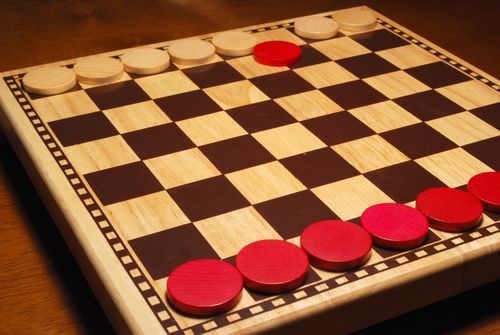
At the start of the game, checkers of opposite colours (8 each) are placed on a chessboard in the outermost rows facing each other. The players then take turns trying to knock the opponent's checkers off the board with a flick, while trying to keep their own checkers in play. If a player knocks out one or more of the opponent's checkers and his striking checker remains on the board, he makes one more strike. The player who knocks out all of the opponent's checkers (and at least one of his own checkers remains on the board) wins the round. In the next round he moves his checkers forward one line.
The game lasts several rounds (seven or more). Some rounds may end in a draw (after the last strike no checkers remain on the board), in which case the checkers stay where they are. After six rounds (not counting drawn rounds) the rows of checkers stand right up against each other. The loser after the sixth round must retreat one line back. The winner is the one who "pushes" the enemy checkers off the last line.
Usually, at the start of the game, the first move belongs to white. In subsequent rounds, the first move belongs to the winner of the previous round.
This is the most basic, widespread and classic version of the game.
If checkers are not available, pawns from a chess set may be used.
Specific Rules
- A checker that has turned over is considered a "traitor" or "defector" and is used by the opponent, except when motorcycles and rooks are used. In those cases a checker that has turned over is not considered a traitor or defector. If a checker is stood on its edge, both players have the right to blow on it at the same time, until it lies flat or falls off the board.
- If a checker is "hanging" on the edge of the board, it must be "checked". To do this, the checker is flicked with the thumb over the hanging edge toward the board. If the checker turns over when it falls, it is considered a traitor. If it covers an opponent's checker, that opponent's checker is "taken prisoner". If the checker lands on its feet, the player continues to use it as usual.
- When two rows of checkers are set up on adjacent rows of the board, the player making the first move has the right to demand that the checkers be set up for a "bayonet attack", that is, in direct contact. If the opponent does not wish this, he has the right to step one step back.
- If all of the opponent's checkers have been knocked out but the winner has not lost a single one of his own checkers, he advances two rows at once. If he acted with only one checker, he advances three rows.
- A player pinned against the last line has the right to the first strike, the "last hope strike". Otherwise a skilled player could win "dry", without letting the opponent enter the game. This rule is sometimes associated with an episode from the film Chapayev, in which the "whites" stage a psychic attack.
- When playing on a folding board, the board may be turned 90 degrees so that the line of the "front", the fold in the board, does not interfere with the flight of the checkers.