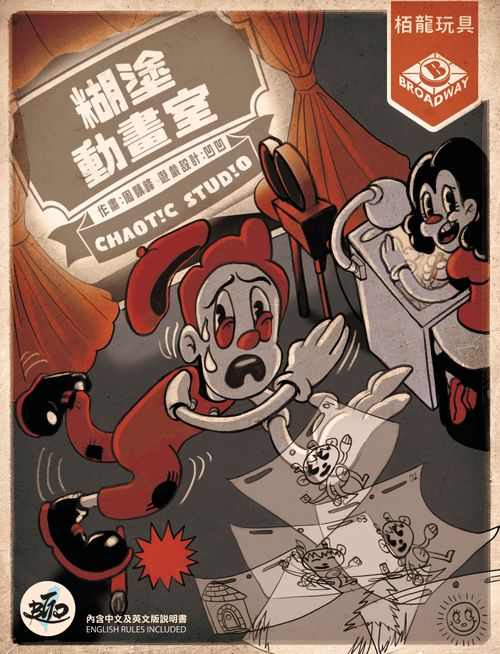
Chaotic Studio
Chaotic Studio Rulebook
Table of Contents
Table of Contents
Game Overview
Chaotic Studio is a game about drawing and deduction. Each player chooses a subject and draws it in pieces across three separate storyboard panels. But all the frames have gotten mixed up! Knowing only one part of each drawing, the other players try to guess who or what is at the centre of your subject, using the shuffled frames laid out on the table.
The longer the players take to guess, the more victory points (VP) the leading player receives. However, the leading player receives no points if none of the players can work out their idea.
Components
- 18 transparent storyboard panels, 6 for each of the scenes A1, A2 and A3
- 6 background cards
- 50 subject cards
- 1 player aid
- 30 VP tokens: 6 tokens worth 5 VP, 6 worth 3 VP, and 18 worth 1 VP
- 6 dry-erase markers
- 1 hourglass
Setup
-
Each player takes 3 storyboard panels (one each for scenes A1, A2 and A3), 1 background card and 1 marker. For easier drawing, place the background card under the storyboard panels. Before the game begins, stack all the storyboard panels as shown in the picture.
-
Place the subject cards, the player aid and the VP tokens next to the storyboard panels. Leave the centre of the table empty.
-
Choose a leading player at random and give them the hourglass.
How to Play
The game consists of two rounds. Each round is divided into two phases:
- Drawing phase
- Guessing phase
Drawing Phase
Place your storyboard panels on the table with the transparent side up, as shown in the picture, so that their opaque part hides your actions from the other players. Put the background card under them.
Then each player takes a subject card from the deck. Each card shows 5 subjects on each side. Together with the other players, choose a number from 1 to 5 by any method, then decide for yourself which side of the card you will use. You must draw the subject under your chosen number. To do this, divide the picture into three parts among your storyboard panels, so that when the panels are overlaid the picture can be seen in full.
Tip: Think about how to divide the drawing into parts and how to draw each part on its own. During the next phase you will keep and show only one random part of your drawing, and the other players will try to find the remaining parts to reconstruct your subject.
When everyone has finished drawing, close the storyboard panels by their clips. The leading player reads out the scene number from the back of the next subject card in the deck, then places that card at the bottom of the deck. Without showing anyone, keep one scene (A1, A2 or A3) for yourself.
Place the remaining frames in the centre of the table face down. The leading player shuffles them and turns them over so that all players can see the drawings.
Guessing Phase
The leading player shows the part of their picture they kept and turns the hourglass over. The other players try to guess which subject their frame is part of, and the leading player says whether each guess is correct or not. There is no limit on the number of guesses. If a player guesses the picture, go on to scoring.
Important: You may only name the suspected subject. You may not say which pair of frames on the table, in your opinion, corresponds to the leading player's frame. Do not touch the storyboard panels until the round is over.
If nobody guesses the picture within 30 seconds, the leading player may give a hint. The hint is located in the bottom-left corner of their subject card. Turn the hourglass over again. The other players continue guessing. If no correct guess is called within a further 30 seconds, go on to scoring.
Scoring
| CORRECT ANSWER IN THE FIRST 30 SECONDS | CORRECT ANSWER IN THE REPEATED 30 SECONDS | NOBODY GUESSED IN THE REPEATED 30 SECONDS | |
|---|---|---|---|
| Leading player | +1 VP | +3 VP if guessed without the hint, or +2 VP if guessed with the hint | 0 VP |
| Other players | The player who gave the correct answer: +3 VP | The player who gave the correct answer: +2 VP | Everyone except the leading player: +1 VP |
The scoring rules are also printed on the player aid.
Once scoring is complete, hand the players their corresponding tokens.
Do not move the frames in the centre of the table. Pass the hourglass to the player sitting to the left of the leading player. That player is now the leading player, and the others guess their subject.
End of Round
The round ends after all players have revealed their kept frames. Take back your storyboard panels. Repeat the drawing phase (taking new subject cards) and the guessing phase. The leading player now becomes the player sitting opposite the one who started the previous round:
- In a 3-player game, this is the player sitting immediately to the right of the leading player.
- In a 4- or 5-player game, this is the second player to the right of the leading player.
- In a 6-player game, this is the third player to the right of the leading player.
(The rulebook shows example play diagrams for a 3-player game and for a 5-player game, with the labels "leading player" and "opposite player". The diagrams are not reproduced here.)
End of Game
The game ends after two rounds. The player with the most victory points wins. In the case of a tie, the victory is shared among the players with the highest score.
You have managed to return the frames to their places!
Variant
In a 3-player game, each player may take two sets of storyboard panels, for a total of 6. In the drawing phase, take 2 subject cards and use 3 panels for each subject. Keep one frame from each subject. The guessing phase follows the normal rules: players show one of their frames, and after scoring they pass the role of leading player. As a result, each player will be the leading player twice during the round.