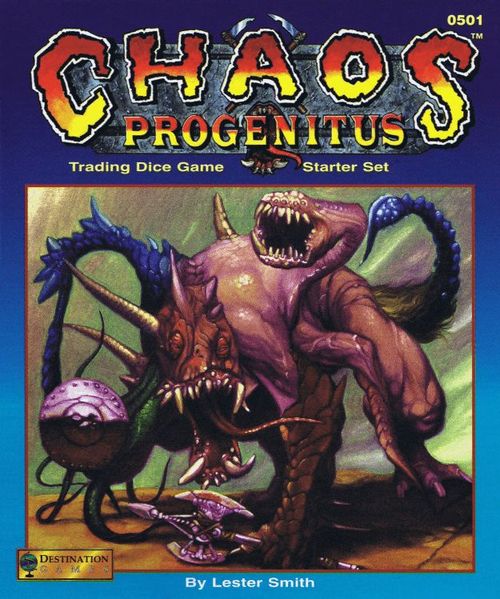
Chaos Progenitus
Chaos Progenitus Rulebook
Table of Contents
Table of Contents
The Basic Game
The Dice
Each fiend consists of 13 dice. The dice are of two categories: items and body parts. Item dice are marked with two dots at the corners of their identifying face. Body parts do not bear these dots.
Each fiend must have at least one body part among its 13 dice.
Each fiend can have any number of duplicate dice among its 13. A fiend could have 13 mouths, for instance. Or it might have 12 axes and a tail (the tail satisfying the requirement for at least one body part, the axes wielded by tiny pseudopods).
Different combinations of dice and ink color represent different breeds of fiends. These colors take effect only in the Advanced Game.
Note: The die-face glossary (the meaning of each item and body-part face, such as eye, wand, and tail) is not included in the source notecard, which refers to the faces by name only.
Getting Started
The Basic Game requires two players. Each must have one 13-die fiend.
Once both players have assembled their fiends, they must describe the creatures to each other: "My fiend has 3 eyes, a set of wings, 2 tentacles, 2 sets of lungs, an arm, a stinger, a potion, and 2 axes!" Dice are always rolled in full view of both players, and each player may examine the opponent's dice freely during play. Next, both players roll for initiative (described below), and play begins.
Winning the Game
A fiend loses a battle when he cannot roll at least one body part die at the beginning of his turn.
Defeat doesn't necessarily mean death. There are several different ways of keeping an enemy from rolling body part dice, without actually having eliminated those dice from play. So the loser of a battle may go on to fight another day.
Definitions
Attack refers to any effect that can cause damage, whether stun or wound.
Defense refers to any effect that can counter an attack, avoiding damage.
Initiative is rolled just once, at the very beginning of a battle. It determines which fiend acts first in the game.
Strength is the power (not damage) of an attack or defense. Strength is measured in points, usually 1-strength or 2-strength.
Stun is a type of damage. It can remove an opponent's body part to his "stun pool," where that die is out of play and cannot be rolled until it has been recovered. Stuns are listed in points, a 1-stun attack affecting one die, a 2-stun affecting two.
Wound is a more severe type of damage. Each wound removes one body part die from play permanently to the "wound pool." Also measured in points, a 1-wound attack affects 1 enemy die, a 2-wound attack affects 2 dice, etc.
Initiative
To begin the game, players first roll all of their dice to determine initiative. Each move, plus, and minus (including bellows, lungs, and wings) counts as one point of initiative. All other rolls have no effect.
High total wins initiative and takes the first turn.
The loser's minuses (including bellows, lungs, and wings) rolled during initiative are counted against the winner's first turn.
Sequence of Play
After rolling initiative, players take their turns one at a time. Each follows the steps below. When one player completes all of these steps, his turn ends and his foe's turn begins.
- Apply Foe's Minuses: Place a number of dice equal to the minuses the opponent rolled in his previous turn into your "minused pile." These dice are not stunned or wounded, but they cannot be rolled this turn.
- Roll Dice: Roll all your dice still in play.
- Set Aside Minuses: Group all minuses rolled; they will count against your foe on his next turn.
- Select Defenses: Match your blocks and other defenses - along with any plusses to strengthen them - against your foe's attacks arrayed against you. In order to counter an attack, a defense must be of a strength equal to or greater than that attack.
- Array Attacks: Put forward your attacks, along with any plusses you choose to strengthen them.
- Recover Stuns & Wounds: For each plus you choose to spend now, rather than adding it to a defense or attack, bring one die back from your "stun pool." (Potions bring dice back from "stun pool" or "wound pool" now.)
- Suffer Stuns & Wounds: Place body part dice in the appropriate pools for stuns and wounds that you did not successfully counter. Choose from any of your unstunned, unwounded body parts. (An item die can be stunned or wounded only if specifically targeted by a brain.) Apply any tentacles and whips now, as well. Keep in mind that any minuses, attacks, and such that you remove now will not be around to affect the foe's next turn.
Special Note: A player can choose to ignore any of his rolled dice. If he rolled a brain symbol, for instance, he might choose not to add it to any of his attacks.
Transcriber's note: the source says "this urn" in step 1; it is printed here as "this turn", the evident intended word.
Keeping Track of Your Dice
For the sake of clarity, set your "stun pool" to your right, your "wound pool" to your left, and your "minused pile" straight back toward you. All other dice are "in play" and are rolled in the middle of your portion of the table.
As your active dice are used, move them to the minused pile. Example: After countering an attack, place the defending die or dice in the minused pile; your opponent should do the same with the spent attack. After using a plus to recover a stunned die, place the plus in the minused pile with the rescued die.
The Advanced Game
The advanced game follows the basic rules, but adds three new elements: Breed abilities, "counting coup," and multi-player battles.
Breed Abilities
Fiends can be of different breeds, indicated by the color of their dice (flesh) and ink (blood). Those with no two dice exactly alike are called mongrels (unless they qualify as a half-breed or pure-breed). Those with at least half of their dice of a single plastic/ink mix are half-breeds. Fiends composed completely of dice from a single plastic/ink mix are pure-breeds. Each type of fiend receives special powers in play.
Mongrel Stamina: Mongrels are especially tough. They automatically recover 1 stun per turn, without spending plusses for it. (To be a mongrel, a fiend can have no dice exactly the same. If he has three legs, for instance, they must each be of a different plastic/ink color mix.)
Half-Breed Immunity: Half-breeds are immune to "rays" (from eye & wand), "gas" (from lungs & bellows), and "poison" (from stinger and dart) of dice that share either their primary flesh or blood color. Example: A half-breed with 7 red-plastic/black-ink dice is immune to ray, gas, and poison of all red plastic dice and all black ink dice.
Pure-Breed Powers: Pure-breeds have immunity to ray, gas, and poison of their specific breed only. But in addition, each breed gains a special power.
Transcriber's note: the source notecard states that each pure-breed gains a special power but does not list the powers. The per-breed power list is not included in this source and is not reproduced here.
Counting Coup
If you defeat your opponent, you can select one of his "wounded" dice to keep as a trophy. If he suffered no wounds, you cannot count coup.
Multi-Player Battles
To begin a multi-player battle, all players roll for initiative simultaneously. The fiend with the most moves and pluses goes first. (Reroll any tie.) Of the other fiends, the one with the most minuses applies them to the starting fiend's first turn.
On his turn, the first fiend proceeds through the normal, basic-game turn sequence, rolling his dice and choosing one other fiend as the target of all of his minuses, attacks, tentacles, etc.
The targeted fiend then takes his turn as normal, applying his defenses to those attacks, and then choosing a new fiend as target of his own minuses, attacks, and such. A fiend cannot attack the fiend who just attacked him, unless they are the only two combatants remaining.
When a fiend is defeated, he still chooses a target, who will act next. His attacker may "count coup," placing the captured die in his own "wound pool." (The attacker then treats the die as a wound of his own; it can be "restored" by potion or captured by another fiend later.)
Play continues in this way; each fiend defending from the previous fiend, and choosing another to attack, until only one remains, victor over all others!