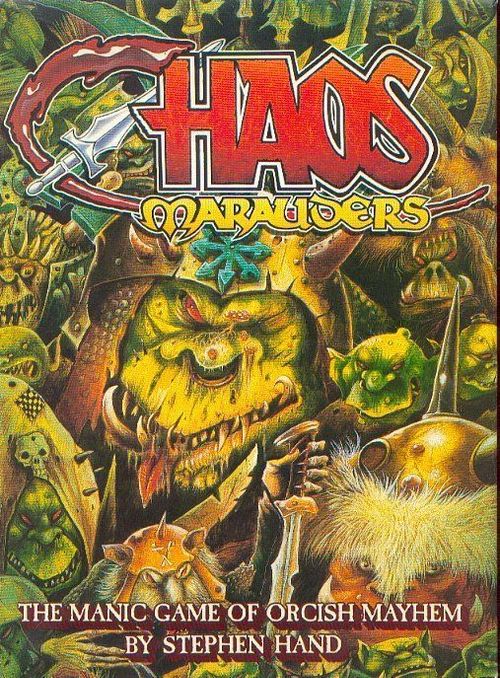
Chaos Marauders
Chaos Marauders Rulebook
Table of Contents
Table of Contents
Goal of the Game
The goal of the game is for a player to assemble three complete formations before the other tribes do (see "Tribes" on page 14). The other players must be surpassed in the number of victory points in formations, since the player with the most victory points wins.
Contents
- 4 player sheets
- 110 cards
- 1 Devastation Die (or "cube", as the spineless scoundrels call it)
- 16 ownership tokens of the Treacherous Scoundrels (4 tokens in each of 4 colours)
- 1 rulebook
- 1 card reference
Components
Below is a brief description of the components.
Player Sheets
Each player sheet has 12 card slots. These slots help players organise their battle formations.
Cards
Cards are troops, war machines, trophies and other tribal resources.
Devastation Die
Some cards and effects require the player to roll the die and accept the consequences, from elite units fleeing the battlefield to the wrath of the Chaos gods.
Ownership Tokens
The plastic tokens in four colours are needed to resolve the Treacherous Scoundrels. When such a card is placed in a formation, the player places a token of their own colour on it (see the use of the Treacherous Scoundrels on page 8 of the card reference).
Card Reference
Many cards have special rules, which are explained in detail in the card reference. There you will also find the stories of famous characters and legendary relics.
Card Anatomy
The card diagram labels: Name, Attack Rating, Victory Points, Text, Coloured Border, Symbol.
Name
The name of a card simply states what it depicts: a band of rowdy orcs, a wiry hobgoblin standard-bearer, or a cunning warlord.
Attack Rating
The attack rating is the strength of a card in battle. It ranges from 1 to 10 (the lowest rating is 1, the highest is 10). Cards without a rating are not needed in battle. The attack rating counts only when the card takes part in an attack (see "Attack" on page 10). The attack strength of a formation is determined by the sum of the ratings of all the cards it is made of.
Victory Points
Many cards bear impressive blue numbers. These are nothing other than victory points! They are totalled at the end of the game, and the tribe that has gathered more victory points than the others earns the recognition of the others (see "End of the Game" on page 12).
Symbol
If a card has a symbol in its lower part, the deck contains several copies of it (see "End-of-Turn Cards" on page 8). Two cards with the same symbol are called duplicates. Duplicates do not differ by name, but the symbols help to recognise them more quickly in formations.
Text
Some cards have special abilities that help or hinder the players. The text on a card briefly describes these abilities. For a detailed account of what a card can do in the heat of the razborochye, see the card reference.
Coloured Border
Each card has a border whose colour shows what kind of card it is. Ordinary units have a purple border, treasures blue, and war machines red. Some rules and abilities affect only cards of a certain type (for a detailed description of the card types and how they apply in play, see the card reference).
Setup
Four-Player Game
Diagram: four players seated around the table, with the draw deck in the middle.
Each player takes a player sheet and the Treacherous Scoundrel tokens. The shuffled cards are then placed face down as a draw deck within reach of all players. After this, the player wearing the greenest clothing takes the first turn.
Playing the Game
The turn passes clockwise around the table. The order of play does not change until the end of the game.
On their turn a player is called the active player. They must take the top card from the draw deck and place it face up in one of their formations.
The player continues to draw and place cards into formations until they draw an end-of-turn card (page 8). As soon as the active player draws such a card, they pass the turn to the player on their left.
Placing Cards
The player sheet helps the tribe assemble its battle formations. The sheet has twelve cells. A card can be placed in a cell, below it, or above it (in this way three battle formations are formed).
A card may be placed in any position within a formation, but there are restrictions that apply to everyone:
- A formation may not contain two cards with the same symbol.
- A player may not place cards to the left of a Banner card or to the right of a Musician card. Only Banner and Musician cards may stand in the outermost positions of each formation.
- Once a card has been placed in a formation, the player may not change its position.
Placing Banners and Musicians
Each of the player's formations may contain only one Banner card and only one Musician card of any kind. If the player draws a second Banner or a second Musician, they must either place the card in another formation or discard it.
If the player has already placed three Banners (or three Musicians) in their formations on the table and draws a fourth such card, that card is discarded and the player's turn ends.
End-of-Turn Cards
During their turn the player places the cards they draw into formations until one of the following conditions arises.
- The player draws a card with a symbol that is already present in their formations. They may place it in a formation where there is not yet a card with that symbol. If the symbol is already present in all of their formations, the card is discarded and the turn ends.
- The player draws a green card. They place it and end their turn.
- The player draws a Musician card, and there are already three such cards in their formations. They discard the Musician card and end their turn.
- The player draws a Banner card, and there are already three such cards in their formations. The Banner card is discarded and the turn ends.
- The player draws a card that they cannot or do not want to place. The card goes to the discard pile and the turn ends.
The turn ends with an attack by a completed formation, if one is made (after the results of the attack have been tallied). See "Attack" below.
Discard Pile
Discarded cards are placed face up in a separate pile. Cards from the discard pile may not be taken. If the cards in the draw deck run out, the discard pile is shuffled and turned over to form a new draw deck.
Formation Building
Drawing and placing cards are necessary for players to create three completed formations. A completed formation may be made up of any number of cards from four to twelve. Also, a Musician must be at the right edge of the formation and a Banner at the left edge.
A formation is considered complete when there are no empty spaces between its cards.
Formations
The formation diagram labels: the cards above the player sheet are the first formation; the cards on the sheet are the second formation; the cards below the sheet are the third formation.
In other words, the whole space between the Musician and the Banner must be filled with cards. The player must think carefully about where to place Musicians and Banners. If there is little room between the outermost cards of a formation, the formation will yield few victory points at the end of the game; a large distance from Banner to Musician may even prevent the player from completing the formation at all!
When a player places the last card in an unbroken line of cards from the Banner to the Musician, they complete the formation.
Immediately after a formation is completed, the player may launch an attack.
Example of a completed formation: it has more than four cards, a Banner on the left, a Musician on the right, and no empty spaces between the cards.
Attack
As soon as a formation is complete, it may attack an incomplete formation of any other tribe. The attacking formation must be stronger. How to find out? Compare the attack strengths of the two formations. The attack strength equals the sum of the attack ratings of all the cards in the formation. If the attack strength of the completed formation is greater than the strength of the formation chosen as the target of the attack, the attack may take place. If the completed formation contains nothing but snotlings and treasures, what attack could there be?
Whatever happens, however fate may kick up, a completed formation may attack only once.
When attacking, the player rolls the Devastation Die.
- If the Orc Eye comes up, the attack succeeds and the enemy formation is broken. Time to collect trophies and lure warriors away from the enemy host! All purple cards from the broken formation are discarded. The other cards may be taken by the winning tribe. The winning tribe places these trophies in the free spaces of its battle formations. Cards that the winner cannot or does not want to place in its battle formations are discarded.
- If the attacking player rolls the Mark of Chaos, their formation falls apart. All grey and purple cards of the disbanded formation are discarded. The winner may place the rest of the cards in its formations. Whatever it does not place goes to the discard pile.
After the results of the attack are tallied, the turn passes to the next player. If a card taken as a result of the attack completed a new formation, that newly completed formation may not attack.
If, by the player's choice or because of a small attack strength, the completed formation does not attack, it may not attack in later turns either. Declining to attack does not interrupt the player's turn: if the formation was not completed by an end-of-turn card, the tribe may continue building its battle formations, simply by completing this formation.
End of the Game
As soon as a tribe has completed three formations by any means, the game ends. The formation completed last may not attack. Then the players count their victory points.
Points are awarded for cards with blue numbers (the number shows how many points the card gives). A player also gains victory points for other achievements (for the length of a formation, for example). The table shows how many points are awarded for what.
Victory Point Table
| Item | Points |
|---|---|
| To the first to complete three formations | 150 |
| Each completed formation of 5-6 cards | 50 |
| Each completed formation of 7-8 cards | 100 |
| Each completed formation of 9-10 cards | 150 |
| Each completed formation of 11-12 cards | 200 |
| Each card in battle formations | 10 |
| Each war machine assembled with crew * | 70 |
| Each war machine assembled without crew * | 60 |
| Chaos Marauders (card) | 10 |
| Garok Varokroksenrok | 100 |
| Idol | 90 |
* Points are awarded only for a machine whose two parts, the machine itself and its crew (or simply the two parts), are assembled in the formation in the correct order (see about the red cards on page 13 of the card reference).
Note: the printed table has no row for formations of four cards, although formations may consist of four to twelve cards; the source gives no points for them. The same table is reprinted on the last page of the source.
Example of Scoring
At the end of the game one tribe has three formations. The player did not manage to complete all of them, but here are the victory points they receive.
The first formation brings 200 points as a completed formation of 12 cards; 40 for the Heap of Loot; 50 for Naplevukha XXXXX; 70 for the Crusher's set: a total of 360 victory points.
The second formation is worth only 110 points, because of Bdyshchishche.
The third (lower) formation brings 50 points: it is a completed formation of five cards.
Finally, each card brings 10 points = 210 victory points. The total score of the tribe is 730.
Other Rules
Here are gathered additions and clarifications.
Tribes
The words "tribe" and "player" are interchangeable in the rules. There is no difference between them.
Fourth Duplicate
A tribe may not have four cards with the same symbol (exception: the Lords of the Plague Scab). If a player draws a card whose duplicates already stand in all three formations, the card is discarded and the player's turn ends.
Attack Before the End of the Turn
If a player completes a formation with an end-of-turn card (for example, a duplicate of a card already in their formations), they may attack, and only after that does their turn end.
Cheats!!!
If, in breach of the rules, a player has two or more duplicates in a formation, all the cards that broke the rule are discarded.
Breaking a Completed Formation
Special cards, for example Odlugg Kishkodyor and Dagromm Edkiy Vydokh, may take cards from a completed formation. If the player later completes a formation again, they may attack with it in the usual way, as after the first completion.
Tie
If at the end of the game several players have the same number of victory points, the disputants simultaneously shout with all their might the traditional orcish battle cry, "Waaagh!" Whoever shouts louder wins!