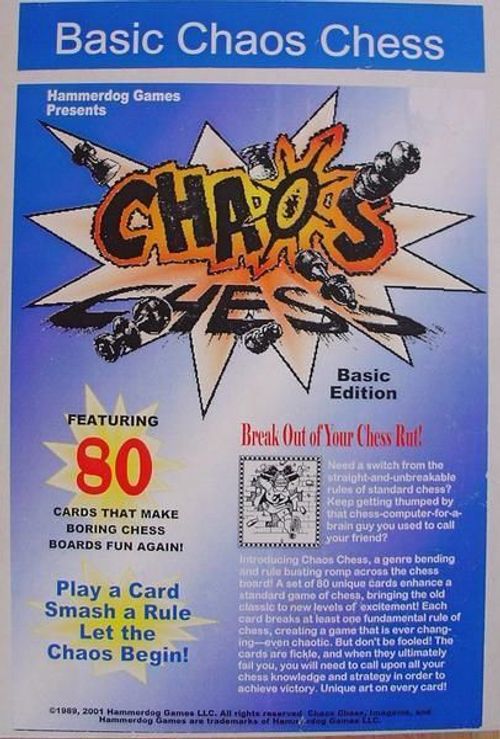
Chaos Chess
Chaos Chess Rulebook
Table of Contents
Table of Contents
What You Need to Play
- A copy of Chaos Chess by Hammerdog Games. The box should contain: this rulebook, 80 Chaos Chess flux cards, 2 sheets of cardboard tokens, 1 paper chess board, and 8 glass Imajewel time counters.
- A chessboard with all the pieces (you can use the board and pieces provided in the box as a last resort).
- The knowledge of how to play chess, or somebody who can teach you.
- Optional: tokens such as Chaos Chess Imajewels (see www.hammerdog.com), extra pieces.
A note on terminology: words and phrases in italics and the codes BM, IM, AM, UA, T, P, and * are explained at the end of these rules in the Lexicon of Chaos.
Setup
- Set up a standard chessboard on a table or flat playing surface. Make sure there are at least one to two feet of space on either side of the board for flux cards you will play later, as well as captured pieces.
- Shuffle all flux cards together and place them face down on one side of the board. This is the draw pile. Leave a space next to it for the discard pile. All flux cards that are pitched, discarded, or dispelled are placed face up in the discard pile.
- Throughout the game you and your opponent play flux cards face up on your own side of the board so that each other can see them. During play you may be required to move a piece into limbo or the dead pile, or even retire it. Consult the image on the next page for the layout of these areas.
- Cut out the cardboard tokens or else keep a pair of scissors handy for when you'll need them.
- Perform a pawn check to determine which player will have the first turn. The player that goes first may choose which color they play. They do not have to play white.
- Each player draws five cards to create their starting hand.
Chaos Chess Layout
The layout diagram in the rulebook labels the following areas around the chess board. Each area is shown on the diagram with a label:
- Chess Board (centre): the standard chessboard.
- Opponent's Side and Your Side: the two sides of the board, each player's area for their own flux cards.
- Opponent's Card in Play and Your Flux Cards in Play: the spaces on each side where that player's flux cards in play are placed face up.
- Limbo: the area beside the board where pieces may be placed temporarily.
- Draw Pile and Discard Pile: the spaces beside the board for the draw pile and the discard pile.
- Opponent's Retired Pieces and Your Retired Pieces: the spaces for pieces that have been retired.
- Opponent's Dead Pile and Your Dead Pile: the spaces where each player places the pieces they have captured.
Playing Chaos Chess
Goal: you must checkmate your opponent the same way you would in traditional chess.
Strategy: You may play flux cards to improve your position, capture or destroy your opponent's piece, recover a piece you have lost, or any number of other actions. Combine these card plays with "regular" chess moves to create a checkmate and win the game!
Flux cards can be used to directly or indirectly create a checkmate. However, the king cannot be destroyed or otherwise captured by a flux card or its effects. Except when altered by a flux card, the chessboard and pieces move and operate exactly as they would in standard chess.
Turn Order
You and your opponent take turns moving and capturing pieces as you would in normal chess until a checkmate or stalemate is achieved. In a given turn you may or may not play flux cards but you must always move a piece, just as in normal chess. A turn is broken up into three major phases which occur in the following order:
- Maintenance Phase: remove time counters from your flux cards in play and resolve any effects this produces.
- Draw Phase: draw 1 card then discard to a maximum of 5 cards.
- Main Phase: move one of your pieces and/or play flux cards or flux card effects.
1. Maintenance Phase
- Remove one time counter from every one of YOUR flux cards in play that do not have the duration permanent (P). Event cards that were drawn by you are considered yours for purposes of removing time counters.
- If a card is not a permanent and it has no time counters left it is dispelled. Place it face up in the discard pile.
- Resolve miscellaneous effects produced as a result of removing time counters or dispelling flux cards.
2. Draw Phase
- Draw 1 card. You cannot decline to draw a card when instructed to.
- If you draw an Event card, resolve it immediately, then draw a new card to replace it.
- Discard cards of your choice until you have no more than five cards in hand.
- During your first turn, you must skip your Draw Phase.
3. Main Phase
Before Move Phase (BM)
- Play and resolve any flux cards that can legally be played during this phase (BM or UA). See the section on Playing Flux Cards later in this manual.
- Resolve the effects of any flux cards in play that have a BM trigger.
Move Phase
- Play and resolve any flux cards that can legally be played during this phase (IM or UA).
- You must make a legal move during your turn. Alternatively, you can play an IM (instead of move) card which replaces your move. If you play an IM card and it is countered, you are still obligated to make a move to end the phase.
- If you capture or destroy a piece put it in your Dead Pile and dispel any flux cards that targeted only that piece.
After Move Phase (AM)
- Play and resolve any flux cards that can legally be played during this phase (AM or UA).
- Resolve the effects of any flux cards in play that have an AM trigger.
Ending Your Turn
Declare the end of your turn by knocking politely on the table.
- Neither you nor your opponent can play flux cards at this time.
- Dispel any flux cards that have a duration of T and resolve any effects this creates.
Your Opponent
During YOUR turn, your opponent can attempt to thwart your plans in one of 3 ways:
- By countering flux cards you play by using the pitch method.
- By playing UA cards that directly counter flux cards you play.
- By playing UA cards that do other annoying things during your main phase.
Playing Flux Cards
Flux Cards are the heart and soul of Chaos Chess. They can only be played during a player's Main Phase. Only the player whose turn it is can play cards with a phase timing of BM, IM, or AM. Both players can play UA cards during any of these sub-phases. This means that your opponent can play UA cards at any time during YOUR main phase and you can play UA cards any time during hers.
Rules of Playing Flux Cards
- You can play as many BM and AM cards on your own turn as you are able.
- You can only play one IM card on your turn if you are able. Doing so replaces your normal move for that turn. Note: if your IM card is countered, you still have to make a move as normal!
- You can play as many UA cards on your own or your opponent's turn as you are able.
- When anyone plays a flux card, no other card can be played at the same time except for Counterspell and Red Herring.
There are five basic steps to playing a Flux Card which always occur in the following order:
Step 1: Declare it
- Declare your intent to play a flux card by revealing it to your opponent.
- You must be able to meet all the conditions required to play the card at the time you declare it.
Step 2: Choose Targets
- Choose any targets required to play the flux card and indicate them to your opponent.
- You cannot target any piece that is in limbo or is retired. You cannot target a piece in the Dead Pile unless the flux card specifically states you can.
Step 3: Pay for it
- Pitch a number of cards from your hand equal to the cost of the flux card. Place the pitched cards face up in the discard pile.
Step 4: Invite your opponent to counter it
- Your opponent must decide at this point whether or not to counter your card. If she does not counter it now she waives her right to counter it from this point on.
- If she counters it, place your card in the discard pile.
- If she does not counter it, proceed to Step 5.
Step 5: Resolve the card.
- Pay any additional costs as required in the card description.
- Resolve the effects of playing the card.
- If the card targets a piece in play, mark it by placing a token on the board next to the target piece. (Chaos Chess Imajewels work perfectly!).
- If possible use two tokens of the same kind to better track your flux cards. Example: you play Bear Trap which is a permanent. You place a penny on the chessboard next to the target pawn. Place another penny on the Bear Trap to show the link.
- Dispel the card if it is an instant.
- If the card has a duration place it face up on your side of the chess board such that you and your opponent can both see it. Place a number of time counters on it equal to it's duration, unless it has a duration of T or is a permanent.
Reading and Understanding Flux Cards
The reference diagram in the rulebook shows the parts of a flux card, using the card Iron Steed as the example. Its labelled parts are: Catchy Title, Cool Art Piece, Card and Set #, Artist Credit, Copyright Info, Hammerdog Logo, Duration, Cost to Play, Phase Timing, Game Text, Story/Quotables, and Targets/Affects Kings. The Iron Steed example shows Phase Timing BM, Cost to Play 2, Duration T, and the game text "Play this card on your piece. Target becomes a Knight."
Phase Timing
- BM: Play this card only before your move.
- AM: Play this card only after your move.
- IM: Play this card during your move phase. If you play this card successfully you cannot make a standard move this turn.
- UA: Play this card any time during you or your opponent's Main Phase.
- EV: Play this card immediately after you draw it then draw a card to replace it.
Cost to Play
X is the number of cards you must pitch from your hand in order to play this card.
Duration
- *: Instant. Dispel this card immediately after it is resolved.
- T: This Turn. Dispel this card at the end of the current turn.
- P: Permanent. This card remains in play until dispelled.
- X: X Turns. X is the number of YOUR turns this card remains in play. Place a number of time counters equal to X on the card when it enters play. Remove one during each one of YOUR maintenance phases.
Countering a Flux Card
You can play any amount of flux cards during your own main phase. However, your opponent can attempt to foil your plans by countering your flux cards. Countering a flux card effectively cancels it. Your opponent can counter any attempt you make to play a card in one of two ways.
- By pitching 3 cards. This is known as the pitch method.
- By playing a UA flux card that specifically counters cards, such as Counterspell.
Rules
- You must pay for any card your opponent counters as if you had actually played it's pitch cost. For example, if you played Iron Steed and your opponent countered it, you would lose a total of three cards (the two you pitched to play it and Iron Steed itself). However, because the card doesn't make it into play, you do not pay any additional costs described in the body text of the card.
- When a card is played and countered, the cards should hit the discard pile in the following order: 1st are any cards pitched to play the initial flux card. 2nd are any cards pitched to counter the card. 3rd any card that was actually played to counter the card, and 4th, the card originally played.
- No matter which method is used to counter a card, your opponent can only counter it when you Invite her to (see Playing Flux Cards, Step 4).
- You can counter an opponent's attempt to counter your card if they used a flux card to counter your card (and you can pay for the counter).
- You cannot counter an opponent's attempt to counter your card if they used the pitch method.
Dispelling a Flux Card
While countering a flux card prevents it from entering play, dispelling a card removes a flux card that is already in play. A Flux cards is dispelled when:
- It is the target of a flux card that specifically dispels cards that are already in play.
- It's duration expires. Each card's duration is indicated in the card's upper right hand corner. When there are no more time counters left on a flux card it dispels immediately regardless of which player's turn it happens on. If it's duration is 'T', it dispels at the end of the current turn. Cards without duration are indicated with an '*'. Such cards dispel immediately after they are played. Cards with a permanent duration are indicated with a 'P' and do not dispel in this manner.
- It's target is removed from the game whether it is captured, destroyed, transformed, or retired.
When the piece leaves play any card that targets it is dispelled.
- If a piece moves to or from limbo, the flux cards that target it do not dispel.
- If a piece is transformed, whether permanently or temporarily, that piece effectively becomes another type of piece. If a flux card that targeted that piece can no longer target it, it is dispelled.
- Permanent transformations can happen due to playing flux cards (for example Black Sheep) or a natural pawn promotion (when your pawn reaches your opponent's promotion rank and is traded for a better piece).
- Temporary transformations are always brought about by flux cards and can also dispel other flux cards that target that piece. For example, if a pawn is caught in the Bear Trap and it's owner plays an Empty Box on it, transforming it into a Rook, the Bear Trap is dispelled.
- The card that causes a transformation does not get dispelled in this way (ie. Black Sheep and Empty Box are not immediately dispelled when the Pawn they target transforms, even though it is no longer considered a Pawn).
Rules
- When a card dispels you must immediately resolve any effects that this causes.
- When multiple cards dispel simultaneously, the player whose turn it is decides which cards dispel in which order.
- Some cards have special effects that happen after they are dispelled. These rules must be followed even though the card has been dispelled.
Takebacks
Any move that is made illegal for any reason results in a Takeback just as in normal chess. Players take turns undoing their actions until the board is exactly as it was before the illegal move took place. Any cards played that created the illegal move are returned to their owners hands, and any cards that were drawn are shuffled back into the deck. Play then resumes from that point on.
Takebacks are usually the result of one or both players playing flux cards that render a once-legal move illegal.
The Six Golden Rules of Chaos Chess
Golden Rule 1: You are playing CHESS! Despite what the cards do or say, you are playing the game of chess. All rules that apply in that game hold in Chaos Chess unless they are specifically overridden by flux cards.
Golden Rule 2: You can only win by creating a legitimate checkmate. The King can NEVER be captured, destroyed, or taken out-of-play by a flux card.
Golden Rule 3: You must always make a move on your own turn unless you successfully use an IM card. If your IM card is countered, you still have to make a move!
Golden Rule 4: If your king is in check, he must be out of check by the end of your move phase or you lose the game. This means you can't count on an AM card to get you out of a jam!
Golden Rule 5: You can play as many cards in your own turn as you are able. You can play as many UA cards in your opponent's turn as you are able.
Golden Rule 6: When in question, the rule on a flux card overrides any rule of standard chess or any rule in this booklet. If a discrepancy somehow occurs that common sense and fair play cannot resolve, perform a Pawn Check to determine whether you or your opponent is "right."
The Lexicon of Chaos
Countering flux cards: The act of denying your opponent the right to play a flux card. You can counter a flux card using the pitch method, or by playing a UA flux card that specifically counters flux cards.
Dead Pile: The area in which you place all pieces you have captured during the game. Your dead pile will typically contain your opponent's pieces and hers will contain yours.
Declare: To announce that you are going to play a flux card. Declaring a card typically involves paying for it and choosing it's target(s).
Destroy: When a piece is removed from play by means of a flux card rather than by a normal capture. Kings can never be destroyed, and cannot be the target of a flux card that destroys pieces.
Dispel, Dispelled, Dispelling: When a card leaves play, it is said to dispel. Cards are dispelled according to their duration. They may also dispel if their target leaves the game (is captured, destroyed, or retired). Some flux cards dispel other flux cards in play.
Duration: Each flux card has a duration. At the end of the card's duration it is dispelled. A card can last virtually any amount of turns, or it may be Instant (*), Permanent (P), or last until the end of the current turn (T).
Flux Card: The cards you play to win Chaos Chess!
Home Space: Any space that a piece could legally occupy at the beginning of the game.
Limbo: An area of the game space where pieces might be placed temporarily. Pieces in limbo are considered out of play and cannot be targeted by flux cards and their effects. However, cards that enter and exit limbo do not dispel flux cards that already target them.
Pawn Check: The act of hiding one of each color pawn in each hand and having your opponent "pick a hand" in order to choose the white pawn. Typically used at the start of each game to determine who will play white and to resolve certain cards. This results in a random 50/50 chance.
Permanent: Permanent cards remain in play until dispelled.
Phase Timing: Flux cards can only be played during particular phases of a game of chaos chess. See Reading and Understanding Flux Cards for more info.
Piece: A True Piece is an unchanged chess piece. A Chaos Piece is any piece that has been transformed, and is NOT considered a True Piece.
Pitch: To discard a card from hand and place it face up in the discard pile.
Pitch Method: The act of pitching three cards from your hand in order to counter a card your opponent plays.
Retire: To remove a piece from the game permanently.
Time Counters: Beads or tokens that are used to track the duration of flux cards. During the maintenance phase of each player's turn, a Time Counter is removed from each flux card they have in play.
Trigger: Flux cards and their effects may be triggered by certain conditions in a game of Chaos Chess. They are often phase driven, having an AM or BM "trigger." When the proper phase is entered, the card or it's effects are triggered, often automatically.