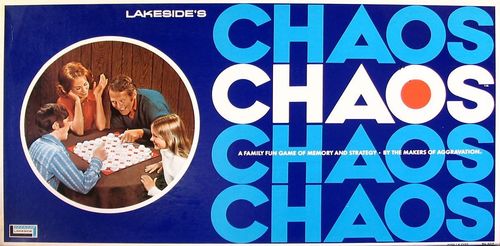
Chaos (1970)
Chaos (1970) Rulebook
Table of Contents
Table of Contents
Gameplay
For 4 players.
Each player selects 6 game pieces that carry the same colored dot on their inner side, and places them, inner side up, on the nearest lowest spaces of the game board.
As soon as the game begins, all players turn their pieces over so that only the blue top side is visible.
Each player must now try to bring as many of their own pieces as possible to the opposite side.
Players move their pieces in turn: straight forward, left, right, or diagonally forward. An opposing piece may be jumped over if the space directly behind it is free. No opposing piece may be removed, unless the proof of identity could not be provided.
As soon as you suspect that another player is not moving with their own piece, you ask the identity question. The player must turn over the piece in question. If you are right and the piece belongs to one of the other players, the player who could not provide proof of identity must remove one of their own pieces from the game. If, however, it is the questioned player's own piece, you yourself must remove one of your own pieces from the game.
When all the pieces are in the middle of the playing field, several pieces may have to be turned over before one reaches one of one's own pieces again. The player whose piece was wrongly turned over always has the right to demand a piece from the other player.
End of the Game
The game is over when all pieces have been brought to the opposite lines.
The winner is the player who has the most of their own pieces "at home". If the number of own pieces is equal, the overall winner of the evening is determined.
Variants
For 3 players: all pieces must first be brought off the starting spaces. Only then may they be moved onto the opposite spaces.
For 2 players: if only 2 players are playing, each player should, if possible, take over 2 sets of pieces, since the game becomes more exciting and more chaotic the more pieces move on the game board.