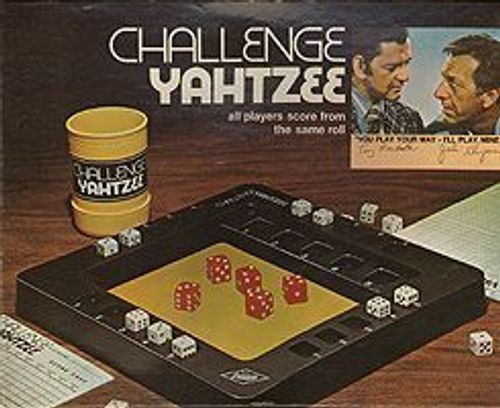
Challenge Yahtzee
Challenge Yahtzee Rulebook
Table of Contents
Table of Contents
Number of Players
CHALLENGE YAHTZEE may be played by two, three or four persons. It can also be played solitarily trying for the highest possible score.
Object of Game
Be the player to make the highest score for one or more games.
Scoring
Each player has his own score card. He must make his own decisions of what and where to score based on his individual strategy.
In each game there are 13 scoring rounds. Each round must be scored in one of the 13 boxes in the vertical column under the game being played.
There are 13 scoring boxes on the score card. They are: "Aces," "Twos," "Threes," "Fours," "Fives," and "Sixes" in the Upper Section, and "3 of a Kind," "4 of a Kind," "Full House," "Small Straight," "Large Straight," "YAHTZEE" (five of a kind), and "Chance" in the Lower Section. The YAHTZEE Bonus is not considered a scoring box. It is used only for bonus points to be explained later. At the completion of each scoring round, each player must place a score or a zero in one of the scoring boxes. A scoring box can be used only once in each game. A player can place a zero at the end of a scoring round rather than a score, if he believes it to be to his advantage. The boxes may be filled in any order, according to the player's best judgment.
On the score card there is an "Upper Section" and a "Lower Section" which, when added together, will give you a grand total which is your final score. There are possibilities in both sections to earn bonus points which count toward the final score. If a player attains a score of 63 in the Upper Section, he should enter the 35-point bonus in the "Bonus" box and add this to his Upper Section total. If a player is entitled to a YAHTZEE bonus (as explained later), this is totaled with the score in the Lower Section.
Each score card is used for six games of CHALLENGE YAHTZEE.
Each of the 13 scoring rounds consists of three steps (rolls of the large dice). The recording of combinations of these dice is by the individual's markers (five small white dice). This procedure is explained later under "The Play."
Scoring Combinations
1. Upper Section
a) In the Upper Section, there are "Aces" (ones), "Twos," "Threes," "Fours," "Fives," and "Sixes." If a player chooses to score in the Upper Section, he counts and adds only the markers with the same number and enters the total of the markers in the appropriate box. If a player at the end of a scoring round has these markers on the platform and elects to take his score in the Upper Section, he would enter 9 in the "Threes" box.
b) The player may enter the total of ANY NUMBER of the same value dice in the appropriate box in the Upper Section. For example, a player's final markers are those pictured in the original; he may choose to score 2 in the "Aces" box.
c) If a player is unable to place a score in either the Upper or Lower Sections, he MUST enter a zero in the scoring box of his choice in either section.
d) If a player scores 63 points or more in the Upper Section, he earns a BONUS of 35 points and enters this in the "Bonus" box in the Upper Section.
2. Lower Section
The Lower Section of the score card is played exactly as indicated. The markers need not be in specific groups or in sequence in the marker pockets to score.
a) "3 of a Kind" box may be filled in only if the markers on the platform show at least three of the same number. For example, the markers pictured in the original would be scored 18 (total of all dice) in the "3 of a Kind" box.
b) "4 of a Kind" box scores the total of all markers provided they include four markers of the same number. For example, the markers pictured in the original would be scored 14 (total of all dice) in the "4 of a Kind" box. NOTE: This could also be scored in the "3 of a Kind" box as 14 as it also meets the requirements for "3 of a Kind." The player must decide which box to score in as only one box can be scored in at the completion of a scoring round.
c) "Full House" box may be scored in when the markers show any combination of three of one number and two of another. Any "Full House" is scored as 25 points. For example, 25 points can be scored in the "Full House" box if the markers show the combination pictured in the original. (NOTE: This scoring combination could also be scored in either (1) the "3 of a Kind" box in the Lower Section as 19, (2) in the "Threes" box in the Upper Section as 9, (3) in the "Fives" box in the Upper Section as 10, or (4) in the "Chance" box as 19. Again, the player must decide which box to score in.)
d) "Small Straight" box can be scored in if the markers show any sequence of four numbers (not necessarily in order on the platform). Any "Small Straight" scores 30 points. The following are examples of "Small Straights": a), b) and c) (dice pictured in the original).
The markers need not be in order on the platform. Example "c" above may have been on the platform as shown in the original.
e) "Large Straight" box can be scored in if the markers show any sequence of five numbers (not necessarily in order on the platform). Any "Large Straight" scores 40 points. The following are examples of "Large Straights": a) and b) (dice pictured in the original).
Once again, the markers need not be in order on the platform. "b" above may have been on the platform as pictured in the original.
(NOTE: "Large Straights" may also be scored as 30 in the "Small Straight" box.)
f) "YAHTZEE" box can be scored in if the markers show five of the same number ("5 of a Kind"). A "YAHTZEE" scores 50 points. One example of a "YAHTZEE" is five matching markers as pictured in the original.
Refer to "YAHTZEE Bonus" and "YAHTZEE used as a Joker" to score more than one "YAHTZEE" in a game.
g) "Chance" box scores the total of all markers and is the one chance to score any combination. For example, the markers pictured in the original could be scored as 22 (the total of all markers) in the "Chance" box if the player chooses to score in "Chance."
h) "YAHTZEE Bonus": A player may put a check (√) mark (valued at 100 points) in a box in the "YAHTZEE Bonus" for his second and subsequent "YAHTZEE" if, and only if, the first "YAHTZEE" was scored as 50 in the "YAHTZEE" box. (If he had previously scored a zero in the "YAHTZEE" box, he is not entitled to any "YAHTZEE Bonus" in that game.) At the end of the game, the check marks are totaled as 100 points each and this is entered under the total of the Lower Section.
i) "YAHTZEE used as a Joker": A YAHTZEE may be used as a joker in the Lower Section when both of the following conditions exist:
-
The YAHTZEE box has been previously filled with 50 or zero.
-
The appropriate box in the Upper Section has been filled. For example, if the YAHTZEE consists of five 4's and the "Fours" box has previously been filled.
The player marks his score in any of the boxes in the Lower Section as follows: If the markers were those pictured in the original, he may score the total of all five markers, which in this case equals 20 points, in any one of the following boxes: (1) "3 of a Kind," (2) "4 of a Kind" or (3) "Chance." Or, he may score (4) 25 points in the "Full House" box, (5) 30 points in the "Small Straight" box or (6) 40 points in the "Large Straight" box. If all the boxes in the Lower Section are filled, he must enter a zero in a box of his choice in the Upper Section. He may also check a "YAHTZEE Bonus" if he is entitled to it.
To Prepare the Game
-
Place the CHALLENGE YAHTZEE tray in the center of the players so that it is convenient for all to see and reach. It should be placed in such a way so that each player will have his five marker pockets on the platform in front of him (see FIG. 1).
-
Each player is given a score card.
-
Each player is given five small white dice. These dice will be referred to as "MARKERS." Five markers should be placed on the table in front of each player.
-
Each player is given a pen or pencil (not supplied with game) for keeping score.
The Game
The large dice will be rolled by one of the players for one complete scoring round. Each scoring round consists of three steps with all players participating. The players endeavor to complete the scoring round with the best combination of markers for scoring.
The Play
One player rolls the dice first. At the end of each scoring round the dice and cup are passed to the player on the left.
A Scoring Round
Step 1
a) The player rolling the dice places all five large dice (not the markers) in the cup and rolls the dice onto the playing surface (FIG. 1).
b) Each player then places all five of his markers into his marker pockets. The numbers on the markers MUST correspond to the large dice (FIG. 2).
c) Each player may decide to save all, some or none of the markers he has showing. Each player may save what he wishes even if it duplicates what another player is saving. If he decides to remove any (or all) of his markers, he: (1) removes the markers he does not wish to save and (2) moves the remaining markers on the platform to the right, leaving the open pockets to the left of the remaining markers (FIGS. 3 and 4). The markers need not be in specific groups or in sequence in the marker pockets to score. The markers removed from the platform should be placed on the table in front of the player.
d) The five large dice are removed from the tray and placed on the table.
e) This completes Step 1.
Step 2
The second step may consist of one or more individual rolls depending on the dice required by each player.
a) The player rolling the dice will first place the least number of dice in the cup required by any player. (Each player's open marker pockets is the number of dice he requires—see FIG. 5.) In the example, Player "A" with two pockets open requires the least dice and two dice are put in the cup.
b) The dice in the cup are rolled onto the playing surface and
c) The dice are placed in the dice pockets on the shelf in order starting with Pocket #1 with the rolled numbers showing (see FIG. 6).
d) All players with open marker pockets will now place markers in these pockets corresponding with the dice in the numbered dice pockets on the shelf (see FIG. 7).
e) The player rolling the dice will again place the least number of dice in the cup required by any player. In this example, Players "B" and "C" still need one more dice rolled (FIG. 7).
f) The required number of dice are rolled onto the playing surface and again placed in the numbered pockets on the platform (see FIG. 8).
g) The players with open marker pockets will again place markers in these pockets corresponding with the dice in the numbered dice pockets on the shelf (see FIG. 9).
h) Each player may decide to save all, some or none of the markers he has showing. If he decides to remove any (or all) of his markers, he: (1) removes the markers he does not wish to save and (2) moves the remaining markers on the platform to the right, leaving the open pockets to the left of the remaining markers as before (see FIGS. 10 and 11).
i) The large dice are removed from the tray and placed on the table.
j) This completes Step 2.
Step 3
The third and final step is conducted in the same manner as Step 2 until the marker pockets are filled. This time the markers on the platform are final. Using his markers, each player must now enter a score that he has obtained or a zero in one of the scoring boxes on his card.
The scoring round ends after each player has scored the round on his score card.
The large dice and cup are passed to the player on the left for the next scoring round.
After 13 scoring rounds have been completed and all scoring boxes filled, the game ends and the scores are totaled. The player with the highest grand total wins.
Example of Two Players
The following is an example of two players playing CHALLENGE YAHTZEE. The illustrations (FIG. A through FIG. G) are shown in the original; the text of each figure caption is transcribed here.
FIG. A—Round 1, Step 1. (Dice rolled onto the playing surface; illustration only.)
FIG. B—Player "A" is trying for a "Full House," "Threes," "Fours," or "3 of a Kind." Player "B" is saving "Fours."
FIG. C—Player "A" places marker on platform. No apparent help for better score. Player "B" likewise places marker on platform.
FIG. D—Player "B" places markers on platform corresponding to numbered pockets on shelf.
FIG. E—Player "A" discards one, still trying for "Threes," "Fours," or "Full House."
FIG. F—Beginning of Step 3. Player "A" places a 5 in Pocket #1. Player "A's" markers are final. He has not helped his hand. Player "B" places the 5 in Pocket #1.
FIG. G—Player "B" places a 4 in Pocket #2.
Player "B" continues to save "Fours." Markers numbered one and six are removed. Four is moved to the right. End Step 2.
Player "A" decides to score a "0" in the "Aces" box in hopes of having better luck in future rolls. He could have scored 6 points in the "Threes" (two "Threes") or 8 points in the "Fours" (two "Fours"), 5 points in the "Fives" or 19 points in "Chance."
Player "B" decides to score 16 points in the "Fours," working for the 63 points required for the bonus. He could have scored 21 points (total of all dice) in the "4 of a Kind" or "3 of a Kind." If the "Fours," "3 of a Kind" or "4 of a Kind" boxes had been previously scored, he could also have scored 21 points in "Chance."
This completes round one. The remaining twelve rounds are played as described above.
Suggestions for Better Play
-
You probably will find it to your advantage to score in the Upper Section first, rather than scoring in the "3 of a Kind" or "4 of a Kind" in the Lower Section. Remember, the 35 point bonus in the Upper Section is important to a high score, so try for the 63 points in this section to earn the bonus.
-
A YAHTZEE (5 of a Kind) usually does not come up very often. Therefore, if near the end of a game you have to score a zero, it usually will be to your advantage to score a zero in the YAHTZEE box.
-
Keep in mind the openings in your score card. Always work to score in the open boxes. There is no point in working for a straight if both the "Small Straight" and "Large Straight" boxes have been previously scored in.
-
Remember, you can always score in "Chance" one time if you have no other scoring combinations. For example, with the "Fives" and "4 of a Kind" previously scored (or zeroed), you could score 21 in "Chance" with the markers pictured in the original.
-
In the early part of the game, and with a low total of all dice to score, it would probably be to your advantage to zero a box rather than fill in "Chance" with a score, hoping for a higher total on future rounds.
-
Even though a player may start out with one combination in mind, the roll of the dice in the second step may change his strategy for the third step.
Remember, all players are scoring from the same rolls of the dice. Although luck plays a role, the winning player will have used the best strategy.
"Challenge Yahtzee" Played Solitarily
CHALLENGE YAHTZEE may also be played solitarily. The highest score that can be obtained in any one game is 375 points (not including YAHTZEE Bonus).