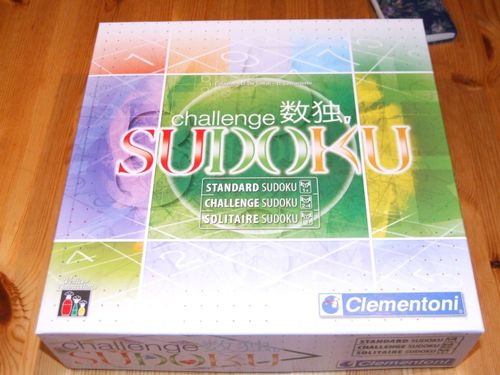
Challenge Sudoku
Challenge Sudoku Rulebook
Table of Contents
Table of Contents
Components
- 1 empty Sudoku board.
- 81 big cards numbered 1 - 9, for the 81 numbers required to fill the 81 cells of a Sudoku puzzle; each number appears 9 times and has its own colour making it much easier to visualise the Sudoku game than the normal pencil and paper puzzles.
- 330 small cards for the numbers 0 - 9.
- Manual of game rules (Standard Sudoku, Challenge Sudoku, Solitaire Sudoku), an overview of the techniques used to resolve the Sudoku puzzles, 50 puzzles with different levels of difficulty.
There is only one rule to resolve a Sudoku puzzle: FILL THE BOARD SO THAT EACH ROW, EACH COLUMN AND EACH REGION CONTAINS ALL THE NUMBERS FROM 1 - 9, EXACTLY ONCE!
Standard Sudoku
For 1 or more players.
Instead of resolving puzzles on the black and white squares of a newspapers, this games gives you a board on which to resolve the puzzles using big coloured number cards that make the game easier to play, above all with friends or family!
- Lay the board at the centre of the table;
- choose one of the Sudoku puzzles in the manual and spread it out on the board; for example, diagram 1 (diagram 1 = FIG. 1 - diagram ... = FIG. ...) shows puzzle one.
You can now start to resolve the puzzle - on your own or with family and friends - just like any other Sudoku puzzle, but using number cards instead of writing the numbers in by pencil.
The small cards are used to make notes! If you are a real sudokuist, you will know by experience that sometimes your reasoning does not lead to the final solution, but often there is more than one solution... which it may be helpful to remember; to do this place the small cards in a corner of the empty cells.
In the example shown by diagram 2, the numbers 5 and 6 are missing from the top right hand region and cells g1 and g3 are empty; if you want to "make a note" of this solution simply place the small cards 5 and 6 in cell g1 and g3.
You can resolve the puzzles in this manual or any other puzzle you find in a newspaper or magazine; the coloured numbers will help you lay out the board and find the solution; the colours also help you visualise the solution making it much more fun to play this otherwise solitary but fantastic game with friends and family!
If you are not yet an expert sudokuist... read the chapter on "Resolving Sudoku puzzles" before you start.
Challenge Sudoku
For 2-4 players - about 30-45 min.
With CHALLENGE SUDOKU you can either resolve the classic Sudoku puzzles or play an exciting and challenging game!
- Lay the board at the centre of the table;
- mix the 81 cards with the number facing down and place them face down on the games board filling it completely (diagram 3);
- turn over any card in the middle region;
- group the small number cards on the edge of the board to mark the scores of the players; otherwise, write the scores down on a pad.
The game rules
Play in clockwise direction starting with whoever has the most walnut shaped eyes. The player whose turn it is, does one of the following two things:
a) turns a card over b) adds a card
Turn a card over
The player picks one of the cards facing down and turns it over; one of two things may happen:
- The card is compatible with the normal Sudoku rules (i.e. no cards with the same number on the same row, column or region): in this case the number card is left facing up on the board and the player scores according to the position of the number card (see "scoring")
In the example in diagram 4, the player turns over the card with the red edge in cell a3. The number is 6. There is no other 6 on the same row, column or region, meaning that the card is compatible and remains on the board while the player makes a note of the score.
Scoring. The player scores as many points as the number of cards already turned over on the row or column or region. In the example, the player scores 7 points corresponding to the other cards in the area highlighted (count them for yourself!). Naturally scoring depends on where you decide to turn the card over. The more numbers in the region, the more points you will score even though the risk that the card is not compatible will of course be higher.
- The card is NOT compatible with the standard rules of Sudoku, i.e. there is another card with the same number on the same row or column or region: if so, the player takes the card and places it face up in front of him, without scoring. The cell from which the number card was removed must remain empty.
In the example given by diagram 5, the player turns over a 2 in the middle region where there is already a 2 in cell f6 and will therefore be removed by the player.
Add a card
The player takes a card from those in front of him or her (non compatible cards turned over) and places it on the board in an empty cell. You can do this provided you apply the basic Sudoku rule; i.e. no card with the same number on the same row, column or region.
In the example shown by diagram 6, the player is holding a 2, a 7 and a 9 and decides to play the 2 in cell i8; the move is permitted because the cell is empty and there is no other 2 on row 8, in column i or in that region.
Scoring. The player earns 10 points less the number of cards he or she is still holding. In the example, the score is 8, i.e. 10 points minus 2 cards (7 and 9) held!
"Compulsory" position
When the player places a card in a cell in which, according to the normal rules of Sudoku, only one number can be placed, this is called a "compulsory" position: the player in this case declares "compulsory" position and earns 20 points (instead of 10) less the number of cards he or she is holding. If the position is compulsory, the number card may even be placed in a cell which still contains a card facing down which in this case is discarded from the game.
In any case, the player must demonstrate that the card is in a compulsory position, i.e. explain to the other players why that cell requires that particular number or why that particular number must be placed in that cell.
A position is compulsory in either of the following cases:
a) When in a row or a column or a region there is only one cell in which that particular number may be placed.
In the example shown by diagram 7, a 3 is placed in cell a1, which is declared to be a compulsory position. That cell in fact is the only cell in the region in which a 3 can be placed: all the other cells in the region have either been filled or made incompatible by the 3s in cells f2, g3 and c6.
N.B.. The move is considered to be unique even if the cell can hold other numbers in addition to the number added; in the example, it would be possible to fill cell a1 with other numbers like 1 or 5, 6 or 8, but because it has been demonstrated that in that specific region the 3 can be added only in that cell, the move is considered to be compulsory and the relevant score is allocated.
b) When according to normal Sudoku rules only that particular number may be placed in that position.
In the example shown by diagram 8, the player places a 7 in cell e5. This is a "compulsory" position because only a 7 can be placed in that cell. In the area highlighted in the diagram, namely the region, row and column corresponding to cell e5, there are in fact all the other 8 numbers: the 1 is in e2, the 2 is in f6, the 3 is in e8, the 4 is in f4 and h5, the 5 is in g5, the 6 is in c5 and d4, the 8 is in a5, the 9 is in b5 or d6.
The only possible number is 7; the move is considered unique over and above the fact that the 7 may or may not be placed even in other cells in the region, column or row.
Impossible number cards
If a player realises that one or more number cards he or she is holding can no longer be used on the board (incompatible with all the cells still available) he or she can put them aside and will not count them in the next moves.
"Non permitted" moves
If a player makes a "non permitted" move, i.e. he or she places a number card in a cell which is not compatible or declares a position to be compulsory when it is not, the turn is lost and he must discard that card. If no one realizes what has happened until the next hand, the game on the board will be valid!
Taking too long with moves!
Challenge Sudoku players must make their move without waiting too long; if a player takes too long (i.e. more than 30 seconds per move) the other players will ask him or her to play more quickly and then, if he or she still does not make the move, the turn is lost and 10 points are deducted from his or her score. A 30-second timer may be useful to keep the time.
The game and how it ends
As the players make their moves they write their scores on a notepad, indicating the total.
When a player can make no other move (no cards to take or play), the game is over and the players will find themselves with a board with a few empty cells. The player who has scored most points, wins the game.
Solitaire Sudoku
Solitaire game.
You have solved Standard Sudoku puzzles, you have battled against family and friends with Challenge Sudoku ... you can now challenge yourself with this new exciting solitaire, Solitaire Sudoku!
- Lay the board at the centre of the table;
- mix the 81 number cards facing down and place them face down on the board, one in each cell, filling the board completely (diagram 3).
For every "move" the player either:
a) picks one of the cards facing down on the board and turns it over; one of two things may happen:
-
the number card is compatible with the standard Sudoku rules (no cards with the same number on the same row, column or region): in this case, the number card is left turned over in its cell;
-
the number card is not compatible with the standard Sudoku rules (there is at least one card with the same number on the same row, column or region): in this case, the player takes the card and places it in front of him or her and the corresponding cell now remains empty;
b) places one of the cards taken from previous moves into an empty cell, provided however that the position is compatible with the standard rules of Sudoku.
THE SCOPE OF THE SOLITAIRE GAME IS TO TURN OVER ALL THE CARDS WITHOUT HOLDING MORE THAN 3 CARDS WITH THE SAME NUMBER AT ANY ONE TIME!
If the player already holds two cards with the same numbers (e.g. two 7s) and then picks a third card with another 7, he or she must immediately place it in an empty cell (permitted move), otherwise the solitaire has failed!
The solitaire is successful if the player turns over all the cards. At that point the player can still try to put down all the number cards he or she is still holding in order to total the highest possible score:
- 3 points for each number of which he is not holding even one card
- 1 point for each number of which he is holding a single card
- 0 points for each number of which he is holding two cards
The player can obviously not hold more than two cards with the same number otherwise the solitaire fails.
If you have successfully solved Solitaire Sudoku, well done! If you have more than 10 points your result is excellent!
The maximum theoretical score is 3x9=27 points, with all 81 cards placed on the board to form a complete Sudoku puzzle... but this is very improbable!
Resolving Sudoku Puzzles
This chapter looks at a number of examples, indicating some of the most useful techniques to resolve Sudoku puzzle.
Sliding
In the example shown by diagram 9 we are looking for number 7 in the top right hand region; rows 1 and 2 contain the numbers 7 already (in b1 and e2) so that in the region in question, the 7 must be placed in row 3; cell i3 is however not empty, and the 7 cannot be placed in cell h3, because there is a 7 in column h; the 7 therefore goes in cell g3!
Crossover
Another three numbers (3, 5 and 6) are missing from column c of diagram 10 and three cells (c1, c2 and c7) are empty. We want to know therefore if the 3, 5 and 6 are present in perpendicular rows 1, 2 and 7. We see that 6 is in both row 2 and 7: it follows that it can only be placed in cell c1.
Let us now consider the 3, which is also in row 7 and must therefore be positioned in c2; consequently, the 5 can only go in c7.
The following is another cross-over example in diagram 11: row 3 has only 4 numbers, i.e. 1, 3, 4, 6 and 9 are missing and naturally there are five empty cells. At first glance it might seem to be pointless to consider it at all, but a closer look may make you change your mind. The 6 is not only in the perpendicular column (meaning that it cannot go in cell i3), but is also in region 2 (meaning that it does not go in three cells: d3, e3 and f3); this means that the 6 can only go in cell c3.
At this point, the row has certainly not been solved in full, but we have added another number, that might have generated other sliding or crossovers or in any case made the solution of other numbers possible.
Never forget that the solution to a Sudoku puzzle is a chain reaction: the numbers that you find as you go along, in turn help you find new numbers... and so on through to the solution of the puzzle!
Region crossover
The numbers 1, 4, 6 and 8 are missing from the middle top region of diagram 12 and cells f1, e2, d3 and e3 are empty. Looking at the crossovers through these cells, we see that the 6 is already in row 1 (and therefore does not go in f1) and is also in column e (and therefore cannot go in e2 and e3); this means that the 6 can only go in cell d3)!
Crossover by elimination
The numbers 6, 8 and 9 are missing from row 2 of diagram 13 and cells c2, f2 and i2 are empty; both the 8 and 9 are in column f so that the number 6 can only go in cell f2.
Another example of crossover by elimination in diagram 14. The numbers 4, 6, 7 and 8 are missing from column h and the cells h1, h2, h5 and h7 are empty.
We see though numbers 4 and 6 do not go in cell h5 because they are in perpendicular row 5, and 7 does not go in this cell because it is already in the same region; this means that number 8 can only go in cell h5!
At this point, we need to place 4, 6 and 7; but neither 7 which is already in row 1 nor 6 which is already in the same region, go in cell h1; this means that only 4 can go in h1!
In column h we only need to place the 7 and 6 in cells h2 and h7; the 6 does not however go in cell h2 because it is already in that region and therefore must be placed in cell h7 so that 7 goes in cell h2 (diagram 15).
With just these clues therefore, we have managed to place all the 4 number missing from column h!
Despite these clues, we can still decide nothing about the other three missing numbers.
Exclusion
Let us look at cell c5 of diagram 16, which crosses row 5 with column c.
We see that the 1 does not go in this cell (already in row 5), nor the 2 (column c), nor the 3, the 4 and 6 (in the same region), nor the 7 (column c), nor 8 and 9 (row 5). Only the 5 is missing from our list, meaning that the 5 can only go into cell c5!
Naturally, this technique requires a trained eye; there is no point trying out cells that in the crossover sections have few numbers or even the same numbers repeated: "explore" the areas with more different numbers!
Reasoning
This takes us to the most complex and advanced techniques used to resolve a Sudoku puzzle. When there are no more sliding and crossovers, when exclusions no longer work and our notes lead us nowhere... the time has come to think hard! You will now have to try some advanced reasoning to find a number that allows you to move on using the standard techniques.
The numbers at this point are no longer staring at you in the face... you will need to "reason out" their position according to information that previously seemed to be of no use.
We are looking for the number 8 in the top right hand region of diagram 17. At first glance according to the sliding technique, there are only two possible positions, i.e. g1 and g3. But there are other things to notice.
We do not know exactly where in the middle top region the 8 will go but certainly it will go in row 1, because row 3 is complete and row 2 contains an 8 in cell a2. This means that an 8 will go in either d1 or e1 or f1. This also excludes that an 8 will go in g1 in the top right hand region, meaning that the 8 can only go in g3!
Let us now see if another number goes into the middle region of diagram 18, using a sequence of reasoning.
Row 4 does not have numbers 4 and 5, which will therefore be in cells b4 and c4, even if we do not know in which order. It follows that 1, 2 and 7 will go in the same region, in the three cells of row 5 even if once again we do not know in which order. It follows that the three cells d5, e5 and f5 will hold the numbers 3, 4 and 6, because they are the last three numbers missing from row 5; this time however we know their exact position thanks to the numbers already in columns d and e: the 4 can only go in cell f5, the 6 must consequently go in d5 and the 3 only in cell e5.
Note that the three numbers in row 6 completing this region have also been found (5, 7 and 8) in this way.
Naturally we still do not know their exact position but we can soon find this thanks to other clues on the board ...
Let us consider row 2 and columns d and e of diagram 19.
2 and 8 are missing from column d, which go in cells d3 and d5; 8 and 9 are missing from column e, which go in cells e3 and e5; 8 and 9 are missing from row 2 and go in cells f2 and g2. Let us now look at the middle top region, where we see that both the cells e3 and f2 must have either the 8 or the 9; this means that the 8 must go in one of these two cells, but not in cell d3; consequently the 2 goes in cell d3, the 8 in cell d5, the 9 in cell e5, the 8 in cell e3, the 9 in cell f2 and the 8 again in cell g2!