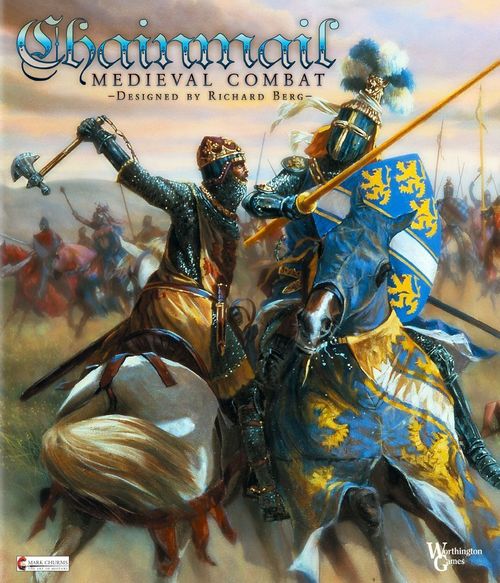
Chainmail: Medieval Combat
Chainmail: Medieval Combat Rulebook
Table of Contents
Table of Contents
- Game Components
- Game Units
- Information Markers
- The Cards
- Starting Play
- Course of Play
- Card Play
- Movement
- Facing
- Reinforcements
- Stacking
- Battle
- Missile Fire
- An Example of a Player Round
- Effects of Battle
- Winning the Game
- Solitaire Chainmail
- Battle Set-up: The Battle of Legnano
- Battle Set-up: The Battle of Bouvines
- Battle Set-up: The Battle of Lewes
- Battle Set-up: The Battle of Bannockburn
- Reference Charts
Game Components
The game's components include:
- Game maps
- 3 sheets of cardboard playing pieces
- 1 Blue deck of battle cards (38 cards)
- 1 Red deck of battle cards (40 cards)
- 1 rules book
Game Maps. Each battle has a game map. The game maps contain rows/columns of squares, each square identified by cross-referencing the letter for that row with the number for that column. For example, on the Bannockburn board the town of St. Ninian's Kirk is in square A2. Various terrain is depicted on the boards that can affect movement points (MP) and battle points (BP). Terrain types are:
Woods (Legnano, Bouvines, Bannockburn). Units pay 2 MP to enter a woods square. Units defending in a woods square get 1 BP (extra) for defending therein. This terrain BP is never doubled. Longbow and crossbow units may not missile fire into woods squares.
Marsh (Bouvines, Bannockburn). Infantry units pay 2 MP to enter a marsh square. If they do so, or they retreat into one, they are automatically, and immediately, disordered. Marsh has no effect on battle. Cavalry units may not enter, or attack into, marsh squares.
Burns and Rivers (Bouvines, Bannockburn). Infantry units pay 3 MP to cross a burn or river square side. Cavalry units may not cross a burn or river square side unless using a bridge. Longbow and crossbow units may fire across burns or rivers, but no unit may shock attack across a burn or river.
Bridge (Bouvines, Bannockburn). Bridges allow movement across burns and rivers for no extra MP. Units may shock attack across a bridge square side with the defender receiving 1 BP (extra). This terrain BP is never doubled.
Clear (All), Towns and Roads (Bouvines, Bannockburn). Units pay 1 MP to enter. Roads allow movement from roads square to connected road square through any terrain for 1 MP. No effect to BP.
Clear terrain with levels (Lewes). Clear terrain where elevation is a factor as you move from one level to another level. Level 3 is the highest level, 2 is next highest, and 1 is the lowest level. During movement, it costs +1 MP to move up one level; this is cumulative. During attacks, a unit attacking from a higher level receives a +1 BP combat bonus when attacking a unit on a lower level. This is not cumulative.
Note: Terrain other than "Clear" is highlighted with white squares.
Game Units
Each combat unit is represented by a counter. Each combat unit is either an infantry unit (pike, longbow, and crossbow units) or a cavalry unit (light cavalry, knights or dismounted knights). Each army also has a leader who may be used to help individual units in combat.
Units have the following information:
- A combat unit's battle rating is the base number of battle points (BP) it has to contribute to a shock attack. The front side of the unit has the higher BP value printed in white. Most units have a back side that has a reduced BP value printed in gold (reverse side; flip unit to this side when reduced). Some units have no reverse side. A combat unit's BP may be increased by cards, terrain, etc.
- Unit type and identification show the type of unit (infantry, cavalry, etc.) and give some of the historical commanders' names. Battle identifiers are:
- LG: Legnano
- BV: Bouvines
- LW: Lewes
- BK: Bannockburn
- A facing arrow that denotes the frontal facing direction of a counter.
Play Note: Some units have a battle rating of zero "0". It doesn't mean they can't shock attack or defend, just that they're not very good at it.
Infantry Type Units:
- Pike. Has a P in front of its BP. May shock attack but not missile fire. An Elite has an asterisk (*) under the BP number.
- Longbow. Has a LB in front of its BP. Longbow units may missile fire at enemy units. They do so either in a player's turn (missile attack fire) by expending MP, or during the opposing player's turn (missile defense fire) by the play of a Longbow Defense Fire card. Longbow units may not shock attack; they will defend against one. Longbow may not fire into woods. Longbow units only appear in Bannockburn.
- Crossbow. Has a CB in front of its BP. Crossbow units may missile fire at enemy units. Crossbow units missile fire (missile attack and defense fire) with the play of a Crossbow card. Crossbow units may not shock attack; they will defend against one. Crossbow may not fire into woods. Crossbow units only appear in Bouvines.
- Dismounted Knights. Has a DK in front of its BP. Top BP number is Attack, bottom is Defense. Appear only in Lewes.
Cavalry Type Units:
- Light Cavalry. Has an LC in front of its BP. May shock attack but not missile fire.
- Knight. Has a K in front of its BP. May shock attack but not missile fire. The only unit allowed to have a Knights Charge Card or Chivalry Charge card played. An Elite has an asterisk (*) under the BP number.
Leader. Each army has a leader, usually a king. Leaders are rated for the number of BP they add (which are never multiplied or increased) to any shock attack or defense (but not missile fire) when stacked with a unit.
- A leader adds his attack rating (the first number) as BP to any attack.
- A leader adds his defense rating (the second number) as BP to any defense.
Leaders are moved like any other unit, using MP from cards to do so. They are considered to be cavalry in being able to combine cards to move them when not stacked. Leaders that start stacked with a combat unit which is ordered to move, may move along with that combat unit without additional expenditure of MP.
Leaders can not attack or defend by themselves. Leaders by themselves move to the nearest friendly unit if attacked or if an enemy unit moves adjacent to them. However, a leader is eliminated if the unit he is stacked with is eliminated.
Information Markers
- Disordered. Used to note which units are disordered.
- Rallied. Used to denote which units have been rallied that round and may not move or attack for the rest of that round.
- Used. Used to denote which units have moved or attacked that round and may not move again that round. Units marked with a used marker can not move again that round, however, they may attack again that round.
- Schiltron/Shield Wall. Used to denote which units are in schiltron or Shield Wall, doubles the unit's BP.
The Cards
In each battle one side uses the Blue deck of cards while the other uses the Red. Battle descriptions will explain which side uses the Blue deck and the Red deck in a given battle. (For example, Lewes has 18 cards in the Blue deck and 18 cards in the Red deck that apply for that battle.) The MP and BP shown on a card are usable in all battles. Actions are usable in all battles unless specified on the card. Actions that are specific to one battle are noted on the card and a yellow highlight is on the action title.
Cards have the following information:
- MP. This rating is the number of movement points that the card, when played for movement purposes, provides for the units of that army.
- BP. This rating is the number of additional battle points that the card, when played for battle purposes during shock combat, provides for the units of that army.
- Action. Cards contain a specific action that is used when the player plays that card for action purposes. The Action description provides unique game rules specific to that card and may override a game rule. If used as an action, it may not be used for its MP or BP. If used as MP or BP the action may not be used.
Use of a card for MP, BP, or Actions, counts against a player's 5-card maximum for his round.
The Blue and Red decks are always kept separately. Players get to use some - not all - of their cards each turn. The number of cards available to each player for a given turn is listed for that battle in the battle description.
Card Deal Table. Dealt cards per turn by battle:
| Battle | Red Deck Total | Red Dealt Per Turn | Blue Deck Total | Blue Dealt Per Turn |
|---|---|---|---|---|
| Legnano | 18 | 12 | 18 | 12 |
| Bouvines | 27 | 16 | 28 | 15 |
| Lewes | 18 | 11 | 18 | 12 |
| Bannockburn | 27 | 15 | 28 | 15 |
Example: For Legnano, each player gives himself 12 cards from his battle deck of 18, setting the rest aside. Each keeps his cards secret from the other player until played. Players will cycle their dealt cards each turn until they run out of cards or both players pass consecutively. Then all the used cards and unused cards from the players' hands are shuffled together with the un-dealt cards again to start the next turn.
Counter Attack Card: In terms of who can play how many cards for Counter Attack, the designations Attacker/Defender refer to whose turn it is. You can not play a second counter attack card against one already played.
Chivalry Charge Card: This card is advantageous under certain battle conditions to place your opponent's knight units in a bad position.
Turn Play Sequence:
- Shuffle and deal cards.
- Determine initiative.
- Player with initiative passes, or plays 1-5 cards for his round.
Round Sequence:
a. Pass or play a card(s) for action or MP. b. Player may attack one target unit per card or group of cards played for the same purpose (usually MP). c. Continue card play until up to 5 cards are played for either MP, BP, or actions. (Note: more than one attack can occur in a round but only one attack per card, or group of cards played).
- Next player may pass, or play 1-5 cards for his round as above.
- Players continue alternating rounds.
- Turn ends when both players pass consecutively in a round, or both players use all of their cards.
Starting Play
I. Setting up the Combat Units. Each battle description lists which units start the game already on the board and which enter as reinforcements. Place starting units in their designated squares and set reinforcements where they can be easily reached.
II. Construct the battle deck for the battle being played. The cards for each deck (Red and Blue) list to which battle they apply.
III. Distribute Cards. Each player shuffles his deck and blindly and randomly deals himself the number of cards he is to get for that turn, placing excluded cards aside and out of play.
IV. Initiative. Players check to see who goes first in each game turn unless the battle rules state otherwise. To determine who goes first each game turn each player randomly/blindly draws a card from the deck of cards not dealt out for that turn. High MP card gets to choose who will go first that turn. Tie? Draw again.
V. Play then begins with that player undertaking a player round.
Course of Play
At the beginning of each turn, each player shuffles all (the entire battle deck) of his cards and deals to himself (randomly and blindly) cards according to his battle card availability.
The game consists of an indeterminate number of game turns. Each game turn consists of an indeterminate number of Player Rounds. In each Player Round, the player whose round it is plays from 0 to 5 of his cards. 5 cards is the maximum number of cards that may be played by the player whose round it is. Use of a card for MP, BP, or Actions counts against a player's 5-card maximum for his round. The cards are used to move his units and attack the enemy, as described below.
When that player has finished that round, play passes to his opponent, who then undergoes a Player Round (0 to 5 cards).
Play passes back and forth, as above, until both players have played all the cards they had for that turn, or both players pass consecutively. When that happens, that game turn is over.
Example: The English player plays a card with 4 MP and a card with 5 MP, for a total of 9 MP available. The most MP he could give to a single infantry unit with the play of those 2 cards is 5 MP. However, he could give all 9 MP to a cavalry unit if he chooses. Using this example he gives 3 MP to one infantry unit, another 1 MP to a second infantry unit and 5 MP to a cavalry unit. One infantry moves one square forward, the other moves and changes facing. The cavalry changes facing during its route and moves four squares.
Exception: If one player has no cards left to play, the other player plays all of his remaining cards (or as many as he wishes, up to the round maximum of 5) as one last round for that turn. Unplayed cards are discarded.
A player can choose not to play any of his cards; if he does so (or has no cards left), he passes. If both/all players pass consecutively, the turn is over, even if cards remain in hand. Discard any unplayed cards.
Card Play
Each card allows the player who plays that card to do only one of the things listed on the card (MP, BP, or actions). Once the card is played, it is discarded.
The actions available are explained on the card. Some actions are exclusive to one battle, and if so are denoted in the title of the card and are highlighted in yellow.
When a card (or cards) is (are) used, it must be used for the purpose (above) declared. That player may not play any other card(s) until that purpose is completed, although several cards may be played together for the same purpose.
If a card is played for MP, the player must use at least one MP. All MP do not have to be used, but those not used are lost.
Certain cards may be played during an opponent's round. Such play does not count against the number of cards a player may play in his round. But that card is considered used, and thus discarded for that turn.
Movement
When a card is played and the player states he is using that card for movement, he may use the number of Movement Points listed - e.g., MP 6 means he has 6 Movement Points from that card - to move one or more of his units. The player may play several cards at the same time, totaling their MP to give to his units.
Single infantry units are limited to the maximum MP available on a single played card. However, a single cavalry or leader unit can combine the MP of two or more cards.
Units pay a specific number of movement points to move into each square. The cost to enter each square is listed on the Terrain Chart shown on the map sheet. Certain sides of squares have additional terrain, and it may cost extra MP to cross that side (such as at burns) and enter that square. A unit may not enter a square unless it has the MP to do so.
Units move only across the sides of the squares; they may never move across the corners. Movement is from square to adjacent square. Diagonal movement is never allowed.
Units are free to move past (but not through) enemy units.
Play Note: The movement advantage a cavalry unit has over an infantry unit is the ability to use multiple cards for movement.
Play Note: There are no zones of control in Chainmail.
Play Note: Use of MP to longbow missile attack fire is considered card play that still enables a shock attack (normal combat), and combined with the use of your longbows can be very telling.
Facing
Play note: Units that are disordered and lose a battle at two to one BP or more are reduced once and have to retreat, they are not reduced twice.
Play Note: Multipliers are applied literally: a unit doubled for a card play and doubled for a flank attack will have its base BP increased fourfold. Thus, a 3 BP unit attacking in this manner will, because of the multipliers, be attacking with a BP strength of '12'.
Facing. A unit must always face one of the sides of the square it is in; never the corner. The top side (with the unit's ID) of the counter is the side which determines facing and is denoted with a directional arrow. The direction in which the unit is faced is called frontal. The squares/sides to each side are its flank; the square/side to its back is its rear.
A unit may only move in the direction it is faced. It costs 1 MP each time a unit changes the direction in which it is faced.
Important: A unit may change facing only two sides during any single round, regardless of how many MPs it spends.
Units moving by road, directly from one road square to another, connected road square, do not pay any MP to change facing, as long as they maintain the facing in the direction the road is pointing.
A unit may always change facing during its move, even if it is adjacent to an enemy-occupied square.
Example: A 2 BP English Pike unit crosses the bridge (1 MP) and changes facing (1 MP), then moves into the woods (2 MP) and changes facing again (1 MP) for a total of 5 MP. The English pike unit now conducts a flank attack, he would start with 4 BP (double his 2 BP for the flank attack) to 2 BP for the Scot pike unit. Both players could play cards for BP and actions for the battle.
Once a unit stops movement it can not move again that round (but could attack again). Once a unit attacks it can not move that round (but could attack again). Place "Used" markers on units to help you keep track of which units have moved and/or attacked. Each unit may move only once per round, although the number of MP it uses is limited only by the cards played. Thus, a player can use several cards at once to give many MP to his units, but once he has moved those units, he may not move them again that round.
Reinforcements
Both players may receive new units – reinforcements – during the course of the game. Reinforcements are eligible to enter the map according to the reinforcement schedule in the battle. They enter the map into the square(s) indicated, using the cards for movement in the normal way.
Stacking
Only one combat unit may be in a square at any one time. A combat unit may not move into a square occupied by another unit, friendly or enemy. Units may attack into an enemy-occupied square. But, when that attack is resolved, only one unit will be in that square.
Leaders may stack with any one combat unit and this is the only time two units can be in the same square.
Battle
A battle occurs when one player attacks another player's unit. There are two types of battle, Shock Attack and Missile Attack Fire. Missile attack fire uses card movement points as opposed to shock attack which occurs following a card play. The playing of a card to move/fire longbow and crossbow units still allows you to make a shock attack. Only one missile attack fire and one shock attack are allowed per play of a card or group of cards for the same purpose during a player's round.
Shock Attack. After a player plays one or more cards for movement, or plays a card (or cards) for action purposes, he may launch one shock attack. He cannot shock attack unless he has played at least one card (for either of those purposes; cards played for battle points do not count) and only one shock attack is allowed per play of a card or a group of cards used for the same purposes (usually to get many movement points).
"One Shock Attack" is defined by the target unit: the player attacking one enemy (defending) unit. More than one friendly unit may shock attack that unit, but only one defending unit may be the object of a shock attack.
More than one shock attack can occur in a round but only one shock attack per card or group of cards played.
Pike, light cavalry, and knight units may shock attack any enemy unit in an adjacent square, as long as the shock attacking unit is facing towards that square. Units shock attack only with their frontal side of the unit.
A player may shock attack an enemy unit with as many units as he has (frontally) adjacent to that target / defending enemy unit. However, cavalry and infantry may not combine to shock attack the same unit.
Longbow and Crossbow units may not shock attack, but they defend against one.
Determining Battle Points (BP) for Shock Attack
Battles are resolved by having the attacker compare his Battle Points (BP) to those of the defender. Each player receives his base BP for each battle from the current (full or reduced) battle rating on the unit's piece. These BP may be increased or reduced.
Multipliers (doubles, triples) are done before any additions or subtractions called for by the game.
Increases and Decreases to BP
- Actions. Some cards may also be used for their actions which will increase a unit's BP. If used for an action the card may not also be used for its BP.
- Position. This applies only to attacking units. If a unit is attacking into an enemy unit's flank side (see facing), it doubles (2x) its BP. If a unit is attacking into an enemy unit's rear side, it triples (3x) its BP. The position bonus applies to individual units, not to all attackers.
- Terrain Benefits.
- Leaders. They add their ratings as BP to any unit they are stacked with, depending on whether they are attacking or defending.
- Use of Cards as BP. The number of BP on each card is added to the total BP for those units. The attacking and defending players may play as many cards as they wish within their maximums. The attacker must stay within his 5-card per Round maximum. The defender has no such limit, and the cards he plays do not count against the 5-card limit.
Important: Cards used for BP are selected secretly and played simultaneously. No card may be played after each player reveals which cards he is using.
Resolving shock attack battle. Each player totals his BP (as above). All cards played for BP are revealed simultaneously. High total wins. If there is a tie, defender wins.
To secretly play BP cards, players should put both hands under the table. In their right hand they put the cards they want used for BP in this battle. In their left hand they put the remainder of their cards. Players bring both hands above the table at the same time and place any cards in their right hands face up on the table.
Example: The Scots player in Bannockburn plays a card (A) with 4 MP and spends one MP to move a 2 BP pike infantry straight ahead and then spends one more MP to change its facing, ending that unit's move in the frontal square of an English 2 BP pike infantry unit. With the remaining 2 MP from the card, he moves a 3 BP pike infantry unit straight ahead into the flank square of the same English pike infantry unit. He decides to attack the English pike unit he just moved next to. The Scot player has 8 BP (2 BP for the pike frontally adjacent + 6 BP for the 3 BP pike infantry attacking from the flank square) and the English 2 BP. Both players can now add card BP to the attack. The Scots player uses 1 card (B) to add 5 BP, for a total of 13 BPs. The English player uses 1 card (C) for 4 BP for a total of 6 BP. The Scots player wins the attack with more than twice the BP of the defender. The English pike must reduce and retreat.
Play note: Full strength units that must reduce, flip to their reduced side, if they have one. Units forced to "reduce" while in a reduced status are eliminated.
Shock Attack Battle Results
Attacker is the Winner. If the attacker has more BP, but less than twice the BP of the defender, the defender (usually) has a choice. He may either stay in his square and flip the unit to its reduced side, or he may retreat (see below) the unit. If the defender cannot retreat due to blocking terrain or units, the unit must reduce. Also if the defender was disordered prior to the battle, he must reduce the unit and is no longer disordered.
If the attacker has more than twice as many BP as the defender, whether disordered or not, the defender must reduce and retreat. Disordered units that reduce are no longer disordered.
The attacker must advance one of the attacking units (his choice) into the vacated square, whether it is vacated by retreat or unit elimination. Advancing units may change facing when they enter the square, at no cost in MP. Any other victorious units may also change facing at no cost, but may not move.
Defender is the Winner. Nothing happens unless the defender has more than double the BP of the attacker. In that case one attacking unit - the one with the highest BP on its counter (if ties, attacker decides) - is reduced.
Play note: Units that are disordered and lose a battle at two to one BP or more are reduced once and have to retreat, they are not reduced twice.
Missile Fire
Missile fire is only allowed by Longbow and Crossbow units. Longbow and Crossbow missile fire disorders the target. Regardless of the result, there is no advance after fire. A second disorder as a result of missile fire has no effect.
Missile Attack Fire
A longbow unit may missile attack fire at any enemy unit directly adjacent to its frontal side, or two squares distant directly through its frontal side. They may fire over a friendly unit.
Longbow and Crossbow missile attack fire is not considered an attack in the sense of rules for shock attack. Longbow missile attack fire uses card movement points to do so, as opposed to shock attack which occurs following a card play. The playing of the card to move/fire longbow units still allows you to make a shock attack. Only one missile attack fire and one shock attack per play of a card or group of cards for the same purpose.
Example: English longbow unit A can target either Scot unit shown. He would need to use 2 MP to missile attack fire at Scot unit B or change facing (for 1 MP) and use 3 MP to missile attack fire at Scot unit D (for a total of 4 MP). Note that attack at Scot unit D is firing over a friendly unit C. If unit C was a Scots unit a missile attack fire could not be done on Scots unit D. The English player chooses to missile attack fire Scots unit B which disorders that unit. The English player can now launch a shock attack (since he played a card for MP) with English pike unit C against Scots unit D.
- It costs a Longbow unit 2 MP to fire at an adjacent enemy unit.
- It costs a Longbow unit 3 MP to fire at a target 2 squares distant.
- Longbow units may move before they attack fire, but not after they attack fire.
- A Crossbow unit may only missile attack fire by the play of a Crossbow card. It may only missile attack fire units directly adjacent to its frontal side.
Missile Defensive Fire
A longbow and crossbow unit may do missile defensive fire during the opponent's turn by the play of a Longbow Defense Fire card or Crossbow card. They may missile defense fire only at target units that end a move adjacent frontally. The effect is the unit fired on is disordered.
Crossbow Card (Bouvines only). The Attacker plays this card as part of his round. The Defender plays it at any time he wants during an opponent's Round, even while an enemy player is totaling his Attack BP! However, if played defensively, it must be played before any other cards are chosen, revealed or used.
When the Crossbow card is played, the player designates one of his crossbow infantry units that is not Disordered as firing. The enemy unit frontally adjacent to that firing unit is then automatically Disordered. You cannot eliminate or reduce a unit by playing a Crossbow card.
An Example of a Player Round
French player's turn. The French player plays the Crossbow card for the action (1 of 5) on the HRE Knight, disordering it. The second card (2 of 5) played is for MP, moving 2 infantry units a total of 5 MPs. Both are now adjacent and facing the HRE infantry unit. The French player now declares a shock attack against the HRE infantry unit. During the combat, the French player plays 1 battle card (3 of 5) and has 11 BP (2 + 4 + 5 BP card) and the HRE plays 2 battle cards and has 10 BP (2 + 5 BP card + 3 BP card).
The battle is won by the French player but not by double the battle points. The HRE player decides to retreat the unit one square directly to the unit's rear. The French player advances a unit into the vacated square.
The French player plays a Knights Charge card (4 of 5), moving the knight unit, 2 spaces to attack the retreated HRE infantry unit on the flank. The French player now declares a second combat this round (part of the play of the Knights Charge card). The HRE player knows that the French player can only play a single battle card (since the French player has already played 4 of 5 cards), but must choose between using a lot of cards to hold the square against the quadrupled (doubled for the knights charge plus doubled again for attacking on the flank) charging knights BP factors, or retreat. The HRE decides that it would cost playing too many cards to win the battle, so he plays no cards. The French player plays his last card for 4 BP (5 of 5) allowed that round to ensure victory. Because the French player's BP were more than twice the BP of the HRE player, the unit is reduced and must retreat. The French player's round is now over and the HRE player now begins his round of up to 5 cards.
Effects of Battle
Unit Reduction. Reducing a unit means flipping the counter to its lower BP rated side (if it has one). A unit that is already reduced, or has no reduced side, that suffers another reduced is eliminated and removed from the game.
Disorder. Units can become disordered as a result of missile fire or terrain. While in disordered status the unit may not shock attack or missile fire. A disordered unit that loses a battle as a result of shock attack is reduced (and is no longer disordered).
Important: A second disorder effect does not apply to missile attacks. In such a case a second disordered result is ignored.
Retreat. A unit that retreats moves into any vacant square to its rear or flank sides (defender's choice). It may only retreat forward (frontally) as a last resort. If the unit does not have a vacant square to retreat to it suffers an additional reduction. The retreating unit may change its facing at no cost in MP. If a unit cannot retreat, it is reduced instead.
Winning the Game
Players get Victory Points for eliminating - removing from play - enemy units. An eliminated unit's victory point is equal to its full strength BP. One player wins the instant the other player has lost the listed number of BP for that battle. Count the normal (full) side BP. Reduced units do not count towards eliminated BP. Eliminated Longbow units (Bannockburn) are worth 1 BP for victory purposes. The Carroccio (Legnano) counts as 10 BP towards victory. Eliminated leaders count as 4 BP for victory purposes.
Solitaire Chainmail
Essentially you, as the player, play both sides, setting up the units as for normal play. You then deal out the cards (blindly and randomly) each army gets from their respective decks, as per the scenario instructions, putting each army's play deck face down, on each side of you.
For whichever side goes first, you pick the top card from that army's deck. Choose to use the card to move or for the listed action. If you want to move a cavalry unit a distance by playing more than one card to do so, as is allowed, you take two cards, but you may then not use any of the actions, just the MP.
Having played a card (or cards), you may then decide to attack, as per the rules. When doing so:
- As Attacker you may then pull the next card (blindly) from the top of the deck and use it either for BP or for the listed Action.
- At the same time you must (if there are cards remaining) draw the top card from the Defender's deck and use it for its BP or Action.
You may not draw any more cards, and the battle is then resolved, after which play transfers to the other army, wherein you start the blind draw process over.
When there are no cards left, the turn is over. Shuffle the army's respective decks, draw the allotted number of cards for each, and start the next turn.
Battle Set-up: The Battle of Legnano
Italy, May 29, 1176. The Holy Roman Empire, under Frederick I Barbarossa vs The Lombard League, under Alberto da Giussano.
Introduction
The Lombards won this battle rather handily, as they do outnumber the Germans and have a nice complement of infantry with knights. The HRE knights, though, are much better at what they do than the Lombards, and good use of them can make a big difference. If you find the Lombard winning too handily, reduce the Lombard hand per turn by a card or two.
The Cards
The HRE player uses the Legnano Battle Cards from the Blue deck, there are 18 cards. The Lombard player uses the Legnano Battle Cards from the Red deck, there are 18 cards. Each Player is dealt 12 cards each turn from their respective Legnano battle cards.
Starting Play
Below are the starting squares for the units.
Lombard Army. All units start facing North.
| Square | Unit |
|---|---|
| K6 | Milan Knights 2 |
| K5 | Milan Knights 1 |
| 013 | Milan Knights 8 |
| O12 | Milan Knights 6 |
| O11 | Milan Knights 5 |
| O9 | Piacenza Mtd Knights |
| O8 | Vercelli Mtd Knights |
| O7 | Lodi Mtd Knights |
| O5 | Milan Knights 7 |
| O4 | Milan Knights 4 |
| O3 | Milan Knights 3 |
| Q13 | Brescia Infantry 2 |
Leader can be stacked with any unit.
HRE Army. All units start facing South. (All units are Knights.)
| Square | Unit |
|---|---|
| A13 | Rhineland 1 |
| A9 | Swabia 2 |
| A7 | HRE 3 |
| A3 | Rhineland 2 |
| B13 | HRE 7 |
| B12 | HRE 6 |
| B10 | HRE 5 |
| B9 | HRE 4 |
| B7 | Fred Grd 2 |
| B6 | Fred Grd 1 |
| B4 | HRE 2 |
| B3 | HRE 1 |
| G7 |
Leader can be stacked with any unit.
Initiative
The Lombard player should be given the Initiative for the first Turn.
The Carroccio
A Carroccio was a war chariot drawn by oxen, used by many medieval republics of cities and armies. It was a rectangular platform on which the standard of the city and an altar were erected; priests held services on the altar before the battle, and the trumpeters beside them encouraged the fighters to the fray.
In battle the Carroccio was surrounded by the bravest warriors in the army and it served both as a rallying-point and as the palladium of the city's honour; its capture by the enemy was regarded as an irretrievable defeat and humiliation. It was first employed by the Milanese in 1038, and played a great part in the wars of the Lombard League against the emperor Frederick Barbarossa. Richard I used one in his march from Acre to Arsouf in the 3rd Crusade.
It costs 2 Movement Points to move the Carroccio, regardless of terrain. No unit may stack with the Carroccio.
If the Carroccio is attacked by any HRE unit the result is an automatic elimination of the Carroccio. The Carroccio counts as 10 BP towards HRE victory.
Winning the Game
Play continues until the instant one player wins by eliminating the required number of enemy BP in units eliminated (not from reductions). Count the full side BP of eliminated units. Knights removed for Pursuit have no effect on victory.
The Lombards win by eliminating 25 HRE BP.
The HRE win by eliminating 30 Lombard BP (the Carroccio counts as 10 BP if eliminated).
Battle Set-up: The Battle of Bouvines
Flanders, July 27, 1214. France, under King Philippe II Augustus, vs the Holy Roman Empire and its Allies, under Emperor Otto IV of Brunswick.
Introduction
The Battle of Bouvines, July 27, 1214, was a conclusive medieval battle ending the twelve year old War of Bouvines that was important to the early development of both the French state by confirming the French crown's sovereignty over the Norman lands of Brittany and Normandy.
The Cards
The HRE player uses the Bouvines Battle Cards from the Blue deck, there are 28 cards. The French player uses the Bouvines Battle Cards from the Red deck, there are 27 cards. The HRE Player is dealt 15 cards each turn and the French player is dealt 16 from their respective Bouvines battle cards.
Design note: The difference in card availability reflects the command superiority of Philippe. If players find the French winning too often they can give the HRE an extra card each turn.
Starting Play
Below are the starting squares for the units. Note the specific facing of the French units.
The French Army Under Philippe II, King of France. The following units start facing west:
| Square | Unit |
|---|---|
| O12 | Beaumont Knights 4-2 (Burgundy stripe unit) |
| O13 | Montmorency Knights 4-2 (Burgundy stripe unit) |
| O14 | Sancerre Knights 4-2 (Burgundy stripe unit) |
| Q15 | Soissons Light Cavalry 3-2 (Burgundy stripe unit) |
| Q16 | Norman Knights 5-3 (Gold stripe unit) |
| Q17 | Isle de France Knights 4-2 (Gold stripe unit) |
| Q18 | Isle de France Light Cavalry 3-2 (Gold stripe unit) |
The King can be stacked with any unit.
The following units start facing east:
| Square | Unit |
|---|---|
| R12 | St. Pol Knights 4-2 (Burgundy stripe unit) |
| R13 | Champagne Light Cavalry 3-1 (Burgundy stripe unit) |
French Reinforcements. All other French units start off of the board. They are brought in, whenever the French player expends MP to bring them in. They pay 1 MP for the first square they enter, and they enter only through square Q-18.
The Holy Roman Empire and Allies Army, under Emperor Otto IV of Brunswick. The following units start facing south:
| Square | Unit |
|---|---|
| S5 | Flanders Knights #A 4-2 (Blue stripe unit) |
| S4 | Flanders Knights #B 3-2 (Blue stripe unit) |
| S3 | Hainault Knights 4-2 (Blue stripe unit) |
| S2 | Hainault Light Cavalry 3-1 (Blue stripe unit) |
| S1 | Flanders Pike Infantry #1 2-1 (Blue stripe unit) |
The King can be stacked with any unit.
HRE Reinforcements. The HRE/Coalition Army is marching along the road from Tournai in one extended line, the length of which may have been several miles. Units not starting on the game board enter through square S-1, as the player wishes and expends MP for, in the following order:
- Ferrand's Division (Blue stripe units)
- Otto's Division (Black stripe units)
- Renaud's Division (Grey stripe units)
Ferrand's "division" was comprised of Flemish troops. Otto's "division" was comprised of Saxon's, German's, and Netherlanders. Renaud's "division" was mostly English mercenaries with some Flemish.
Initiative
The HRE player should be given the initiative for the first game turn. Every turn thereafter players determine first turn initiative as per the rules for such.
Winning the Game
Play continues until the instant one player wins by eliminating the required number of enemy BP in units eliminated (not from reductions). Count the full side BP of eliminated units.
French win by eliminating 27 HRE BP.
HRE win by eliminating 27 French BP.
Battle Set-up: The Battle of Lewes
England, May 14, 1264. The Royalists, under King Henry III vs the Barons, under Simon de Montfort, Earl of Leicester.
Introduction
The Battle of Lewes was one of two main battles of the conflict known as the Second Barons' War. It took place at Lewes in Sussex, on May 14, 1264. It marked the high point of the career of Simon de Montfort, 6th Earl of Leicester and made him the "uncrowned King of England".
Terrain Effects
For game play all terrain is clear. However, elevation is a factor as you move from one level to another. Level 3 is the highest level, 2 is next highest, and 1 is the lowest level. During movement, it costs +1 MP to move up one level, this is cumulative. During attacks, a unit attacking from a higher level receives a +1 BP combat bonus when attacking a unit on a lower level. This is not cumulative.
Example: A unit moving from square K10 (level 3) to attack a unit at K5 (level 2) would receive +1 BP bonus during combat.
Example: A unit moving from square D6 (level 3) to attack a unit at D1 (level 1) would still only receive a +1 BP bonus during combat.
The Cards
The Baron player uses the Lewes Battle Cards from the Blue deck, there are 18 cards. The Royalist player uses the Lewes Battle Cards from the Red deck, there are 18 cards. The Baron Player is dealt 12 cards each turn and the Royalist is dealt 11 cards from their respective Lewes battle cards.
Design Note: This imbalance represents the difference in military capability between Simon de Montfort and King Henry III. For play balance, if players find the Baron's winning too often, we suggest giving the Royalists 12 cards not 11 per turn.
Starting Play
Setting up the Combat Units. Below are the starting squares for the units.
The Royalist Army Under Henry III, King of England. All units facing North.
| Available Squares | Units |
|---|---|
| Henry's "Battle" | |
| P 9-13 and Q 9-13 | 8 Pike Infantry and 2 Knights, Dismounted |
| Cornwall's "Battle" | |
| P 2-6 and Q 2-5 | 8 Pike Infantry and 1 Knight, Dismounted |
| Edward's "Battle" | |
| I 2-4 and J 3-5 | 6 Knights; must start Mounted |
The Barons in Revolt, under Simon de Montfort, Earl of Leicester. All units facing South.
| Available Squares | Units |
|---|---|
| Simon's "Battle" | |
| C 6-13 | 6 Pike Infantry and 2 Knights; may be either Mounted or Dismounted |
| Henry's "Battle" | |
| E 10-12 | 2 Pike Infantry, 1 Mounted Knight |
| Gloucester's "Battle" | |
| E 7-9 | 2 Pike Infantry, 1 Mounted Knight |
| de Segrave's "Battle" | |
| E 4-6 | 3 Pike Infantry |
| E 3 | 1 Mounted Knight |
Initiative
The Baronial player should be given the Initiative for the first Game Turn, although players may wish to determine first turn initiative as per the rules for such.
Historical Note: The battle apparently started with a mass charge by the front three battles of Simon's army.
Mounted and Dismounted Knights
Knights could fight either mounted or dismounted. In Lewes, your knights can fight in either status, and the scenario deployment designates what status they start in.
To change status – mount or dismount – it costs 1 MP, and is that unit's "movement" for that round. They may not do so when they are adjacent to any enemy unit. Simply replace one status counter with the other (there are two counters for each unit of knights).
For Dismounted Knights, the top rating is the attacking BP, the bottom is the defensive BP.
Winning the Game
Play continues until the instant one player wins by eliminating the required number of enemy BP in units eliminated (not from reductions). Count the full side BP of eliminated units. Eliminated Dismounted Knights are counted at their Mounted state. Knights removed for Pursuit have no effect on victory.
The Royalists win by eliminating 25 Barons BP.
The Barons win by eliminating 30 Royalist BP.
Battle Set-up: The Battle of Bannockburn
Scotland, June 24, 1314. Scotland, under King Robert I (the Bruce), vs. England, under King Edward II.
Introduction
The Battle of Bannockburn, 24 June 1314, was a significant Scottish victory in the Wars of Scottish Independence. It was the decisive battle in the First War of Scottish Independence.
The Cards
The Scots player uses the Bannockburn Battle Cards from the Blue deck, there are 28 cards. The English player uses the Bannockburn Battle Cards from the Red deck, there are 27 cards. Each Player is dealt 15 cards each turn from their Bannockburn battle cards.
Starting Play
Below are the starting squares for the units. The placement of individual unit BP and identification is up to the owning player as long as the correct unit type is placed in the listed squares. All units start the game at full strength.
The English Army, under King Edward II, King of England. All English pike infantry start disordered. All units are facing West.
| Square(s) | Unit |
|---|---|
| G4-5 | 2 Longbow |
| G15-16 | 2 Pike Infantry |
| G18 | 1 Longbow |
| H4-5 | 2 Longbow |
| H14 | 1 Knight |
| H18 | 1 Pike Infantry |
| I4 | 1 Longbow |
| I18 | 1 Pike Infantry |
| J8-9, 10-12 | 5 Knights |
| J18 | 1 Pike Infantry |
| K8-9, 11 | 3 Knights |
| K18 | 1 Pike Infantry |
King Edward starts stacked with any unit.
The Scots Army, under Robert I (The Bruce), King of Scotland. All units are facing East.
| Square(s) | Unit |
|---|---|
| A17-18 | 2 Light Calvary (sic; printed "Calvary") |
| A5-11; A13-15 | 5 Pike Infantry (deployed as you want within these squares) |
| B3-4 | 2 Longbow |
| B5-14 | 10 Pike Infantry (in Schiltron formation) |
| C15-16 | 2 Longbow |
| D17 | 1 Longbow |
Robert the Bruce starts stacked with any unit.
Initiative
Determine first turn Initiative as per the rules for such.
Schiltron (Scots Only)
The play of the Robert the Bruce card is the only way Scots units enter schiltron. Play of the Robert the Bruce card allows the Scots player to put as many of his Pike into or out of schiltron as he wishes. These units may be adjacent or non-adjacent to enemy units.
Pike in schiltron:
- May not move or attack (and that includes counter-attack).
- They double (2x) their printed BP.
- Knights may not charge a unit in schiltron; they may shock normally.
- A disordered unit cannot form schiltron. However, units in schiltron that become disordered can remain in schiltron.
- Units in schiltron may choose to become disordered instead of incurring a retreat result.
- Units in schiltron that choose to retreat are taken out of schiltron following the retreat.
The Scots player can have as many pike units as he wishes leave schiltron at the start of any Scot Player round – no cards need to be played. Scots units leaving in this manner (unlike during the play of the Robert the Bruce card) may only do so if they are not adjacent to an enemy unit. They may do so even if disordered.
Schiltron was a phalanx-like, hollow formation of pike infantry (supposedly "invented" by William Wallace). The infantry was trained to use their pikes to form a wall of "points" that few cavalry units could break, or even choose to try.
Winning the Game
Play continues until the instant one player wins by eliminating the required number of enemy BP in units eliminated (not from reductions). Count the full side BP of eliminated units.
Scots win by eliminating 27 English BP.
English win by eliminating 20 Scot BP.
Reference Charts
Terrain Chart
| Terrain Type | Combat Modifier | Movement Modifier | Used in Following Battles |
|---|---|---|---|
| Clear | No Effect | No Effect | Legnano, Bouvines, Lewes, Bannockburn |
| Woods | Defender +1 BP | 2 MP | Legnano, Bouvines, Bannockburn |
| Marsh | No Effect | 2 MP (Cavalry cannot enter) | Bouvines, Bannockburn |
| Towns and Roads | No Effect | No Effect | Bouvines, Bannockburn |
| Bridges | Defender +1 BP | No Effect | Bouvines, Bannockburn |
| Rivers and Burns | May not Shock Attack or Retreat Across | 3 MP (Cavalry cannot cross) |
Shock Attack Battle Results
| Battle Result | Effect |
|---|---|
| Attacker Wins | Defender retreats or reduces |
| Attacker Wins: 2x BP or more | Defender retreats and reduces |
| Defender Wins | Nothing happens |
| Defender Wins: 2x BP or more | Attacker reduces one unit |
Missile Fire Battle Results
Missile Fire Attacks and Defense by Longbow and Crossbow units Disorder the target unit.
Attack Chart
| Action | Effect |
|---|---|
| Attack into flank | Attacking unit BP doubled |
| Attacking into rear | Attacking unit BP tripled |
| Shield Wall/Shiltron | Defending unit BP doubled |
| Elite Bonus | Card play doubled elite unit |
| Barbarossa Bonus | Card play +2BP |