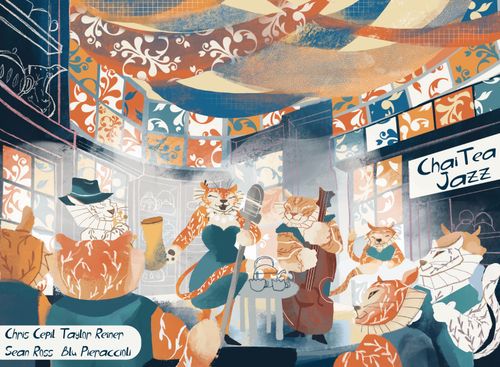
Chai Tea Jazz
Chai Tea Jazz Rulebook
Table of Contents
Table of Contents
Overview
A trick-taking game for 2-4 or 6 players, 55-125 minutes.
The Hook
A trick-taking* game where players must all accomplish the same tasks and compare feats.
*More info about trick-taking in the Trick-Taking section.
Components
- 52 Playing Cards (A-K in four suits)
- 12 Extra Jass Cards (U/O/B)
- 2 Joker Cards
- 2 Current Bet/Direction Cards
- 2 Barrel/Bet Debt Tracking Cards
- 4 Player Aids
- 1 Paper Pad
Setup
These rules are for three players. See the section "Rules for Two, Three, and Six Players" for rules for other player counts.
- Remove cards 10-13 in each suit. The resulting deck has 36 cards consisting of ranks 1-9 in four suits.
- Shuffle the deck and deal all cards equally, 12 each to the players.
- The start player for the first round is the last player to drink a chai. Give that player the 5-point Barrel card (0 side up) and the Current Bet card (Current Bet side up).
- Players agree on the amount of contracts (and which contracts) they will play in the game. The standard game is on one side of the Paper Pad (with room for additional contracts, if desired), while the opposite side has a fully blank contract list for full customization. For your first play, it is recommended to play the standard side without additional contracts.
Gameplay Flow
The standard game lasts 12 rounds (4 contracts, each played by the three players).
Each round is broken up into two phases: a Picking phase and a Trick-Taking phase.
In the Picking phase, players decide what type of game they are playing, through a mix of picking a contract, passing, and/or betting.
After a contract is determined, the Trick-Taking phase involves one player trying to score points, while the other two players try to hinder that sole player. After the trick-taking, players count the points won by the sole player and track that on the Paper Pad.
At the end of the game, players compare scores for all of the contracts and the player who did the best comparatively wins.
Picking Phase
To begin, the player with the Barrel card first looks at their hand, then either picks a contract for the round or passes.
Pass
If they pass, the next player clockwise is in the same position where they must either pass or pick a contract. If everyone passes, that original player with the Barrel card is forced to pick a contract.
Pick a Contract
If the player with the Barrel card did not pass, but rather picked a contract, then the next player clockwise may now either pass or incur Bet Debt to pick a different contract.
Overall, if a contract has been picked and the next player has not yet passed, that next player may either pass or pick a new contract and increase the Bet Debt to any amount on the barrel card, up to 35.
The game is Hard Pass, meaning if a player passes then they are out for the remainder of that picking phase.
Players may not pick a contract they have already completed. Therefore, once a player has completed all contracts, they must pass for the rest of the game. They may not take on Bet Debt to "bid up" another player.
When a player picks a contract, they take the Current Bet card, not the Barrel card. If any Bet Debt is declared, the Barrel card is rotated and/or flipped to have that Bet Debt number at the top, to keep track of the current Bet Debt.
The player who finally picked the contract is the declarer. The declarer plays alone against the other two players, who are now on a team.
Contracts
The types of contracts are: Trump, Under, Slalom, Joker. They are worth different game points, listed on the side of the Paper Pad.
- Trump: The picking player decides which of the four suits is trump for the round. The trump suit is declared when the player picks the contract. No trump suit is not allowed in this contract. The ranking would then be the 9 in the trump suit is the strongest down to the 1 in the trump suit, then the 9>1 in the lead suit.
- Under: The ranking is changed to where the lowest card now is the strongest: 1>2>3..>9.
- Slalom: The ranking alternates every trick between 9>1 and 1<9, repeating until the end of the round. Before the round starts, the picking player chooses whether the round starts with the highest being the strongest or the lowest.
- Joker: This contract is whichever of the above contracts the player wants, declared when picked. It may be any contract, even one the player has previously completed.
Examples
Example: Aslan has the Barrel card and decides to pick Trump as the contract, with Diamonds as the trump suit. The other players all pass. Trump (Diamonds) is the contract and players move to the Trick-Taking phase.
Example: Aslan has the Barrel card and decides to pass. All the other players pass. Aslan is forced to pick a contract, and he chooses Under. Under is the contract and players move to the Trick-Taking phase.
Example: Aslan has the Barrel card and decides to pass. Leo picks Under as the contract, taking the Current Bet card. Mufasa picks Trump (Hearts) as the contract. He increases the Bet Debt to 5 points and takes the Current Bet card. The Bet Debt card is rotated to 5. Aslan passed, so he is skipped. Leo takes on 10 Bet Debt to pick Under as the contract, taking the Current Bet card. The Bet Debt card is rotated to 10. Mufasa takes on 20 Bet Debt to pick Trump (Hearts) as the contract, taking the Current Bet card. The Bet Debt card is flipped and rotated to 20. Aslan passed, so he is skipped. Leo passes. Trump (Hearts) is the contract and players move to the trick-taking phase.
Example: Aslan has the Barrel card and decides to pick Joker (Under) as the contract. Leo passes. Mufasa takes on 5 Bet Debt to pick Slalom as the contract, taking the Current Bet card. The Bet Debt card is rotated to 5. Aslan takes on 10 Bet Debt to pick Under as the contract, taking the Current Bet card. The Bet Debt card is rotated to 10. Notice Aslan changed their contract, which is allowed. Mufasa passes. Under is the contract and players move to the trick-taking phase.
Trick-Taking Phase
With the contract picked, the declarer will lead to the first trick. The trick-taking is must-follow, may-trump (if trump was declared). If the contract has a trump suit, may-trump allows players to play a trump card, even if they could follow suit. If the trump suit is led, the following players must play a trump card, if they have one.
The declarer's goal in the trick-taking phase is to capture the cards with the points on them; all of the odd cards have points. The number of points an odd card has is equal to the card's rank.
Example: The contract is Trump (Hearts) and Aslan leads a 9 of Clubs. Leo has both Clubs and Hearts, and decides to play a 2 of Hearts instead of following suit. Mufasa has Clubs and no Hearts, so he plays a 7 of Clubs. Leo wins the trick, capturing 16 points on the 9 and 7 cards.
The strongest card wins the trick (which may be the highest, lowest, trump, or something else, depending on the contract). The winner of the trick leads to the next trick. Play out all of the tricks, taking note of who wins the last trick as it's worth points.
Scoring
After all of the tricks have been played, the declarer counts the points on the cards that they won. (Sometimes it's easier for the other team to count their points and do the math to find out how many points the declarer won, as there are 100 total points on the cards.) If the declarer won the last trick, they add 10 points to their total. If the declarer took on Bet Debt, this amount is subtracted from their total.
They put this total onto their spot for the contract that was just played. They also mark whether they were the first, second, or third to complete that specific contract.
If a row on the scoreboard is completed, players award game points. Depending on the value of the contract, the player who scored the most points gets game points equal to the positive value of the contract. The player who did the worst gets game points equal to the negative value of the contract. The middle player gets zero points. If there is a tie in any way, the tied player who finished the contract earliest gets the higher position in the scoring.
Example: The contract of Under was just completed by Leo, who got 75 points. All three players have now completed the Under contract, and it can be scored. Aslan got 59 points and Mufasa got 33 points. The Under contract was worth 2 game points, so Leo wins +2 game points, Aslan gets 0 game points, and Mufasa gets -2 game points. If Leo got 59 points and he and Aslan tied, Aslan would get the +2 game points because Aslan finished the Under contract before Leo.
End of Round
If a player finishes their last contract, mark their Final Score box with which position they finished the game (similar to the contract position).
If there are more contracts to complete, shuffle and redeal the cards. Flip the barrel card to the 0 side face-up and pass both it and the Current Bet card to the next player in turn order who has contracts to complete.
Note: If it's impossible for a player to lose the overall game, players may end the game early if they don't wish to determine second or third place.
End of Game
The standard game ends after 12 rounds. Players total their game points from the contracts and the player with the most game points wins!
If tied, the player who finished all their contracts first wins.
Congrats on playing the sweetest licks in the spiciest chai club!!
Rules for Two, Three, and Six Players
Two Player
The two player game is similar to the three player game, except for a few things.
The game is one versus one. Players sit across the table from each other. Each contract is only played twice, once for each player.
The deck is the same. Each player is dealt 17 cards each as follows:
- Set aside 2 cards facedown.
- Deal 5 cards facedown in front of each player.
- Deal 5 cards face-up on top of the facedown cards to create each player's straw-pile. A straw-pile is a group of cards that is part of the player's hand.
- Deal 7 cards to each player.
During the Trick-Taking phase, players may play any card from either their hand or any face-up card from their straw-pile. When a card from their straw-pile is played, the card below it (if there is one) is flipped face up, but only after the trick is complete.
Before Scoring begins, the 2 set-aside cards are split between the players, with the winner of the final trick taking the higher card.
Everything else is the same as the three player game.
Four Player (Teams)
The four player game is similar to the three player game, except for a few things.
The game is now two versus two. Players sit alternating from their teammate, so the teams are A,B,A,B.
Each contract is only played twice, once for each team.
The deck is the same, with the players dealt 9 cards each.
The Barrel/Bet Debt card is now the 3 point increment card.
Players may not discuss their hands or intentions with their teammates.
Everything else is the same as the three player game.
Six Player (Teams)
The six player game is similar to the three player game, except for a few things.
The game is now three versus three. Players sit alternating from their teammate, so the teams are A,B,A,B,A,B.
Each contract is only played twice, once for each team.
The Barrel/Bet Debt card is now the 3 point increment card.
The final trick is now worth 20 points.
The deck is different: 1-13, in four suits, plus 2 Jokers. Players are dealt 9 cards each. There are now 200 total points in the deck.
The Jokers are the strongest cards in the game, beating any trump or other card. The later-played Joker wins if both are played in the same trick.
If a more balanced deck is desired, players can make a double deck with 2 copies of 1-9 each, in the four suits. This would keep the 200 points in the deck. This can be done using 2 decks combined from the box. The only rule needed is that the later played card wins, if there is a tie.
Players may not discuss their hands or intentions with their teammates.
Everything else is the same as the three player game.
Variants
Passing the Barrel Variant
When everybody passes and the player with the Barrel card is forced to pick a contract, they may instead reverse the Bet Debt by offering any amount out to other players to take the barrel instead. If accepted by another player, that player adds those offered points to the total that they get after picking a contract for themselves and playing that picked contract. The offer may keep growing, in the allotted increments until either an opponent takes the offer, the max of the Bet Debt is offered, or the player with the Barrel card gives up, rescinds the offer, and picks a contract themselves.
Jass Variant
To play Chai Tea Jazz more like the traditional game it's founded on, play with these three rules tweaks:
- Match Points: If a player wins all the tricks in a round, they get 1 additional game point.
- Jass Deck: Included in the box are 12 cards to be able to play the original game Coiffeur-Jass. You simply use the deck makeup of 6,7,8,9,10,U,O,K,A. Rules for playing the full game of Coiffeur-Jass are found online.
(The source lists only these two tweaks under "three rules tweaks".)
Custom Contracts Setups
Short:
- 1st Tier (Worth 1 Game Point): Any Suit Trump
- 2nd Tier (Worth 2 Game Points): Slalom/Pyramid
Long:
- 1st Tier (Worth 1 Game Point): Black Suit Trump; Red Suit Trump
- 2nd Tier (Worth 2 Game Points): Under; Over; Slalom; Pyramid (See Below)
- 3rd Tier (Worth 3 Game Points): Joker; Joker; Joker
Additional Contracts
- Pyramid: This contract is like Slalom, except that it involves 6 tricks either Up or Down, then 6 tricks the other way. So instead of oscillating between High and Low, it is 6 tricks one way, then 6 the other. The declarer decides whether to start the round High or Low.
- Over: This is like Under, except the highest card wins. This could be thought of as standard trick-taking without a trump suit.
- Trump Under: This is a combination of the Trump contracts and the Under contract. It also leans toward there being other trump combination contracts like Trump Slalom, Trump Pyramid, etc.
- Trump Specific Suit: You could have 4 separate contracts where a specific suit is trump.
- Middle: This is similar to Over and Under, except that the middle cards are the strongest, with the order being (from strongest to weakest): 5, 4, 6, 3, 7, 2, 8, 1, 9.
- Avoidance: Score as few points as possible. First place goes to the player with the lowest score, second place to second lowest, etc.
Meta Contracts
The below contracts work with any other contract, as they turn things on their head in a meta way:
- Get second place in the row: Lowest score gets 0 game points, first gets negative game points. (Only works in a 3 player game)
- Cumulative: At the very end, add all scores over the whole board from each contract. Most (or least) wins. (Note: interesting combo with an avoidance contract)
Trick-Taking
Trick-taking is a mechanism used in many card games. A trick is formed when each player, in turn, plays a card from their hand to the middle of the play area. The trick is then won by one of the players. The first player in any trick (or lead player) may play any card from their hand. The suit of this led card is the trick's led suit. The remaining players in turn order must then add to the trick with a card of the same suit, or follow suit, if they are able to. May trump involves being able to play cards of the trump suit, even if you could follow suit. If a player cannot follow suit, they may play any other card from their hand. The winner of a trick will lead the next trick.