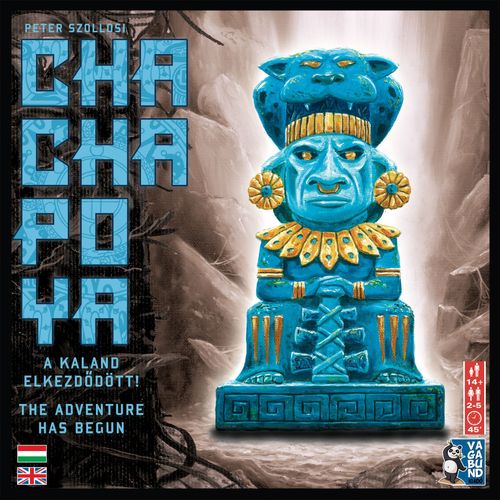
Chachapoya (Second Edition)
Chachapoya (Second Edition) Rulebook
Table of Contents
Table of Contents
The Aim of the Game
Players collect treasures and idols with the help of their adventurers by bidding. They have to bluff and combine wisely to get the most valuable art treasures by the end of the game.
You have to be cautious not to be either too greedy nor too coward because these can eliminate you from the game or leave empty handed. The aim is to balance your greed and modesty which will not be easy...
Content
50 large treasure cards, 75 adventurer cards, a board for the drawing deck and discard pile, 70 coins, 25 bonus tokens, 1 rule booklet
Settings
| Number of players | Number of treasure cards |
|---|---|
| 2 players | 35 cards |
| 3 players | 40 cards |
| 4 players | 45 cards |
| 5 players | 50 cards |
- Shuffle the large treasure cards (objective cards) and adventurer cards (bidding cards) separately to form a treasure and an adventurer deck respectively. Depending on the number of players discard random cards from the treasure deck according to the table to the left and put them back into the box without looking at them.
- These cards are not used in this game.
- Put the coins together in a pile where everyone can reach them. This is the bank.
- Then give one of each bonus tokens to every player, 3 coins and deal them eight cards from the adventurer deck face down. Players take these cards into their hands without showing them to their opponents.
- Put the remaining adventurer cards on the board within easy reach of everyone.
- Whoever visited a museum most recently will be the starting player. If it cannot be clearly decided, the youngest player starts the game.
Gameplay
- The starting player always starts a round by drawing three treasure cards, laying them on the table face up so that every player could clearly see them.
- After this the starting player takes all three cards, chooses one of them secretly and puts it back face down to the bottom of the deck of the treasure cards. The other two cards are offered for bidding, one of the cards put face down and the other one face up, so the rest of the players only know one of the three treasures for sure.
- Bids can be made for these two treasures.
(Illustration: 3 randomly drawn treasure cards; put the first treasure card under the deck; the second treasure card face down and the third treasure card face up next to the deck.)
Bidding
- From the starting player and proceeding clockwise each player must choose adventurer cards from their hands which they wish to offer for bidding and they put them face down in front of themselves. Note: each player must play one card at least.
- Players are allowed to raise their bids with one, two or three coins by placing them on top of their played card(s). The bids are raised depending on the number of coins played as in one coin equals one more point, two coins equal two more points and the same applies to having chosen to use three coins.
- After each player placed their bids, cards must be turned face up simultaneously and then the result of the bidding is determined. Values of the bidding cards of each player must be added up including the used coins on the cards (one point/coins) and the winner of the bidding is the one with the adventurer or adventurer team of the highest value or highest score (except for some special occasions, see their descriptions below).
- The value of a given adventurer card can be seen on both the top left and top right corner of the card, and under these you can also see the maximum number which can be played of the same card for a single bidding.
Example for playing (valid) adventurer cards: two number 11 cards and two coins (24 points); four number 9 cards (36 points, winner of the bidding); five number 7 cards (35 points); one number 31 card and one coin (32 points).
- Each player can only offer one kind of adventurer for a bidding. For example, three number 9 cards (27 points), five number 7 cards (35 points) or two number 11 cards (22 points) can be legally played. When choosing cards, you also have to take into account the maximum number that can be played of the same card simultaneously (marked on both sides of the adventurer cards): for example, only two can be played of a number 17 (34 points at most), playing three or more of it is not allowed.
- In case two or more players could win a bidding (because they played cards of the same value, you must calculate the played coins), they knock out each other and the right of winning falls on the next player in line (so the player with the raised adventurer cards having second highest value in line).
- After the evaluation of the played adventurer cards the winner of bidding gets the two treasure cards: both the face down and the face up card (except some special situations, see their description later).
- The winner of bidding gets all the coins on the adventurer cards played by the players as well as the treasure cards and is given coins from the bank depending on the recently acquired treasure cards.
- Played adventurer cards must be discarded face down, forming a discard pile. Discarded adventurer cards must be put on this pile throughout the game.
Treasure cards
- The winner of the bidding lays the acquired treasure cards face up in front of themselves, slightly shifted on each other so that their amount could be seen.
- At the upper left corner of the treasure cards you can see the value of a single card while the scale at the bottom of the card from left to right shows the different points you can get based on the number of acquired cards of each type.
- The black ✗ means that if you acquire that amount of a type of treasure, you immediately lose and get eliminated from the game.
- Any possible special feature of a card can be seen above this scale, just like the total amount of that specific card in the deck.
(Card anatomy: value of the card; special features; total number of the card in the deck; number of acquired cards; scores for acquired cards.)
Example: A yellow idol (TEZCALOTE) is worth 5 points, while getting two of them brings you 10 points, however, if you accidentally get three of them, you get 0 points. In case you would acquire four or five of them (an unlucky bidding can bring you two of the same cards as well), then you automatically get eliminated from the game.
Checking
- After acquiring treasures, you always have to check if the winner of the bidding is still in play.
If the player got too many cards of a specific card (✗), they immediately get eliminated from the game. They have to put the adventurer cards from their hands to the adventurer discard pile and every treasure card they have must be put into the box of the game, these will permanently be out of the game.
Note: Experience shows that players get eliminated from the game usually only in the last round of the game.
Three Cards Rule
- If checking and evaluating the bidding is finished, each player that is still in play gets to draw one card from the adventurer deck.
The number of adventurer cards in hand is not limited, but at the end of every round each player must have at least three of them. In case a player still does not have at least three adventurer cards after drawing this one, they have to draw cards from the adventurer deck until they filled up the cards in their hands to three.
When the draw pile runs out of cards, shuffle the discard pile to form a new draw pile.
When There Is a Tie...
- In that rare case when nobody wins a bidding, played adventurer cards must be put on the discard pile of the adventurer cards and the treasure cards must be put into the box without looking, meanwhile the coins offered for bidding are placed into the bank.
Players would still get one adventurer card each at the end of the round, and they also have to fill their hands up to three cards.
New Round Begins
- After each player drew one card, the round ends and another one begins.
- The player to the left of the starting player starts the new round as the new starting player by drawing three treasure cards, choosing two treasures the same way, starting a new round of bidding.
Last Round and the End of the Game
- If only two or three cards remained in the deck of the treasure cards, those cards must be offered for bidding without looking at them, face down. The starting player does not have to choose from them, and the winner of the bidding acquires all three of them at the same time. If not all of the cards would be acquired (thanks to some special cards), the game still ends and proceeds to scoring.
Scoring
- At the end of the game both collected treasure cards in front of the players and adventurer cards in their hands must be checked. Scores are calculated according to the scoring scales on the acquired cards of each player.
- The adventurer cards left in their hand and the remaining coins in front of them are not worth anything. Before scoring, the players must put the active token(s) onto their treasure card sequences while following the detailed description. You must use the active tokens which have not been played until the end of the game (including the permanently active Hidden Treasure token).
- While scoring do not forget about evaluating the bonus tokens.
- After every player summarized their acquired points, the player who collected the most points with their spoils is the winner, getting the title of the most cunning adventurer archeologist. When there is a tie the player with the most treasure cards wins. If the tie still exists the player with the most coins left is declared the winner. If it still cannot be decided, they share the victory.
Special Treasure Cards, Adventurer Cards and Exceptional Cases
Bonus Tokens
In the beginning of the game every player is given the five bonus tokens. The Hidden Treasure card has both sides active since the start, but the other bonus tokens should be activated during the game in order to use them. There are two ways to use the bonus tokens:
- Before their own round of bidding, the players can choose only one bonus token to activate by paying by coins written on the respective token.
- The player might decide to use one of the tokens by placing it back into the box and is given the reward written on the bottom right. They can use it in that round, almost immediately.
- The player can use the token in another round but in that case they cannot activate or use another token.
Note: you can acquire bonus tokens during the game.
Reward for using bonus tokens: 5, 6, 7 or 8 adventurer cards and 3 or 4 coins; to activate the tokens costs 8, 9, 10 or 11 coins.
- If a player hasn't used an activated token until the end of the game, they must use it for the scoring phase. The left activated bonus tokens must be added to the player's treasure cards which modify the score. Only one bonus token can be added to different treasure card sequences. Bonus tokens must be added to the sequence even if its consequence is a drop out.
- If a bonus token cannot be played according to the rules (example: if all bonus tokens have been added to sequences) it should be discarded. In this case the players can decide which bonus token to use and to discard.
End Game Bonuses
- Hidden Treasure: the bonus token identifies as the treasure card placed on it therefore it counts as a one plus card. The Hidden Treasure must not be placed on a Curse card. Example: the Hidden Treasure card is worth 10 points instead of 6 if it's put with 2 green idols.
- Day of Destruction: the player can discard a card chosen by themselves from a treasure card sequence where they have put their bonus tokens. Example: the Day of Destruction card placed with three blue idols brings 15 points instead of zero because they can discard a card from a chosen sequence.
- Interreption of gods: at the end of the game it counts as 5 plus points (Victory Point). It does not matter which treasure card we put it together with. Example: it does not modify the (minus) points brought by three Grim Warriors, but secures 5 plus points for the player.
- The Feast: the card brings one plus point per coins left at the end not depending on which treasure card we add the card to. Example: the player is left with 8 coins at the end of the game, which does not come with plus points, but that specific player has placed the bonus token to the treasure card sequences therefore the coins are worth 8 points at the end.
- The Balance of Life: the player counts the highest value of a treasure card sequence not depending on how many cards they have of given treasure cards at the end of the game. Example: the Balance of Life card brings 10 points instead of 3 added to 2 Gold treasure cards as that is the highest value to acquire of the Gold card.
Grim Warriors
- The card depicting native warriors is worth 0 points (in the beginning), but getting five of them can eliminate its careless owner from the game.
The exceptional advantage of this card is that as soon as a player acquires one of it via bidding, they get immediately three adventurer cards from the draw deck and put it into their hand. If a player acquires the card of the Grim Warriors in the last round of the game, they still have to draw three adventurer cards.
Curse (Azetachily) - When Fate Catches Up...
- If a player acquires the Curse card via bidding, they immediately have to discard their most valuable treasure cards acquired in the previous rounds (according to the value shown on the upper left corner of the card). This treasure card must be put back into the box of the game, it permanently gets out of the game, while the Curse card must be put in front of the player who acquired it, because this is a cursed treasure card.
- If the bidding player gets the third one of this card, they immediately get eliminated from the game.
Tracker - The Wild Calls!
Tracker cards marked with the mask sign cannot be played alone! They are treated basically as a type of joker card and can be used in only two ways:
1. Exactly one Tracker can be played with one or more adventurer cards of the same type. In this situation the Tracker is treated as one more card of that type of adventurer card.
Example: If you play the Tracker card with two number 11 cards, you must treat it as if you played three number 11 cards (22 + 11 = 33 points).
Note: You cannot exceed the number that can be played simultaneously of a certain adventurer card, even together with Tracker cards!
PLEASE NOTE! If a player wins a bidding with a combination that contains a Tracker card, they can only acquire one of the treasure cards and put it in front of themselves! The bidding winner player decides which card they would like to put into their collection. If they choose the card turned face up, the other card, turned face down must be put back to the bottom of the deck of the treasure cards without looking at it. They get one coin from the bank as they have acquired one treasure card in that round.
Exceptional case: If using a Tracker card would cause a tie between the two players playing the highest value cards, the winner cards would still eliminate each other and the next player in line to play the most valuable cards would win the bidding.
2. You can only play exactly two Tracker cards on their own simultaneously (without any adventurer card). When this happens, the player removes both treasure cards from bidding (nobody wins), and no effect of any other cards is resolved (Leader cards).
- These treasure cards must be taken out of the game (without looking at the face down card). Every adventurer card that was played this round must be put on the discard pile, and the 2 Tracker cards must be put into the box. The player playing the Tracker card can immediately draws three adventurer cards. Of course, according to the usual course of a round, after this drawing every player gets one adventurer card each, including the player who played the two Trackers, so they get four adventurer cards in this round.
PLEASE NOTE! In that rare case when two or more players play such a pair of Trackers at the same time, all of them knock each other out and the next player in line with the highest played cards is the winner of the bidding. In this case the players who played the Tracker cards cannot draw the three extra cards. The Tracker and treasure cards must be put into the box and immediately get removed from the game because these cards have knocked each other out.
Leader Cards
- There are four Leader cards in the game: the Chinese mafia, the South American dictator, Russian spy and the Gambler. These cards are stronger than almost every adventurer card combination.
- If two or more Leader cards are played in the same round, only that one is resolved which was played later according to turn order, every other Leader card that was played earlier loses its special feature and must be put on the discard pile.
Attention! In case a pair of Trackers is also played in the same round when Leader cards are played, the Leader cards lose their special feature and the effect of the native Trackers will be resolved immediately (so the treasures offered for bidding and Tracker cards must be put back into the box).
Note: players can use their coins for bidding for that will be taken by the declared winner of it according to the rules. Coins can be put onto Leader cards as well.
Chinese Mafia - The Dangerous Triad
The Chinese mafia can quickly and effectively act thanks to its extensive relationships, and gets away with both treasure cards and 2 coins from the bank.
If it is the only Leader card played in a round, or played last during the round so it can be resolved, the player who played the Chinese mafia acquires both treasure cards.
Dictator - Under the Spell of Power
The Dictator with his almost unlimited power and influence simply has higher value than the rest of the adventurer cards. It can be defeated, but if it wins a bidding, it can only take one of the treasure cards which can be chosen by the player who played the South American Dictator. If the player chooses the card turned face up, the other, face down card must be put back to the bottom of the treasure cards without looking at it.
They get one coin from the bank since the Dictator has only acquired one card.
Russian Spy - Female Ingenuity
The tricky Russian lady spy turns the order, and supporting the weak, she will make a winner of the player who offered the lowest bid. (The Russian spy can never win a bidding, only influence the result of the bidding — not even in case of a player using coins).
If two or more players tie with the lowest bid, the player with the second lowest bid is the winner of the bidding.
The Gambler - All-In!
The fearless Gambler loves to risk and is ready to fight face to face with his rivals even if he knows he cannot win everything...
If it is the only Leader card played in a round, or played last during the round so it can be resolved, the player who played the Gambler acquires a coin from the bank and the treasure card faced down. The face up card must be put back to the bottom of the treasure cards' pile without looking at it.
If the Gambler wins the last round of bidding he gets all the cards as all cards are offered for bidding face down in the last round.
Tricky Play of Leader Cards
Example: Lucy played two number 7 adventurers this round, Betty played the lady spy and John played a number 31. Since in this case the effect of the Russian spy is resolved first, to John's surprise, Lucy wins the bidding round, who offered the lowest bid of the round and acquired both of the treasure cards. Every dog has his days — as I always say.
2 Player Variant
In case of 2 players use the rules described above with the following exception: in a round when both players play Leader cards, none of them wins. Since these Leader cards neutralize each other, they must be put on the discard pile, however, the treasure cards must be put back into the box and the players start another round of bidding.
Of course, before starting a new round, just like at the end of any valid bidding round, they get to draw adventurer cards at the end of this round as well.
Example for Scoring
Pete gets 15 points for the blue idols because of the bonus token (chosen cards from the sequence can be discarded). For the purple KUMA treasure cards the player gets 9 points instead of -3 as a consequence of a used bonus token as they count the highest value of a treasure card sequence. It does not matter how many treasure cards they have collected. Pete scores 24 points at the end of the game.