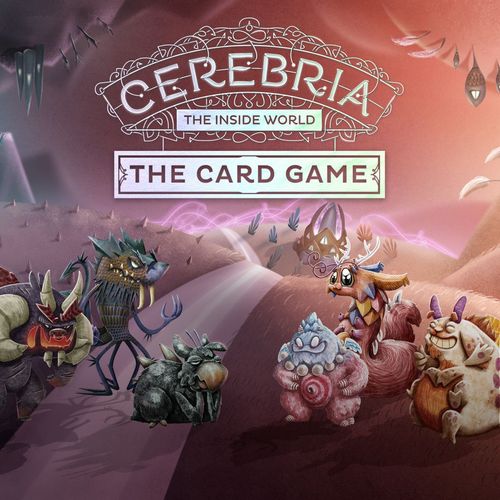
Cerebria: The Card Game
Cerebria: The Card Game Rulebook
Table of Contents
Table of Contents
Game Components
48 Bliss Emotion Cards
- 16 Mild Bliss Emotion Cards
- 16 Strong Bliss Emotion Cards
- 16 Brightness Cards
48 Gloom Emotion Cards
-
16 Mild Gloom Emotion Cards
-
16 Strong Gloom Emotion Cards
-
16 Bleakness Cards
-
5 Quick Reference Cards
-
40 Bliss Identity Fragments
-
40 Gloom Identity Fragments
-
1 Mood Marker Coin
Terminology
- Bliss Emotions — Emotion Cards with bright red frame
- Gloom Emotions — Emotion Cards with dark blue frame
- Vibe — The suite of an Emotion (Red Vibes, Yellow Vibes, Green Vibes, Blue Vibes)
- Mindset — Up to 4 Emotion Cards in the player's play area in front of the players
- Impulse Stack — The 3 stacks of face down Emotion cards
- Impulse — The 3 face up cards below the Impulse Stacks, available for the Impulse Action
- Cycle — Playing phase of the game, when players take their turns
- Identity Fragment — Used to keep track of players' score and Emotion Ability uses
- Revelation — Scoring phase of the game, end of a Cycle
Setup and Starting the Game
- Shuffle the 96 Emotion cards.
- Create 3 piles of random face down Emotion Cards and shift them so that each card is visible.
- Each pile should consist of a number of cards equal to the player count plus two. These are the Impulse stacks.
- Place one Emotion Card face up below each Impulse stack. These 3 face up Emotion cards below the Impulse stacks are referred to as the Impulse.
- Deal a starting hand of 4 Emotion Cards to each player. Player hands are kept secret from other players during the game unless a card effect instructs otherwise. Players may take a mulligan once by discarding their entire hand and drawing 4 new cards from the main deck before the first turn starts.
- Place the remaining deck above the Impulse stacks face down. This is the main deck.
- Leave some empty space next to the main deck for the discard pile created during gameplay.
- Determine the starting face of the Mood Marker with a coin flip and place it on the other side of the main deck. The Mood Marker determines the affiliation of the bonus Identity Fragments earned during a Revelation (see Revelation — Scoring).
- Place the Identity Fragments within easy reach of all players.
- Randomly choose a starting player. Players take their turns clockwise.
The game can now begin.
A Player's Turn
On your turn, you take exactly 2 Actions and may use any number of Emotion Abilities. Using an Emotion Ability is not considered as an Action. Emotion Abilities can be used any time during a turn, but each type of Ability (see Types of Emotion Abilities) can be used only once per turn.
Your turn ends when you performed your 2 Actions and used all the Emotion Abilities you wanted to.
Actions
There are two types of Actions you can take: the Impulse Action and the Invoke Action. On your turn, you may perform them in any order, or one of them twice (a total of 2 Actions).
1. Impulse Action: Choose 1 Emotion Card from the 3 face up cards in the Impulse, and add it to your hand.
Immediately after the Impulse Action, replace the taken card with the topmost card of the Impulse Stack above it and turn it face up.
NOTE: If there aren't any Emotion Cards left in the Impulse Stack to replace the taken card, a Revelation triggers (see Revelation).
NOTE: You may hold any number of Emotion Cards until a Revelation (see Preparing for the next Cycle).
2. Invoke Action: Place 1 Emotion Card from your hand into your Mindset (your play area in front of you).
There are three types of Emotions:
- Mild Emotion — has an Ability with 1 Fragment slot
- Strong Emotion — has an Ability with 2 Fragment slots
- Bleakness and Brightness — doesn't have an Ability, but has 2 Absorb slots
When an Emotion Card enters your Mindset (typically with the Invoke Action) it also receives Identity Fragment(s) on their Fragment slot(s) from the general supply, based on their affiliation:
- Bliss Fragment for the Bliss Emotions, and Gloom Fragment for the Gloom Emotions.
- Mild Emotions receive 1 Fragment.
- Strong Emotions receive 2 Fragments.
Bleakness and Brightness Emotions don't receive any Identity Fragments upon entering the Mindset.
Each player's Mindset is limited to 4 cards. You may discard one card from your Mindset to the discard pile immediately before a new Emotion enters the Mindset. If you use the Invoke Action or the Summon Ability when there are 4 Emotions in your Mindset, you have to discard one of your Emotions from there to make room for the new one.
Emotion Abilities
Using Emotion Abilities: Strong and Mild Emotions have Abilities that can be used as long as they are in the Mindset. To use an Emotion's Ability, spend 1 Identity Fragment from one of its Fragment slots. When a Fragment is spent, the Ability is used instantly. If there aren't any Fragments on an Emotion, you cannot use its Ability.
Emotion Abilities can be used any time during your turn. Using an Emotion Ability does not count as an Action. Any number of Emotion Abilities can be used during your turn, but each type of Ability (see Types of Emotion Abilities) can be used only once per turn.
IMPORTANT: When an Emotion enters your Mindset, its Ability cannot be used during the current turn. You may only use Abilities of Emotions that have been in your Mindset at the start of your turn.
Brightness and Bleakness: Contrary to the Strong and the Mild Emotions, Brightness and Bleakness don't have Emotion Abilities. However, they can absorb Identity Fragments spent from other Emotions' Fragment slots that are in the same Mindset: instead of placing the Fragment spent from your Emotion back into the general supply, you may place it on an empty Absorb slot on a Brightness/Bleakness Emotion that is in your Mindset. Brightness can absorb only Bliss Fragments (red) and Bleakness can absorb only Gloom Fragments (blue).
If there are no empty Absorb slots on a Brightness/Bleakness, that Emotion is unable to absorb any more Fragments. Fragments absorbed by Brightness and Bleakness cannot be spent to use Abilities, but they will be scored during a Revelation.
Merging Emotions: if a Strong or Mild Emotion is about to enter the Mindset with the Invoke Action or the Summon Ability (see below), you may decide to merge it with a Brightness or Bleakness in your hand, respectively. In this case, place the Brightness or Bleakness in your Mindset and place the other Emotion to partially cover it, leaving only the Absorb slots of the Brightness or Bleakness uncovered. From then on, the two cards together are considered a single Emotion in any situation.
IMPORTANT: Merging is not an Action in itself — it is an optional part of the Invoke Action or the Summon Ability.
After a merged Emotion enters the Mindset, its Ability can be used right away (as opposed to being available only next turn as normal). You may spend the Fragment from the Emotion's Fragment slot onto the merged Brightness/Bleakness' Absorb slot, avoiding the loss of the Fragment. However, this Fragment can not be spent again to continue using the Ability.
IMPORTANT: Merged Brightness/Bleakness Emotions can only absorb Fragments from the Emotions they were merged with, while non-merged ones can absorb from any other Emotion in the Mindset with the same affiliation.
IMPORTANT: A merged Brightness/Bleakness no longer has a Vibe, so it does not count towards the Vibe bonus (see Revelation — Scoring).
Types of Emotion Abilities
- Destroy: Discard an Emotion from any player's Mindset. Return its Fragment(s) to the general supply.
- Drain: Take Fragments from an Emotion's Fragment and/or Absorb slot(s) in any player's Mindset and place them onto the empty Fragment and/or Absorb slot(s) of one Emotion in your Mindset. Bliss Fragments (red) can be placed on Bliss Emotions and Gloom Fragments (blue) can be placed on Gloom Emotions this way. If there are more Fragments on the drained Emotion than empty slots on the host Emotion, the excess Fragments (of the opponent's choice) stay on the drained Emotion.
- Deprive: Discard any face up Emotion Card from the Impulse, and replace it from the respective Impulse Stack, if able. You must do this twice.
NOTE: If the discarded card cannot be replaced, Deprive triggers a Revelation (see Revelation).
- Summon: Place an Emotion Card into your Mindset and fill up its Fragment slots with Fragments of the same affiliation from the general supply. You can merge Emotions with Brightness/Bleakness when placing them with this Ability.
NOTE: This Ability is essentially the same as an Invoke Action, but does not count as an Action.
- Steal: Choose an opponent and look into their hand. You may choose and move 1 Emotion from their hand into your hand.
- Swap: Choose an Emotion in any player's Mindset and swap it with one of your own Emotions in your Mindset. The Fragments, if any, stay on the swapped Emotions. You may also swap the Emotion that provided the Swap Ability.
- Draw: Draw 2 face down Emotions from the main deck.
- Embrace: Take any one Emotion from the Impulse and put it into your hand. Replace the taken Emotion from the respective Impulse stack, if possible.
NOTE: This Ability is essentially the same as an Impulse Action, but does not count as an Action. If the discarded card cannot be replaced, Embrace triggers a Revelation (see Revelation).
Canceling Ability Effects
After you spent the Identity Fragment to use an Emotion Ability, but before you resolve the Ability, other players, in a clockwise order starting from your left, may counter-act to prevent the effect. To do this, they have to discard an Emotion from their hand and the Vibe on the discarded Emotion has to match the Vibe of the Emotion performing the Ability.
Revelation
Players take their turns one after another as long as the Cycle lasts. The Cycle ends when the Revelation is triggered and a scoring is resolved.
A Revelation triggers when an Emotion Card leaves the Impulse and there aren't any Emotion Cards left in the respective Impulse Stack to replace it. The Revelation is resolved immediately and ends the current player's turn, even if they had unused Action(s).
Scoring
When a Revelation is triggered, all players collect all Identity Fragments from their Emotions' Fragment and Absorb slots. Scored Fragments are collected in each player's own scoring area (next to their Mindset).
Check the Vibes of the Emotions in each Mindset and see if their combination matches any of the scoring Vibe Combinations. Players may earn additional bonus Identity Fragments if their Vibes make a scoring Vibe Combination.
Vibe Combinations with examples
- 3 different — 1 bonus Fragment
- 3 of a kind — 2 bonus Fragments
- 2 pairs — 2 bonus Fragments
- 4 different — 3 bonus Fragments
- 4 of a kind — 4 bonus Fragments
The affiliation of the Fragments earned as bonus is decided by the Mood Marker Coin's face up side.
Finally, each player counts every Fragment currently in their scoring area (from current and any previous Revelations) and check if one or more player has collected enough to meet any of the winning conditions (see Winning the game). If no player met any of the winning conditions, a new Cycle begins (see Preparing for the next Cycle).
Preparing for the Next Cycle
After the scoring is resolved and if the game didn't end, a new Cycle begins. Before that, players must prepare as follows:
- Discard the remaining Impulse and refill it from the main deck. If the main deck ever runs out, reshuffle the discard pile and make it the new main deck.
- Refill each Impulse Stack to their original quantity (player number + 2) from the main deck, without discarding the remaining Emotions in the Impulse Stacks.
- Discard all Mindsets.
- If a player has more than 4 Emotions in their hand, keep 4 cards and discard the others.
- If a player has less than 4 Emotions in their hand, they draw from the main deck to have hand of 4 Emotion Cards.
- Toss the Mood Marker Coin. The face up side determines the affiliation of the Identity Fragments earned as Vibe bonus for the upcoming Cycle.
Winning the Game
After each scoring, count all the Identity Fragments in each player's scoring area. If a player's set of Identity Fragments meets any of the winning conditions, that player wins.
Winning Conditions
- Single-minded (Bliss) — Have at least 12 Bliss Identity Fragments.
- Single-minded (Gloom) — Have at least 12 Gloom Identity Fragments.
- Balanced — Have at least 7 Bliss and 7 Gloom Identity Fragments.
If more than one player meets any of the winning conditions after a Revelation, the player that met any of the Single-minded conditions wins.
In case of a tie, the player with the most Identity Fragments in their possession wins.
If still tied, the player who scored the most in the final Revelation wins.
If still tied, victory is shared between the tied players.