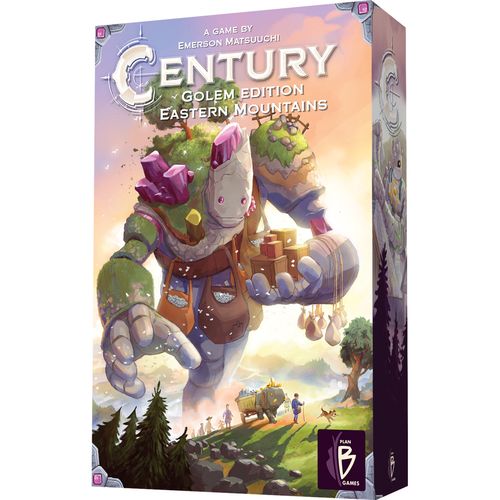
Century: Golem Edition – Eastern Mountains
Century: Golem Edition – Eastern Mountains Rulebook
Table of Contents
Table of Contents
Game Setup
To set up a game of Century Golem Eastern Mountains, follow these steps in order:
- Sort all the mountain tiles by trade symbol and randomly remove 1 tile of each symbol. Then shuffle the remaining mountain tiles. If it is your first game, build the map according to the pattern shown in the rulebook. If not, you may refer yourself to the "Create your own maps" section to learn how to make unique, customized maps!
- Place the 4 village tiles at each corner of the map.
- Shuffle the Victory Point (VP) tiles without the Closed Village tile to form a pile, face down. Draw and place one face up VP tile on each village. Then, shuffle the Closed Village tile, face down, among the first 5 VP tiles of the pile. Finally, put these 6 tiles back on top of the pile. Put that pile on the table, next to the map.
- Sort all bonus tiles by type and place them on the table. Form a pile with the 6 VP, 5 VP, 4 VP and 3 VP bonus tiles by sorting them in ascending order so the 6 VP tile is on top.
- Distribute a player board to every player with the Eastern Mountains side face up. The first player is the one who reached the top of a mountain the most recently. That player takes the player board showing the First Player Icon on it.
- Each player then takes a wagon and all 20 outposts of the matching color. Each player places an outpost on each space of their player board.
- Place the starting crystals in the middle of the table. In reverse turn order, each player will select their starting crystals, put them in their caravan and place their wagon on any mountain tile. Once all players have selected their starting crystals, return any remaining crystals to the supply.
Taking a Turn
Century Golem Eastern Mountains is played over a series of rounds. Each player will take one turn each round (starting with the first player and going clockwise).
On a player's turn, they may move their wagon and then perform an action.
Move
You may move your wagon to an adjacent tile for free. Then, you may continue moving by placing a single crystal (of your choice) from your caravan onto each tile you leave. You may continue moving this way as long as you have crystals available in your caravan.
When you end your movement on a mountain tile where one or more other wagons are present, you must pay each of their owner 1 crystal from your caravan. However, you cannot end your movement on a mountain tile where other wagons are present if you don't have enough crystals to pay all concerned players.
If there are crystals on the tile where you have ended your movement on, you may place them in your caravan. If there are both wagons from other players and crystals on the mountain tile you end your movement on, you must pay the concerned players crystals from your caravan first, before picking up the crystals.
After moving your wagon (or choosing not to move), you may perform one of the following actions:
- a Trade action on a mountain tile.
- a Village action on a village tile.
- a Mine action on any tile.
If the tile is a Closed Village tile, the village is considered closed – meaning that VP tiles won't be placed on that village while it is present. From now on, if a VP tile is claimed in another village, first move the Closed Village tile to that village and then place a VP tile on the village that previously held the Closed Village tile.
Trade
If your wagon is on a mountain tile, you first have the option to build an outpost on that tile. You may build one of your outposts on a mountain tile if you don't already have one of yours on it. Each mountain tile can have an outpost of each player. The cost to place an outpost is 1 crystal for each outpost currently on that mountain tile (2 crystals for each outpost in a 2-player game). This means that building the first outpost on a mountain tile costs no crystals. When building an outpost, pay the cost by returning crystals of your choice from your caravan to the supply, then take the leftmost outpost from your player board from the row that matches the trade symbol and place it on that tile. Lastly, after placing an outpost, if you just emptied a vertical column, immediately choose one bonus tile from the supply and place it next to your player board.
Once you have an outpost on a mountain, you may perform the Trade action by trading the crystals listed above the arrow for those below the arrow from the supply. During a Trade action, a trade can be performed any number of times in a row as long as you have the appropriate crystals available.
Example: Chris has 9 yellow crystals and performs a Trade action that allows him to trade 3 yellow crystals for 1 magenta crystal. Chris may trade 3, 6 or 9 yellow crystals for 1, 2 or 3 magenta crystals respectively.
Village
If your wagon is on a village, you may claim the VP tile available at that village by returning the crystals shown on the VP tile from your caravan to the supply. Take the VP tile and place it face down next to your player board. Then, draw the next VP tile from the pile and place it face up on that village.
Mine
Take 2 yellow crystals from the supply and add them to your caravan.
Caravan Limit
At the end of any turn, if you have more crystals in your caravan than spaces available, you must discard crystals of your choice until you reach your limit. Your caravan limit starts at 10.
Note: To perform an upgrade, return a single crystal from your caravan to the supply and take one of the next level in exchange.
Bonus Tiles
- During movement, move to an additional adjacent tile for free. Worth VP at the end of the game.
- May upgrade 1 crystal 1 level immediately after you build an outpost. It is also worth 2 VP at the end of the game.
- Gain 1 additional green crystal when you perform the Harvest action. It is also worth 1 VP at the end of the game.
- Your caravan has 3 more spaces available for crystals.
Game End
The game's end is triggered once a player claims their 4th VP tile. The game will end after the current round of play. At that point, players count all the points from their VP tiles, uncovered values from spaces on their player board, bonus VP tiles, and remaining crystals in their caravan (each non-yellow crystal being worth 1 point).
The player with the most Victory Points wins. If there is a tie, the last concerned player to take a turn wins the tie.
Create Your Own Maps
After their first game of Century Golem Eastern Mountains, players may create their own unique maps. When placing each tile, it is recommended to place it adjacent to at least 2 other tiles if possible.