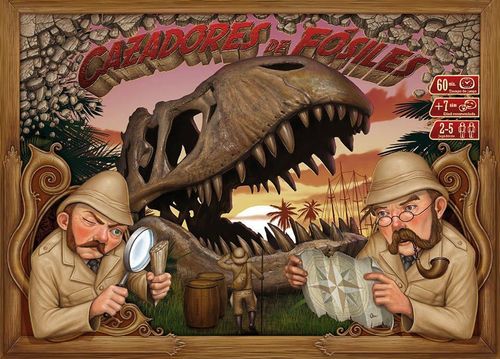
Cazadores de Fosiles
Cazadores de Fosiles Rulebook
Table of Contents
Table of Contents
1. Contents
- 1 game board
- 5 individual boards
- 5 Ships
- 5 Museums
- 5 Scoring markers
- 5 Provisions markers
- 210 fossil dinosaur tiles
- 60 pieces of green color
- 45 pieces of blue color
- 36 pieces of red color
- 36 pieces of magenta color
- 33 pieces of yellow color
- 25 Mission cards and 1 bonus card
The game board
The fossils sites, replenishment points, ports and navigation routes through which ships can be moved are marked on the game board. The triangles are the replenishment points. The squares are the fossils sites. Navigation routes connect the ports. Around the game board is the points track.
All the circles near to the coast are ports, at some of them are replenishing points, at others fossils sites and the rest are free.
The individual boards
The individual board of each player represents the cargo areas of his ship and allows to control the cargo capacities to do not exceed the limits. The ships have a limit of 20 for provisions and a limit of 24 for fossils. Each board has a provisions counter and a fossils cargo area.
The fossil dinosaur tiles
The dinosaurs are classified by colors in 5 groups and there are 4 dinosaurs in each group. Also there are 3 copies of each dinosaur.
- The green tiles correspond to the big herbivores: there are 20 different tiles.
- The blue tiles correspond to the marines: there are 15 different tiles.
- The red tiles correspond to the carnivores: there are 12 different tiles.
- The magenta tiles correspond to the armored herbivores: there are 12 different tiles.
- The yellow tiles correspond to the flying: there are 11 different tiles.
The sum of one copy of each dinosaur is 70 tiles and as there are 3 copies of each dinosaur the total are 210 tiles.
Each tile has printed the name of the dinosaur to which it belongs and the part number. Example; for a 3 pieces dinosaur the tiles have printed 1/3, 2/3 and 3/3 respectively.
The mission cards
The mission cards deck is formed by the following cards:
- 5 mission cards with 4 dinosaurs of different group. Points value: 25
- 10 mission cards with 3 dinosaurs of different group. Points value: 15
- 10 mission cards with 2 dinosaurs of different group. Points value: 8
None mission is repeated as they are all the possible combinations.
2. Goal of the game
The goal is to score the highest quantity of points. The points can be obtained through the following methods:
- Completing fossil dinosaurs
- Missions delivery
- Fossil tiles trade at museums
On section 4 "playing the game" is explained in detail how to obtain the points with this 3 methods. At the end of the game the players lose the points of uncompleted missions.
3. Preparation
-
The game board is placed at the center of the table.
-
The fossil tiles are placed on the game board (seeking to do not block the visibility of the ports and navigation routes) under the following indications:
- For 2 players; the tiles of the following dinosaurs are not used: Tyrannosaurus, Diplodocus, Quetzalcoatlus, Stegosaurus and Kronosaurus. And 2 complete copies of all the other dinosaurs are used; this is a total of 90 tiles. The tiles of each color are shuffled separately and are placed face down in piles (on the fossils sites marked with the corresponding color on the game board) under the following quantities:
- Big herbivores: 3 piles of 6 tiles and 2 piles of 5 tiles.
- Marines: 4 piles of 5 tiles.
- Carnivores: 2 piles of 5 tiles and 1 pile of 4 tiles.
- Armored herbivores: 2 piles of 5 tiles and 1 pile of 6 tiles.
- Flying: 3 piles of 4 tiles.
- For 3 players; 2 complete copies of all the dinosaurs are used; this is a total of 140 tiles. The tiles of each color are shuffled separately and are placed face down in piles (on the fossils sites marked with the corresponding color on the game board) under the following quantities:
- Big herbivores: 5 piles of 8 tiles.
- Marines: 2 piles of 8 tiles and 2 piles of 7 tiles.
- Carnivores: 3 piles of 8 tiles.
- Armored herbivores: 3 piles of 8 tiles.
- Flying: 1 pile of 8 tiles and 2 piles of 7 tiles.
- For 4 players; the tiles of the following dinosaurs are not used: Archaeopteryx, Ichthyosaur, Corythosaurus, Centrosaurus and Dilophosaurus. And 3 complete copies of all the other dinosaurs are used; this is a total of 180 tiles. The tiles of each color are shuffled separately and are placed face down in piles (on the fossils sites marked with the corresponding color on the game board) under the following quantities:
- For 2 players; the tiles of the following dinosaurs are not used: Tyrannosaurus, Diplodocus, Quetzalcoatlus, Stegosaurus and Kronosaurus. And 2 complete copies of all the other dinosaurs are used; this is a total of 90 tiles. The tiles of each color are shuffled separately and are placed face down in piles (on the fossils sites marked with the corresponding color on the game board) under the following quantities:
4. Playing the game
The youngest player starts and continues clockwise. During his turn each player can perform all the actions that he wishes while he has enough provisions to do it (as mentioned before at the beginning of the game each player has 8 provisions) each player must move his provisions marker each time that he performs an action, according to the cost of the action.
The actions that a player can perform during his turn are:
-
Ship movement: the cost is of one provision per each space traveled. At the same turn various ships can be at the same port.
-
Fossil tiles digging: once that a ship arrives to a fossils site, the player can dig with a cost of one provision per each fossil tile. The maximum quantity of tiles that a player can dig at one fossils site is equal to the number of players, for example if it is a 3 players game then the maximum will be 3 tiles. However the player can also dig at another fossils site during the same turn (when having enough provisions).
Each time a player dig a fossil tile he must place it immediately face up at his individual board at the fossils cargo area.
If a player has filled the fossils cargo area at his individual board then he will be not allowed to continue digging until he makes room, in order to do this he must go to discharge at his museum.
Each time that a player completes a fossil dinosaur he obtain immediately the points corresponding to the number of tiles that form the dinosaur, represented on the following table:
Tiles Points 1 1 2 3 3 5 4 8 5 12
The end of the turn is when a player returns to a replenishing point, where he will receive 8 provisions.
Note: the players must always calculate their provisions in order to be able to return to a replenishing point. Example: if a player is at 3 spaces from the nearest replenishing point and he is only 3 provisions left, then he will not be able to perform any other action as when arriving to the replenishing point his provisions marker will be at zero.
Note: if at the end of the turn when increasing his provisions by 8 a player reach more than 20 provisions, then the surplus is lost as the limit is 20.
5. Game end
The game ends when the fossil tiles expire. At the moment that a player digs the last tile available on the game board, the game ends immediately and no player is allowed to perform more actions.
At the end of the game the players review how many dinosaurs completed each player at his museum including the ones delivered in missions and the ones at the ship, in order to see who receives the bonus card, the player with the biggest set of completed fossil dinosaurs receives the bonus card. All tied players score the 10 points bonus.
The points of uncompleted missions are discounted to each player.
The winner is the player with most points at the end of all of these calculations.