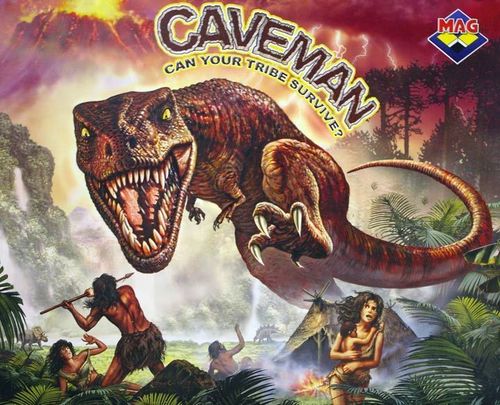
Caveman
Caveman Rulebook
Table of Contents
Table of Contents
Winning the Game
Each player has a different coloured set of game pieces made up of 4 men, 4 women, 4 children and 5 evolutionary developments, which must be developed or obtained. There are 3 ways to win:
- By getting all 8 adult pieces.
- By getting the 5 evolutionary development tokens (fire, furs, camp, spear and wheel).
- By being the player with the most adult pieces and evolutionary developments when the card deck runs out.
Setting Up Volcano Island
- Choose one of the 6 colours and sit as close as possible to the area of the board in that colour.
- The board is made up of many circles forming a hexagon. Each player starts the game from the circle with the beach nearest to the section of the board in your colour, which is located at one of the corners of the hexagon. During play you will move your pieces from circle to circle.
- Take the 12 pieces of your colour (4 men, 4 women and 4 children) and stack them near the board.
- Take the 5 evolutionary development tokens of your colour and place them next to the above. Do not place them on the board unless you obtain them.
- Shuffle the card deck and place it in the centre of the board.
- Shuffle the resource tokens and place 15 face down on the grey circles. Set the remaining 7 aside, to one side of the board.
- The youngest player takes 3 dinosaurs (T-Rex, Triceratops and Stegosaurus) and places them on the red circles near the volcano.
- Turn over the resource tokens.
- You are now ready to play.
How to Play
Move the pieces on the board. You play the game by moving your pieces from circle to circle across the island, gathering resources, "creating" children and avoiding dinosaurs, in short developing and making your tribe grow.
Each game is different depending on where the resources are on the island. For example, you may have piles of wood nearby but no flint. During your turn you may use your movement to help your tribe grow and/or to prevent the growth of a rival tribe.
Keeping Adults in Play
You may look for or obtain adults on the beach whenever you have fewer than 4 pieces (including children) in play. This means you can only get half of the 8 adults you would need to win the game.
You gain adults by "creating" children (of course you need a couple to form a family) and making them survive until they are adults.
Getting Evolutionary Developments
Evolutionary developments help your tribe in different ways. Some help children survive (fire and furs), others help movement (wheel), fighting (spear) or hiding safely (camps).
You get evolutionary developments by having two adults on different resource circles. For example, one adult on a wood resource and another on a flint resource will let you obtain fire. Resources are in different places in each game and may even change during the same game, so sometimes they will be easier to get than others.
Using Dinosaurs to Hinder Rival Tribes
You will be able to move dinosaurs in the same way as your pieces. If you move a "wandering" dinosaur to a circle with an enemy tribe, it will attack. A T-Rex can eat up to 3 members of a tribe in one sitting, if you are lucky. Use them to stop other tribes getting ahead.
Using Your Own Pieces to Hinder Other Tribes
You can occupy important resources so as to complicate the search for other tribes. You can even attack other tribes to take away their resources or reduce their numbers.
Reference Cards
The rest of the rules describe in detail how to carry out each step/turn. The reference cards look like this:
(The reference card is printed as artwork in the source PDF. Its text is transcribed in the sections below.)
How to Use the Reference Cards
On one side the 5 phases are described, with a detailed description of the steps and rules to follow during play: everything you must do in your turn. They are carried out in strict order and are colour-coded. On the other side you will find: the resources needed to claim each evolutionary development, the requirements to "create" a child, and the meanings of the dice symbols and their effects in fights and/or survival.
The Card Deck
Look at the reference card, then draw a card from the deck. There are two types of game card:
- Standard card (x30): gives the movement assigned to your pieces (tribe), as well as the set movement for a dinosaur.
- Special card (x30): shows the movement assigned to your pieces, as well as the special effect or characteristic that applies in the corresponding phase (as a rule, the red one).
Turn Sequence
Every turn, take a card and follow this sequence: 1. Green actions, 2. Red actions, 3. Fights, 4. Develop, 5. Grow tribe.
1. Green Actions
- Move your adults as far as the card allows (the number next to the tribe symbol).
- Count 1 each time you move an adult from one circle to another, or place one on the beach circle (if you do not have all 4 pieces within the island).
- Add one extra movement if you have the wheel.
- Children move freely with an adult (at no movement cost). They die if they are left alone.
- Pieces stop moving when they enter a circle with a dinosaur or another tribe.
- Only your own pieces may enter your beach or camp circle.
- Maximum 3 adults and 1 child per circle.
2. Red Actions
- If a dinosaur symbol is revealed, move that dinosaur to the point shown or marked, or follow the instructions of any special card.
- A dinosaur ends its movement when it enters a circle with a tribe.
- A dinosaur may never enter a circle with another dinosaur, nor a beach or camp circle.
3. Fights
- A fight occurs when a tribe enters a circle with a dinosaur or another tribe.
- The fight is resolved by rolling the red and green dice and comparing their results.
- Tribes roll 1 green die per adult in that circle.
- Dinosaurs roll red dice as follows: 1 Stegosaurus, 2 Triceratops and 3 red dice for the T-Rex.
- The winner is the player who gets more successes than the opponent.
- If a dinosaur loses the fight, it dies. The winner places it back on any red circle.
- If a tribe loses, as many adults die as the difference between the dice results. The player who started the fight moves the losing tribe to one of the adjacent circles.
- In case of a tie, the attacker is withdrawn to an adjacent circle.
- Children left alone die and are removed from the island.
4. Develop
- You may claim a development by getting two adults on two different suitable resources (on different circles).
- Any adult used now cannot "claim" children in this same turn.
- You may claim only 1 evolutionary development per turn.
- Some cards prevent you from developing.
5. Grow Tribe
- Players with children in play decide whether those children grow up to be adults.
- Roll the yellow survival die and compare the result with the symbols. Children who die are removed from the island.
- You may add children to couples if you also have a hunter or gatherer (see the reverse of the card).
- You cannot use adults that claimed an evolutionary development earlier in the same turn.
Reverse of the Reference Card
Evolutionary Developments
Two resources are needed for each development, on different circles:
- Flint + Flint = Spear. The spear symbol gives success in fights.
- Flint + Wood = Fire. Better survival for children.
- Animals + Animals = Furs. Better survival for children.
- Wood + Wood = Wheel. One extra movement every turn.
- Caves + Wood = Camp. You cannot be attacked in a cave.
Fight Dice
- Green dice (tribe): the tribe face is always a hit. The spear face is a hit only if you possess the spear.
- Red dice (dinosaurs): the dinosaur face is always a hit.
- All blank sides are a miss.
Survival Dice (yellow, for children)
- Becomes adult.
- Fails to survive (the child dies).
- Becomes adult if you have furs; otherwise dies.
- Becomes adult if you have fire; otherwise dies.
Growing the Tribe
- Food provider: a hunter (man on animal) or a gatherer (woman on fruit).
- Couple: a man and a woman on the same circle.
- Couple + food provider = a new child.