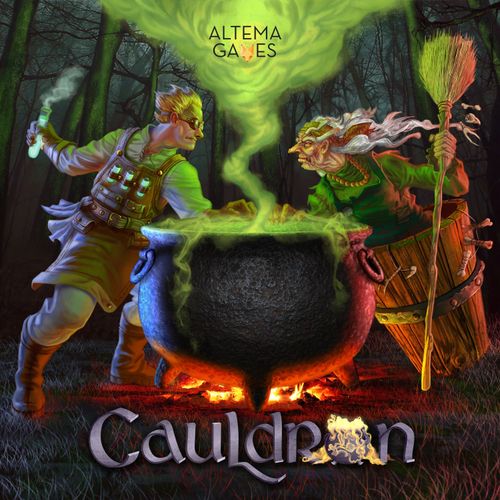
Cauldron
Cauldron Rulebook
Table of Contents
Table of Contents
Components
- Omen cards
- Basic Potion cards
- Advanced Potion cards
- Basic Spell cards
- Advanced Spell cards
- Cellar cards
- Fields
- Ingredient tokens
- Character cards
- Character tokens
- Magik Track
- "Used" tokens
Before You Begin
Before your first game, spend a few minutes removing the labels from the sticker sheet and attaching them to the wooden bases of the Character tokens. For characters you can use either the wooden or the cardboard tokens: in the rules the term "Character token" refers to whichever version you choose.
Setup
Step 1 - Select a Character
Each player chooses a character and takes the corresponding Token and Character card. The unique abilities of each character are described on the cards. Some abilities can be used once per season, while others are available as often as you like, provided you can satisfy any listed requirements. The use of abilities is covered in the Harvest Season (page 6).
The abilities of each character give a unique flavor to the game experience. Will you use your talent to gather the fruits of nature as the Druid, or would you rather sneakily steal your opponents' supplies as the Trickster? It is up to you to choose the style of play that suits you best.
Step 2 - Prepare the Magik Track
Put your Character tokens on the space marked "Start" on the Magik Track. Everyone begins with a fragment of knowledge, so "Start" is worth 2 Magik. When your Magik changes, move your tokens forward and backward along the Magik Track. The most common way to increase your Magik is to brew Potions.
The Magik symbol is used on cards and on the Magik Track to indicate Magik.
Step 3 - Lay Out the Starting Fields
It is time to lay out the Fields in which the Ingredients will grow. Take the Starting Fields: a number of Spider Web Fields, Frog Legs Fields and Poisonous Mushroom Fields equal to the number of players plus 1. So, in a four-player game, take five Spider Web Fields, five Frog Legs Fields and five Poisonous Mushroom Fields.
To create the starting board, place any two of these Fields next to each other on the table, then place the rest of the Starting Fields randomly around them, making sure each new one is adjacent to at least two Fields already placed. As you play, the board will grow with the addition of other Fields.
(Example of Field setup for a three-player game: four Fields of each type are used.)
a. Take the Fields not yet placed and separate them by type, then stack them near the Starting Fields. Do the same with all the Ingredient tokens. These Ingredients form the game supply.
Step 4 - Shuffle and Deal the Cards
Separate the cards by type into five decks, one for each of:
- Omen
- Basic Potion
- Advanced Potion
- Basic Spell
- Advanced Spell
Remove the six Basic Potions (Easy) from the Basic Potion deck and set them aside. Then shuffle each deck separately and place it face down near the Starting Fields, so that it is easily reachable by all players. Keep the pile of Cellar cards within reach.
Before starting the game, each player receives:
a. One Basic Potion (Easy)
- These come from the six Potions that were set aside. Discard any extra cards, as they will not be used in the game.
- Once the game has begun, Basic Potions (Easy) are equivalent to Basic Potions for all purposes and mechanics.
b. One additional Basic Potion from the Basic Potion deck.
c. Two Basic Spells.
Spells are always kept secret, while Potions are always visible to all players.
How to Play
Once setup is complete and you have focused, it is time to begin. Cauldron proceeds by alternating seasons - Harvest Season and Market Season - and talent is essential in both if you hope to become Grand Infuser. The game begins with the Harvest Season.
Harvest Season
Aspiring potion brewers venture into the fields to gather ingredients, carry them to their cauldrons and transform them into potions, increasing their power. As you try to outdo your opponents, you may accidentally gather exactly the ingredient they desperately need, cast a spell to bring them bad luck, or simply steal one of their precious possessions.
Phase 1 - Draw an Omen Card
Every Harvest Season opens with a new Omen. Draw an Omen card, read it aloud and do everything it says. Omens introduce either a one-time effect that is carried out at the start of the Harvest Season or a continuous effect that applies throughout the Harvest Season.
Omens and Spells sometimes refer to the LSP or the HSP. LSP stands for Lowest Scoring Player and HSP for Highest Scoring Player. For more details see page 13.
Phase 2 - Fill the Board
Put on each Field of the board a corresponding Ingredient token from the game supply. So put a Spider Web token on each Spider Web Field, and so on. Some Omen cards may affect this phase, reducing or increasing the number of ingredients certain Fields produce.
Ingredients: Blood Crystal, Mandrake Root, Spider Web, Snake Skin, Dragon Egg, Frog Legs, Poisonous Mushroom.
Phase 3 - Determine Turn Order
All players roll a six-sided die and the one with the highest number begins. In case of a tie, only the tied players roll again. Play order proceeds clockwise starting from the first player.
Phase 4 - Perform Actions and Quick Actions
Now it is time to make toil and trouble bubble. During the Harvest Season, players take their turns until every Ingredient has been gathered from the board. So each player will have several turns during each Harvest Season. In each of your turns during the Harvest Season, one Action and any number of Quick Actions are allowed.
Actions
You must perform one (and only one) of the following Actions, provided you are able to:
- Gather: Take an available Ingredient token from a Field of the board and add it to your pool, placing it next to your Character card and visible to the other players.
- Steal: Try to steal an Ingredient token from another player's pool. To steal, roll a six-sided die. If the result is 4 or higher, you steal successfully and add the Ingredient token to your pool. If the result is 3 or lower, your Action produces nothing, you have been caught and must offer embarrassed apologies as to why you were snooping around.
- Unless otherwise specified, you cannot steal an Ingredient token stored in a Cellar.
- Brew: Combine Ingredients to brew a Potion. Each Potion card you own lists the Ingredients needed to brew it. Once brewed, remove those Ingredient tokens from your pool and return them to the game supply. The Magik yield of the Potion increases your Magik by the number shown and your Character token advances on the Magik Track accordingly.
Your chosen character may have its own way to gather, steal or brew that replaces the way the Action is normally performed. Follow the instructions on your Character card. For example, the ability "Little Helpers" of the Witch replaces the regular Gather Action, allowing her to gather not one but two available ingredients on the board.
If you use an ability that is available only once per season, place a "Used" token on it to mark it as spent.
Potion card layout: Card Type icon, Potion Name (e.g. Potion of Piercing Sight), Required Ingredients, Magik Yield, Special Rules. A symbol on a card means that, when you brew the Potion, this ingredient requirement can be satisfied by discarding any Ingredient token.
Remember that if you gather on your turn the last Ingredient you need to brew a non-Quick Potion, you cannot brew it in the same turn (since gathering an Ingredient and brewing a Potion are two distinct Actions).
You do not have to discard a Potion card after brewing it: you can brew the same Potion again later in the game.
- Brewing a Potion marked "Quick" is a Quick Action. Quick Actions are described below.
- Brewing a Potion marked "Spell" immediately grants you a free Basic Spell.
- You can cast that Spell during the current turn, since casting Spells is a Quick Action.
Quick Actions
You may perform as many of the following Quick Actions as you like, either before or after the non-Quick Action of your turn:
- Brew a Quick Potion: During your turn, you can brew a Quick Potion by combining ingredients, just as you would with any Potion. Once brewed, remove those Ingredient tokens from your pool and return them to the game supply. The Magik yield of the Potion increases your Magik by the number shown and your Character token advances on the Magik Track accordingly.
- Cast a Spell: During your turn, you can cast any number of Spells from your hand. Once cast, follow the instructions on the card, then discard it.
- A Spell marked "Instant" can be played at any moment, even during any other player's turn. These disruptive Spells are made to interfere with the Actions of your fellow potion brewers. If an Instant Spell interrupts another player's action, resolve the Spell's effect first, then (if still possible) continue resolving the action that triggered it. Casting Spells against someone this way is a sure way to thwart their plans.
- Move Ingredients: You can move ingredients between your pool and your Cellars as a Quick Action, but only on your turn.
About Spells
- You can hold a maximum of three Spells, in any combination of Basic and Advanced. If at the end of your turn you have more than three Spells, you must discard down to three.
- The Spell Fizzle cancels the effect of the last Spell played.
- Casting Magik Dome cancels the effect of the last Spell played and prevents any further Spell casting for the rest of the season. It is immune to cancellation.
- Spells can only be cast during the Harvest Season.
An Example of Gathering and Brewing
- Luca wants to brew an Oil of Earthquakes. He has three Spider Webs from previous turns and now gathers a Dragon Egg, the last ingredient needed.
- Since the Oil of Earthquakes is a Quick Potion, Luca brews it in the same turn in which he gathered the last Ingredient. He gains the resulting 6 Magik and moves his Character token six spaces along the Magik Track, then returns the used Ingredients to the game supply.
- Had it been a normal Potion instead of a Quick Potion, Luca would have had to wait until the next turn to brew it, thus exposing his Ingredients to potential theft by the other players.
Play continues clockwise until the last Ingredient on the board is gathered.
Phase 5 - Close the Harvest Season
As soon as the last Ingredients are gathered, the Harvest Season ends. No other Action can be performed in this season, with one exception. The player who gathered the last Ingredient may choose to perform as many Quick Actions as they wish, including brewing a Quick Potion.
- At the end of each Harvest Season, ALL INGREDIENTS IN THE PLAYERS' POOLS SPOIL AND MUST BE RETURNED to the game supply. Any Ingredient token stored in a Cellar may be kept.
- At this point remove all "Used" tokens from your Character cards, since these abilities become available again for the next Harvest Season.
Cellars are explained in detail below.
Market Season
Once the frenetic activity of the Harvest Season dies down, potion brewers have a moment to rest and think about their future strategies. They can perform mysterious rituals and use the Magik they have acquired to obtain new arcane knowledge or create new fields or cellars.
Phase 1 - Continue in Turn Order
At the start of the new Market Season, continue in turn order. The player immediately to the left of the player who gathered the last Ingredient in the Harvest Season goes first.
Phase 2 - Make Purchases
It is time to assemble your stock of spells and your mystical inventory for the ongoing struggle. Each player may make one purchase, spending their hard-earned Magik. You can buy Cellars, Potions, Spells or additional Fields. The cost of a purchase is subtracted immediately from your Magik total, moving your Character token back on the Magik Track.
Succeeding in Cauldron depends on shopping, but invest your Magik wisely. Learning when and what to buy is often what distinguishes the powerful from the weak.
Some characters may have discounts on certain purchases: check your Character card and make sure to take advantage of them!
Fields. Cost = 3. You may choose to buy and add to the board any one of the seven types of Fields. The new Field must be placed adjacent to at least two existing Fields. If all Fields of a certain type are already on the board, Fields of that type can no longer be bought.
The player who buys a new Field immediately receives a corresponding Ingredient token, to be used in the next Harvest Season. At the start of the next Harvest Season, a new Ingredient token is still placed on the newly bought Field and all players have the same chance to gather it. Nobody "owns" a particular Field, even if they bought it.
Basic Spells. Cost = 1. Draw the top card of the Basic Spell deck and add it to your hand.
Advanced Spells. Cost = 3. Draw the top card of the Advanced Spell deck and add it to your hand. Advanced Spells can be bought only after "Rituals of Power" has been triggered on the Magik Track.
You can hold a maximum of three Spells, in any combination of Basic and Advanced. If you currently have three Spells, you must discard one of your choice before buying a new one.
Basic Potions. Cost = x, equal to the number of Basic Potions you own. So, if you already have 2 Basic Potions and are considering buying a third, the cost of this third Basic Potion is 2. Draw the top card of the Basic Potion deck and place it face up near your existing Potions.
Advanced Potions. Cost = x, equal to the number of Potions of any kind you own, + 2. So, if you already have 2 Potions and are considering buying an additional Advanced Potion, the cost of this Potion is 4. Advanced Potions can be bought only after "Rituals of Power" has been triggered on the Magik Track. Draw the top card of the Advanced Potion deck and place it face up near your existing Potions.
The cost of new Potions can be reduced by discarding some of those you currently have. You may discard any number of potions for this purpose. Discarding potions this way gives no benefit other than reducing the cost of buying new ones. Use this strategy sparingly, otherwise you risk limiting your brewing options.
Cellars. Cost = 3 for a player's first Cellar, 4 for the second. Unless otherwise specified, you can own a maximum of two Cellars.
Take a Cellar card from the game supply and place it next to your Character card. At any given time each Cellar can hold a single Ingredient token. During the Harvest Season, on your turn you can move Ingredient tokens in and out of Cellars as a Quick Action. At any other time Ingredient tokens cannot be moved in or out of Cellars. Cellars help you in two ways:
- Any Ingredient token stored in a Cellar does not spoil at the end of a Harvest Season and is therefore available in the following season.
- Unless otherwise specified, Ingredient tokens stored in Cellars cannot be stolen.
Phase 3 - Close the Market Season
Unlike the Harvest Season, you may choose to do nothing during the Market Season. Once all players, in their turn, have made a purchase or passed, the next Harvest Season begins.
Winning the Game
Victory, with all its glory, goes to the first player to reach 35 Magik. You must brew a Potion to win the game: Spells and Omens can only take you up to 34 Magik.
After reaching 35 Magik, you are crowned Grand Infuser and all lesser alchemists will tremble in your presence for ever and ever. Enjoy your new title and power, because you have surely earned it.
Magik Track
Wonders abound on the road to greatness and a variety of mysterious effects are triggered by the first player to reach certain points. Follow the instructions written on the Magik Track, keeping in mind that each of these effects occurs only once. A "Used" token is placed as a reminder on the effect just triggered. Subsequently passing these points produces no additional effect.
(The effect texts on the track itself, such as "Magik Overflow", "Rituals of Power" - which unlocks Advanced Potions and Advanced Spells for purchase, with every player getting a bonus - and "The Breaking", are printed in English on the board art; they are not legible enough in the source to transcribe in full. Consult the board.)
In addition, there are two Magik Zones that exert their power on all players within them. Pay particular attention to them during play:
- Enthusiasm: Players with 10 Magik or less gain one extra point of Magik when they brew Basic Potions, including Basic Potions (Easy).
- Advanced Alchemy: Players with 25 or more Magik can no longer brew Potions that require only two Ingredients. In addition, they no longer receive an Ingredient token when buying a new Field.
You can only reach 35 and win by brewing a potion.
What Are LSP and HSP?
Some cards refer to the LSP or the HSP. LSP indicates the Lowest Scoring Player. If there is a tie for the fewest Magik, all those tied roll dice. The player with the lowest roll is considered the LSP.
HSP indicates the Highest Scoring Player. If there is a tie for the most Magik, all those tied roll dice. The player with the highest roll is considered the HSP.
Alternative Rules to Consider
Simple Game
For a simpler, less complicated game, do not use Spells. Remove the Spell cards and ignore any Omen that refers to Spells, drawing a new Omen card in its place. Magik Track effects that refer to Spells are ignored. Do not use the Wizard character.
Quick Game
This variant skips the initial part of the game, emulating a mid-game starting point. During setup put the Character tokens on 15 instead of 2 on the Magik Track. In addition to the cards described on page 5, each player also receives one Advanced Potion, one Advanced Spell and one Cellar. Add to the Starting Fields one each of the following Fields: Blood Crystal, Snake Skin, Dragon Egg and Mandrake Root. This variant removes some of the strategy and personal choices made early in the game, but reduces the length of the game to about 45 minutes.
Advanced Game
For a game with more strategy and interaction between players, allow up to 2 purchases during the Market Season, instead of 1. This will extend the length of the game to about 2 hours.
Less Luck
For players who are familiar with the game and prefer less luck and more strategy, make the following changes. Instead of rolling dice for turn order at the start of each Harvest Season, the player with the lowest score goes first. Discard all Omens that refer to turn order rolls, drawing new ones in their place. When buying a new Spell or Potion, each time draw two cards: choose one and discard the other.
Rules That Are Often Overlooked
- Brewing a normal Potion (not a Quick Potion) requires an Action (a complete turn during the Harvest Season).
- You cannot brew any Potion that requires only two Ingredients after reaching 25 Magik. As a reminder, turn these Potions upside down. A strategy that works is getting rid of them toward the end of the game.
- At the end of the Harvest Season all Ingredient tokens not stored in a Cellar spoil and must be removed.
- You can hold at most three Spells. If you have more than three at the end of your turn, you must discard down to three.
- When you buy a new Field, you receive the Ingredient token of the corresponding type. The Field still produces an Ingredient token at the start of the Harvest Season. The bonus Ingredient token is a one-time effect and players with 25 or more Magik no longer receive bonus Ingredients.
Good luck, and may the greatest infuser win!
Be Creative!
Blank cards are included in the game: use them to create Omens and Spells with unique, custom effects. Make sure your group knows them before using them in a game.
Quick Reference
Harvest Season
- Phase 1 - Draw an Omen Card and do everything it says.
- Phase 2 - Place the Ingredients. On each Field, put a corresponding Ingredient token (unless an Omen card affects it).
- Phase 3 - Determine Turn Order by rolling a die. Play then proceeds clockwise.
- Phase 4 - Perform Actions and Quick Actions. Each player's turn during the Harvest Season allows one Action (Gather, Brew or Steal) and any number of Quick Actions. Continue until all Ingredients are gathered.
- Phase 5 - Close the Harvest Season. All Ingredients not stored in a Cellar are discarded. Players may choose to discard Spells or Potions.
Market Season
- Phase 1 - Continue in Turn Order with the player to the right of the last player to have played in the Harvest Season. (Note: the full rules on page 10 say the player to the left of the player who gathered the last Ingredient; the printed rulebook is inconsistent on this point.)
- Phase 2 - Make Purchases. Each player has the possibility of making one purchase of Cellars, Potions, Spells or additional Fields.
- Cellars: 1st Cellar - 3M, 2nd Cellar - 4M
- Field - 3M (and take the corresponding Ingredient)
- Basic Spell - 1M
- Advanced Spell - 3M
- Basic Potion - cost equal to the current number of Basic Potions
- Advanced Potion - cost equal to the current number of all Potions + 2
- Phase 3 - Close the Market Season. Once all players, in their turn, have purchased or passed, the next Harvest Season begins.
Winning the Game
The victory goes to the first player to reach 35 Magik! You can win the game only by brewing a Potion.
LSP - Lowest Scoring Player. HSP - Highest Scoring Player.