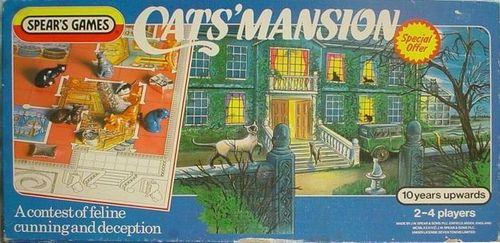
Cats' Mansion
Cats' Mansion Rulebook
Table of Contents
Table of Contents
Components
- 1 game board
- 5 cats in 5 different colours
- 4 favourite objects (food bowl, cushion, mouse, parcel)
- 50 reaction cards (Miau cards)
- 10 purr cards (Schnurr cards)
- 5 cat cards (Katzenkarten)
- 4 character cards (Charakterkarten)
Setup
The five cats are placed on the five cushions of their colour in the middle of the house. The four favourite objects are distributed at random onto the correspondingly marked spaces (one object per space).
Shuffle the cat cards well and each player secretly receives one. Do the same with the character cards. Set the remaining card aside face down.
Each player now knows his own cat and its character, i.e. its favourite object, but remains uncertain about the cats of the other players and their goals.
Finally each player secretly receives five reaction cards from the stack. The stack is shuffled well and lies face down on its space on the game board.
Playing the Game
CATS is a very original game. Unlike most other games, a player here may move ALL game pieces; the other players can influence his turn by playing reaction cards.
Example: A player moves the black cat into the kitchen during his turn. The second player does not agree, so he plays a matching Miau card and moves the black cat into the salon. This in turn does not please the third player; he wants to send the black cat into the dining room with a suitable Miau card. Now the first player plays a purr card; this keeps the black cat in the salon, and the first player's turn is over.
Turn Order
Who begins is decided by lot. Play proceeds clockwise.
Moving
Whoever is on turn may move any cat and any favourite object. However, he may move no more than four spaces in total, and only two of those may be used for the objects.
This gives each player a number of movement options. For example, he may move one cat four spaces, or four cats one space each, or one cat three spaces and one object one space, and so on.
Movement is allowed in any direction, but not diagonally and not through walls. The starting spaces are also off limits. Only one playing piece (cat or object) may stand on each space, except in the bedrooms, where several may stand. Occupied spaces may not be passed through; the sole exception is that a cat may move through a space on which an object lies.
Hissing
If a cat meets another cat, it may hiss at it. This is possible if the cat stands on a space next to another cat (not diagonally). The hissed cat must retreat one space backwards or to the side (but not diagonally).
This retreat does not count as a move and is therefore not charged against the four spaces each player may move in his turn.
A player may hiss at as many cats as he likes in one turn, but each cat only once. A cat that has been hissed at may not be moved again by that player in the same turn.
Reaction Cards
As soon as a player has finished his moves (he must have moved four spaces), he asks the other players whether the cats he has moved may stay where they are. This does not apply to hissed cats.
One of the other players may now play a Miau card and send one of the cats moved into another room. The Miau card states which cat goes to which room; the player on turn may then decide on which space of that room the cat is placed.
Any number of Miau cards may be played for one cat, including by the player on turn. However, he may not play such a card as the first one for that cat. Also, a player may not move the same cat with a Miau card twice in a row unless another player has moved it in the meantime.
Example: A player has moved the black cat during his turn. The second player plays the Miau card "Black cat – wine cellar". The first player, who is still on turn, must then place the black cat on any free space in the wine cellar, unless another player or he himself plays a purr card (Schnurr card) that cancels the effect of the Miau card and leaves the cat in its place.
As soon as a player plays a purr card, the last Miau card is void and the cat remains on its last space. No further Miau card may then be played for that cat.
All reaction cards are placed face up next to the card stack on the game board. For each card played, a new one is drawn immediately, so that players always hold five cards.
When the Miau and purr phase is over and no more cards are played, each player may discard one of his reaction cards and draw a new one. Then the next player is on turn.
Challenge
At the end of his turn, and only once in each game, a player may "challenge" one of the other players. He names which cat belongs to that other player. If he guessed wrongly, he must reveal his own cat card and thereby reveal the colour of his cat. If he guessed correctly, he may immediately play another round.
As soon as the owner of a cat has been identified, no reaction card may be played for that cat any more. It may no longer be hissed at, and it may only be moved by its owner.
Important
In each player's first turn, no cat may be hissed at, no reaction card may be played, and no challenge may be issued.
A cat cannot be hissed at through a wall. Nor can a cat be driven into or out of the bedroom by hissing.
End of the Game
The player whose cat moves onto the space where its favourite object lies wins the game. The game then ends immediately.