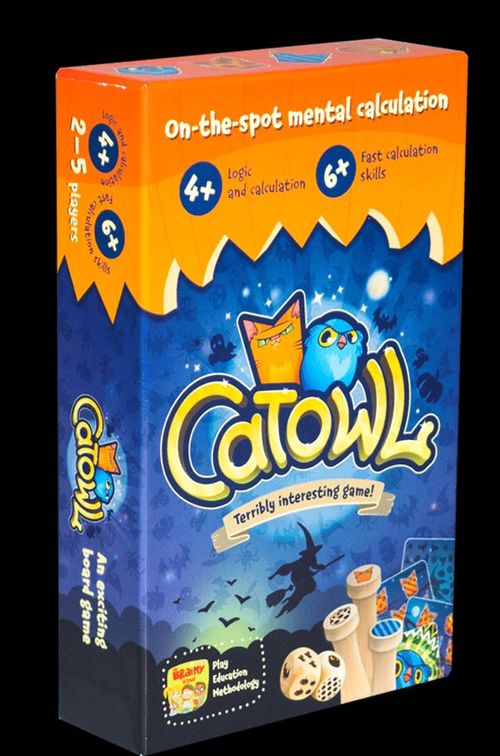
Catowl
Catowl Rulebook
Table of Contents
Table of Contents
Components
- 30 cards
- 2 dice
- 3 totems
- 1 Rules Booklet
Object of the Game
To be super alert and count cats and owls faster than anyone.
Winner. The player with the most cards wins.
Count! (4+, thinking game)
Take the magical cards (with one animal) from the stack.
Option 1. The stack of cards is on the table, back-side up. The players take turns, starting with the youngest one. The first player opens the top card and puts it in front of him. Then he rolls the dice with attributes and says the number of animals (on the card) that have such an attribute. If the answer is correct, the player keeps the card. If it is wrong, he puts the card to the bottom of the stack, and the next player takes his turn.
The game continues until all cards from the stack are taken. Player with the most cards wins.
Option 2. The rules are the same, except that the dice with numbers is used. The player has to look at the card and name the common attribute of animals whose number corresponds to the number on the dice.
Example: Look at the card at Fig. 1. If number 5 is rolled, the player has to say, "Owls!", if number 3 is rolled, he has to say, "Striped!", and if number 1 is rolled, the answer is "Orange!"
Fig. 1: a card showing blue and orange owls and cats.
Remember! (5+, thinking game)
This version of the game is also played without the magic cards.
Option 1. The stack of cards is on the table, back-side up. The players go in turns. The active player opens one card and studies it for 5-10 seconds (the rest of the players also have to be able to see the card), and then turns it back-side up. After that, the player rolls the dice with numbers. Once the dice is rolled, the player has to remember and name the common attribute of animals whose number on the card corresponds to the number on the dice.
Other players, taking turns (clockwise, starting to the left of the active player), offer their answers. The card cannot be opened until everyone names the attribute. After that, the card is opened for review. Whoever named the correct attribute first, takes the card. If nobody named the correct attribute, the card is put into the bottom of the stack. The game continues until all cards from the stack are taken. Player with the most cards wins.
Fig. 2: speech bubbles showing the answers "Blue!" (Player 1), "Striped!" (Player 2), "Cat!" (Player 3) and "Orange!" (Player 4).
Option 2. The rules are the same, but the players use the dice with attributes and have to remember the number of animals on the card with the specified attribute.
Snatch! (6+, speed game)
Now, all of the game cards are used (yahoo!) along with the totems (finally!).
Option 1. The totems are put in the middle. The stack of cards is on the table, back-side up. Players take turns.
The first player rolls the dice with numbers and opens the top card from the stack. The players' objective is to quickly determine the common attribute of the animals whose number corresponds to the number of the dice, and snatch the totem with the corresponding attribute from the table.
If a magic card (with one animal only) is opened, the players try to snatch the totem, both of whose attributes are absent from the card. For example, if a card depicts a blue spotted owl, you have to snatch the totem with an orange cat, since the card has neither the "orange," nor the "cat" attributes.
Whoever snatches the totem first, takes the card for himself. If you snatch the wrong totem, you have to return one card from your personal stack as a fine. If two players snatch the totem simultaneously, whoever holds it the lowest, gets the card.
The game continues until all cards from the stack are taken. Player with the most cards wins.
Option 2. (for true masters of the game). The rules are the same, but the card is only shown for 5-10 seconds, then it is closed again, and the dice is rolled.
Fig. 3: illustration of the Snatch! game (no caption in the source).
Fig. 4: an example card captioned "5 owls!"
Fig. 5: an example magic card captioned "Magic card!"
More educational games at www.thebrainyband.com