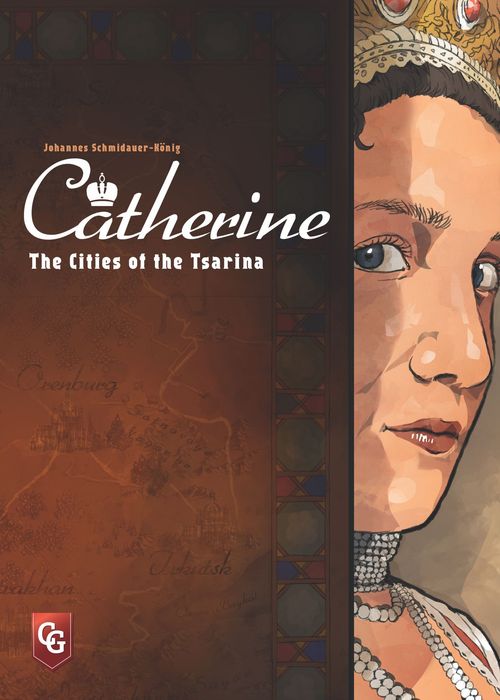
Catherine: The Cities of the Tsarina
Catherine: The Cities of the Tsarina Rulebook
Table of Contents
Table of Contents
Game Materials
- 1 gameboard
- 102 project cards
- 8 order cards
- 48 residences (12 in each of the 4 player colors)
- 4 favor markers
- 4 victory-point markers
- 4 50-/100-markers
- 6 joker tiles
- 48 goods tiles (12 in each of the four kinds: iron, food, caviar, and fur)
Before the first game, remove the 50-/100-markers, the joker tiles, and the goods tiles from the punch-out sheet.
Set-up of the Game
The illustrations in the rulebook show an example of a set-up for the game with three players.
- Put the gameboard on the table.
- Sort the goods tiles by type. Several cities on the gameboard depict a good; put as many of the respective goods tiles as there are players next to these cities. In the two- or three-player game, put the remaining goods tiles back into the box.
- Keep the joker tiles handy next to the gameboard (except for the two-player game; in this case, put them back into the box).
- Each player chooses one color and takes the corresponding 12 residences, the victory-point marker, the favor marker, and the 50-/100-marker. a. Put your victory-point marker on space "0" of the victory-point track. b. Put your favor marker on the bottom space of the favor track. c. Put your 50-/100-marker next to the gameboard.
- Shuffle the order cards; each player draws one of them. Put the order you have drawn in front of you, face up.
- Shuffle the project cards (simply called "cards" from now on) and deal 6 cards to each player. The remaining cards are put out ready as a face-down draw pile. Leave some space next to the draw pile for a discard pile.
- All players simultaneously choose 3 of their 6 cards and put the cards face up in front of them in one row. This is your action row. Leave some space below it for the activation row. Keep your other 3 cards as hand cards. The action row and the activation row together form your display.
- Put the remaining order cards, residences, favor markers, 50-/100-markers, and goods tiles back into the box; they will not be needed in this game.
Overview
Each round you play 2 cards: 1 to your "action row", and 1 to your "activation row". When you play a card to your activation row, you may 'activate' the card directly above it in the action row - but only if the two cards match in color!
Perform actions on cards in your action row to build residences, or to gain cannons, books, and other goods. Gain the most victory points to win the game!
The upper area of a card may depict goods, cannons, and/or books; or instead, 3 city names. All symbols showing on cards in your action row are considered in your possession. Ignore all symbols on cards in your activation row!
The bottom of each card shows an action. A bonus may be shown below the action (on most cards). Depending on the action, it may be triggered once or several times; however, bonuses may only be activated once. The actions and bonuses are explained in detail from p. 7 on.
Course of the Game
The game is played over 3 decades. Each decade consists of 4 rounds. At the end of each decade, an interim scoring takes place. After the third interim scoring, there is a final scoring.
Each round consists of 5 phases. Players perform phases simultaneously; there is no fixed order of play.
Phase A — Draw 2 cards
Each player draws 2 cards into their hand (from the draw pile). Ignore your hand limit during this phase. If the draw pile is ever empty, shuffle the discard pile to form a new deck.
Phase B — Play 2 cards into your display
Play any 2 cards from your hand face down: 1 card must be played to your action row, and 1 card must be played to your activation row.
This is done in the following way:
- Place 1 card from your hand face down to the right of your action row (extending the row to the right).
- Place 1 card from your hand face down in your activation row, below any card in your own action row (i.e., into the activation row) in a position where you don't have any other card yet. This doesn't have to be below the card you just connected to the action row!
Try to play a card to your activation row that matches the color of the card directly above it in the action row (but this is not mandatory).
Phase C — Reveal the cards played
Now all players simultaneously reveal the two cards they have played.
Phase D — (conditional) Perform actions
Based on the card you just played to your activation row: If the card in the action row directly above it is the same color, you may perform the action on that card in the action row. Only if you perform the action on a card at least once, you may perform the bonus once after (if there is a bonus).
Always ignore everything except color on cards in your activation row. The only purpose for cards in your activation row is to 'activate' cards in your action row to perform their actions.
You may choose to forfeit and not perform an Action; if you do, you cannot perform the bonus.
If you choose not to perform the action on the card - or you cannot, because the colors do not match - draw 1 card (from the deck).
IMPORTANT! The colors of these two cards must match in order for you to perform the action on the card in the action row. If they don't match, you must pass on the action; instead, you draw 1 card from the draw pile. You may also voluntarily skip the action in order to draw 1 card instead.
Players may perform their actions simultaneously; there is no fixed order of play.
You find more about the different effects of action cards from p. 6 on.
Phase E — Check for the end of the decade
Once there are 7 cards in each player's action row, the decade ends at the end of the current round, and an interim scoring takes place. Otherwise, another round begins with phase A.
Interim Scoring
At the end of each decade, i.e., after 4 rounds, a brief interim scoring takes place. Conduct the following steps in the order listed below:
Cannon scoring
Count the cannons on cards in your action row only (not the activation row) and compare this to the numbers your two neighbors have. For every neighbor who owns fewer cannons than you do, gain 4 victory points. In case of a tie, you and your neighbor earn 2 victory points each.
In the two-player game, these points are awarded only once.
Book scoring
Count the books on cards in your action row only (not the activation row).
First, players check who owns the most books. Each player with the most books may build a residence in any city (and possibly take a goods tile from there; see "Residences" on p. 7).
Then, players check who has the fewest books in their possession. This player (or these players) cannot gain any rewards in this phase. (If all players have the same number of books in their possession, they all may build a residence.)
All the others – those who own neither the most nor the fewest books – receive a joker tile.
Example: Monica owns 4 books; Christina and Peter own 2 books each; and Marcus owns 1 book. Monica may build a residence in a city of her choice. Christina and Peter both receive a joker tile. If Marcus had owned 2 books, he would have been tied for last place, along with Peter and Christina, and they would all have gone away empty-handed (and nobody would have received a joker tile).
At the end of the game, you can use joker tiles to replace any good for your own order (but during the game, they do not count as a good of your choice in your possession!).
Victory points for residences
Now count your residences on the gameboard and score them according number of victory points. For each residence you have in a city showing the "1" symbol, gain 1 additional victory point.
Victory points on the favor track
You score victory points depending on the position of your favor marker on the favor track. The victory points you get are shown in the middle column of the favor track.
Clear up the display
Discard all 4 cards in your activation row - and additionally the 4 cards directly above them in the action row (the cards in the action row that were 'activated'). Slide the 3 remaining cards in your action row to the left filling gaps as needed.
Draw new cards or do the final scoring
At the end of the first and the second decade scorings, draw 2 cards. For these cards, you must respect your hand limit (see p. 6): If you exceed this limit, you will not draw the respective cards but earn 1 victory point each instead.
At the end of the third interim scoring, the final scoring takes place.
After the first and the second interim scorings, you begin a new decade.
Final Scoring
After you have conducted the third interim scoring at the end of a decade, the final scoring takes place. To this end, perform the following steps.
Leftover cards in hand
For each card in hand you have left over, score 1 victory point.
Scoring for orders
Your orders depict 7 goods tiles. Now check how many of these goods tiles you own. A joker tile (that you could get through the book scorings) counts as any type of goods tile.
For 5/6/7 of the goods tiles depicted that you have in your possession, you score 5/8/12 victory points.
Keep in mind that goods on any cards do not count for scoring your orders!
Scoring for contiguous residences
Now count the largest number of contiguous residences of your color on the gameboard. Residences are considered contiguous if they are connected with one another by a road.
Multiply this number by the multiplier value (the rightmost value) determined by the position of your favor marker on the favor track, and score that many victory points.
Example: Maria has built 8 residences; one of these is not connected with the others. Her multiplier on the favor track is 3. Consequently, she scores 7 x 3 = 21 victory points.
The player who now has the most victory points wins the game!
Additional Rules
Hand limit for cards
At the beginning of the game, you have a hand limit of 3 cards. During the course of the game, you can increase your hand limit by moving your favor marker up on the favor track.
If you are about to draw cards during phase D (from an action or bonus) or thanks to bonus cards at the end of an interim scoring, but this would exceed your hand card limit, you don't draw these cards; instead, you score 1 victory point for each card you were not able to draw.
Important: The 2 cards that you draw during phase A of a round never counts against your hand limit. That means you draw these 2 cards even if this exceeds your limit (the reason being that you will have to play 2 cards right after that).
Example: Your hand card limit is 6. Currently, you have 4 cards in your hand. An action allows you to draw 3 cards. You draw 2 cards and score 1 victory point for the one card that "goes to waste."
The favor track
The favor track is important for several factors:
Depending on the position of your favor marker, you must observe your shown hand limit, the yield of victory points (that is generated only at the end of a decade), and the connection multiplier at the final scoring.
Some actions allow you to advance your favor marker on the favor track. These effects are marked with the crown symbol.
For each crown symbol, move your favor marker 1 space up.
If your favor marker is on the top space of the favor track and you were allowed to move it further, this move goes to waste; instead, you score 1 victory point for every forfeited step.
Effects of action cards
Each card is divided into 2 areas.
The upper area shows 3 cities, goods, cannons, and/or books.
Once you have played and revealed a card in your action row, all symbols depicted on this card count for you – even if they haven't been activated!
However, the symbols on cards in your activation row do not count!
The bottom area shows an action that you perform in phase D, only if you have just played a matching-color card into the activation row below it. If the card shows a bonus, you may only activate it if you performed the action at least once (and the bonus can only be activated once).
The following rule applies to all effects: If the costs consist of cards, you have to discard these cards from your hand. If they consist of goods, cannons, or books, you need only to own these; you never give them up (not even goods tiles!).
Performing a bonus is optional: If you are eligible to perform a bonus, and choose not to, you do not draw a card as compensation (as you do for forfeiting an action).
Earning victory points
Every time you earn victory points, you advance your victory-point marker the according number of spaces on the victory-point track. If your marker arrives at space "0" again, take the 50-/100-marker and put it in front of yourself with the "50" side facing up; if you manage to arrive there another time, turn it over to show its "100" side.
Overview of the Actions and Bonuses
Some actions show a black arrow. The number in the arrow determines how many times you may perform the action. If there is no number in the arrow, you may perform this action as often as you want. If an action does not show any arrow, you perform the action exactly once.
You may never use the effect of a bonus more than once. To do so, you need to have performed the action on the card and also to meet the condition shown to the left of the arrow.
Residences
Many actions enable you to build a residence.
If a card shows the residence symbol, you may take a residence from your supply and build it in a city. For this, the following rules apply:
- If not stated otherwise, you have to place the residence in one of the three cities indicated in the upper area of the card.
- You may not build a residence in a city that already contains one of your residences (however, it is irrelevant whether this city already contains residences of other players).
- In the rare case that you don't have any residences left in your supply, you may not build a residence; instead, you draw 1 new card from the pile.
After you have placed a residence in a city that has one or more goods tiles, you take one of these and put it in front of you. This good will never be "spent" – at each action, it counts for you as one good of the respective kind.
If the city where you build a residence shows a crown symbol, you immediately advance your favor marker 1 space on the favor track.
If the city where you build a residence shows a "1", you score 1 additional victory point at each interim scoring (but not immediately!).
Further actions: Next, the actions – along with their bonuses – are explained in detail.
- Markets show only an action and no bonus. You may draw 1 card for each of the two goods depicted if they are in your possession. So, if you own 3 iron and 2 food, for example, you may draw 5 cards for the market shown here. Your "possessions" consist of all goods showing in on cards in your action row only, and those on your goods tiles.
- As an action, once, discard 3 cards from your hand to score 10 victory points. As an additional bonus, if you discard 3 cards of the same color, advance your favor marker 1 space.
- As an action, score 2 victory points for each book in your possession. As a bonus, once, you may discard 1 card from your hand to advance your favor marker 1 space.
- As an action, once, discard 1 card from your hand to advance your favor marker 2 spaces. As a bonus, once, you may discard 1 additional card to advance it 1 additional space.
- As an action, draw 1 card for each book in your possession. If you own at least 3 cannons, you may, as a bonus, advance your favor marker 1 space.
- As an action, draw 2 cards. If you own at least 3 books, you may, as a bonus, advance your favor marker 2 spaces.
- For each set of 4 different goods in your possession, score 4 victory points. As a bonus, you may discard 1 card to advance your favor marker 1 space.
- As an action, discard 2 cards to build a residence in a region of the color matching the activated card – you can choose among all six cities in the color of the activated card. As a bonus, if you possess 2 or more of the shown good, you may advance your favor marker 1 space.
- As an action, score 3 victory points. As a bonus, discard 1 card to score 4 additional victory points.
- As an action, score 3 victory points. As a bonus, if you possess the shown goods, you may advance your favor marker 1 space.
Imprint
Author: Johannes Schmidauer-König Illustration and graphic design: Claus & Antje Stephan Layout and print preparation: atelier198 Editor: Markus Müller English translation: Sybille & Bruce Whitehill, "Word for Wort" Proofing: Jonathan "Frisk" Bobal
© 2022 dlp games Verlag GmbH · © 2022 Capstone Games
We thank Felix Stockhausen and all the other test-players and proofreaders for their valuable feedback!