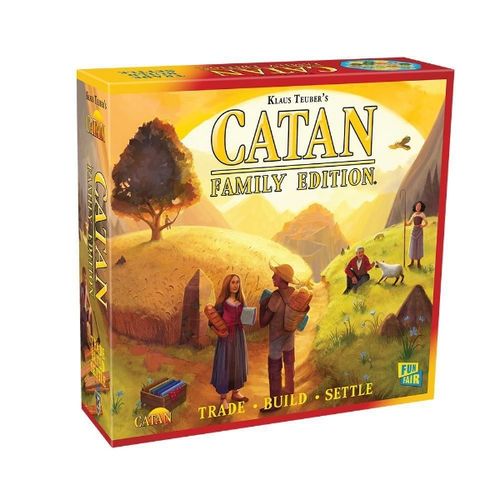
Catan: Family Edition
Catan: Family Edition Rulebook
Table of Contents
Table of Contents
Components
- 6 island tiles (each double-sided)
- 60 roads (15 of each color)
- 20 settlements (5 of each color)
- 16 cities (4 of each color)
- 4 building costs cards (1 of each color)
- 25 development cards (14 Knight, 5 victory point, 6 progress)
- 93 resource cards (brick, lumber, ore, wool, grain)
- 2 dice
- 1 robber
Constructing the Island
You play the Catan Board Game on a variable, 6-piece game board representing the island of Catan. By varying the positions of the pieces—or "island tiles"—you can vary the starting settlements and starting roads for each game.
Each island tile has a numbered "Side A" and "Side B." For your first game, lay out the island using the Side A tiles as shown here to the right in the component summary. Use the "Starting Set-Up" shown on page 2 to place your starting settlement and road pieces. This is a well-balanced set-up.
Note: The Variable Set-Up section on the back of the Overview Sheet provides guidelines for varying the set-up.
Hexes, Paths, and Intersections
An island tile consists of sea, coastline, and 2-4 land hexes, each with its own "terrain type." A path is an edge between two hexes or an edge between a hex and the outer board. An intersection is a point at which the corners of 2 or 3 hexes meet.
Important: One and only one settlement or city may be placed on an intersection. One and only one road may be placed on a path.
No two settlements or cities may occupy adjacent intersections.
Setting Up the Game
Select a color and take your building costs card, 5 settlements, 4 cities, and 15 roads.
Place 2 each of your roads and settlements on the game board as shown in the Starting Set-up above. Place your remaining settlements, roads, and cities down in front of you. Place your building costs card beside you for later reference.
Note: Remove the orange pieces from the game if you only have 3 players.
Place the robber on the desert terrain hex. Place the "Longest Road" and "Largest Army" bonus victory point cards beside the game board along with the 2 dice.
Sort the resource cards into 5 supply stacks (i.e., the bank) and put them face up next to the game board. Shuffle the development cards and place them face down in a stack by the board.
See the illustration above. You receive resource cards for each terrain hex beside your starting settlement marked with a white star:
- Blue receives 1 lumber card, 1 brick card, and 1 ore card.
- White receives 1 wool card, 1 lumber card, and 1 ore card.
- Orange receives 2 grain cards and 1 ore card.
- Red receives 2 lumber cards and 1 grain card.
Keep your resource and development cards hidden from the other players.
Turn Overview
The youngest player takes the first turn. After you've finished your turn, pass the dice to the player to your left, who then proceeds to take a turn.
On your turn, you can do the following in the order listed:
- Produce Resources — You must roll for resource production (the result applies to all players).
- Trade — You may trade resources with other players or by using maritime trade.
- Build — You may buy development cards and/or you may build roads, settlements, or cities.
You may also play 1 development card at any time during your turn.
The Turn in Detail
1. Produce Resources
Begin your turn by rolling both dice. This is your "production roll." The sum of the dice (2-12) determines which terrain hexes produce resources. Your roll can affect any player, for all hexes marked with the number rolled produce 1 resource card of the hex's type for each player who has a settlement on an intersection that borders that hex. If you have 2 or 3 settlements bordering that hex, you receive 1 resource card for each settlement. Similarly, wherever you have a city instead of a settlement bordering the hex, you receive 2 resource cards.
Example: Loren rolls a "4." Her blue city "A" borders a fields hex marked with the number "4," so she takes two grain cards. (If settlement "A" had been a settlement, she would have received one grain card.) Bridget owns the two red settlements. Her settlement "B" borders the pasture marked with the number "4," so she also receives a wool card. Her settlement "C" also borders the fields hex marked with the number "4," so Bridget also receives a grain card.
2. Trade
After resource production is resolved, you may trade freely (using either or both types of trades below) to gain needed resource cards. No one can trade development cards.
a) Domestic Trade
On your turn, you can trade resource cards with any of the other players. You can announce which resources you need and what you are willing to trade for them. The other players can also make their own proposals and counter offers—but only with you.
Important: Players may only trade with the player whose turn it is. The other players may not trade among themselves.
Example: It is Bob's turn. He needs one brick to build a road. He has 2 lumber and 3 ore. Bob asks aloud, "Who will give me 1 brick for 1 ore?" Marty answers, "If you give me 3 ore, I'll give you a brick." Nick interjects, "I'll give you 1 brick if you give me 1 lumber and 1 ore." Bob accepts Nick's offer and trades a lumber and an ore to Nick in exchange for a brick.
Note that Marty may not trade with Nick, since it is Bob's turn. Also note that Bob may continue to trade with Nick or any other player.
b) Maritime Trade
On your turn, you can also trade with the supply stacks (i.e., the bank):
- You can always trade at 4:1. Put 4 identical resource cards back in their supply stack. Then take any 1 resource card of your choice other than what you trade in.
- If you have a settlement or city on an intersection bordering a "3:1" harbor (A), you can trade at 3:1. Put 3 identical resource cards back in their supply stack. Then take any 1 resource card of your choice.
- If you have a settlement or city on an intersection that borders a "2:1" harbor (B), you can trade the specific resource shown at 2:1. Put 2 identical resource cards of the appropriate type back in their supply stack and then take any 1 resource card of your choice.
In order to control a harbor, you must build a settlement on one of the two coastal intersections that border the harbor (note the pairs of coastland extensions).
3. Build
Now you can build. Through building, you can increase your victory points, expand your road network, improve your resource production, and/or buy useful development cards.
To build, you must pay specific combinations (i.e., sets) of resource cards. Refer to your "Building Costs" card to see what you need to pay when you build something. First, return the required card combination to the supply stacks. Second, take the appropriate number of roads, settlements, and/or cities from your supply and place them on the game board.
Keep any development cards hidden in your hand.
You cannot build more pieces than what is available in your pool. So, you may only build a maximum of 5 settlements, 4 cities, and 15 roads.
a) Road Requires: Brick & Lumber
A new road must always connect to 1 of your existing roads, settlements, or cities.
Only 1 road can be built on any given path (i.e., the edge of a terrain hex).
The first player to build a continuous road (not counting forks) of at least 5 road segments (i.e., pieces) receives the special card "Longest Road." If another player succeeds in building a longer road than the one created by the current owner of the "Longest Road" card, he immediately takes the special card (and its 2 victory points).
b) Settlement Requires: Brick, Lumber, Grain, & Wool
You may only build a settlement at an intersection if all of the adjacent intersections are vacant (i.e., none are occupied by any settlements or cities—even yours). See examples of this "distance rule" in the illustrations at the bottom left of page 1 and top left of page 2.
Each of your settlements must connect to at least 1 of your own roads.
Regardless of whose turn it is, when a terrain hex produces resources, you receive 1 resource card for each settlement you have adjacent to that terrain hex.
Each settlement is worth 1 victory point.
c) City Requires: 3 Ore & 2 Grain
You may only establish a city by upgrading one of your settlements.
When you upgrade a settlement to a city, put the settlement (house) piece back in your supply and replace it with a city piece.
From now on, if your city is adjacent to a terrain hex that produces resources, you receive 2 resource cards for that city (regardless of whose turn it is).
Each city is worth 2 victory points.
d) Development Card Requires: Ore, Wool, & Grain
When you buy a development card, draw the top card from the stack. Keep your development cards hidden until you play them. Normally, you cannot play a development card during the turn you buy it. (The sole exception is a Victory Point card that provides you 10+ victory points.)
4. Special Cases
a) Rolling a "7" and Moving the Robber
If you roll a "7" as your production roll, no one receives any resources.
Instead, each player who has more than 7 resource cards must select half (rounded down) of his resource cards and return them to the bank.
Then you must "move the robber." Proceed as follows:
- You must move the robber immediately to any other terrain hex. Place the robber so that it covers up the number on the hex.
- Then you steal 1 (random) resource card from an opponent who has a settlement or city adjacent to the terrain hex now occupied by the robber. The player who the robber steals from holds all of his resource cards face down. You then take 1 resource card at random. If the robber's terrain hex is adjacent to 2 or more players' settlements or cities, you choose which one you want to steal from.
Important: If the production number of the hex containing the robber is rolled, the owners of adjacent settlements and cities do not receive resources. The robber prevents it.
Example: Larry rolls a "7" and must move the robber. He moves the robber from the hills hex and puts it on the number "3" forest hex. If a "3" is rolled during the coming turns, the owners of settlements "A" and "B" do not receive a lumber resource card. This lasts until the robber moves, either by another "7" or a Knight card. Larry may also take 1 random resource card from one of the players who own settlements "A" or "B."
b) Playing Development Cards
At any time during your turn, you may play 1 development card. That card, however, may not be a card you bought during the same turn!
There are 3 different types of development cards: Knight, progress, and victory point. Each type has a different effect.
Knight Cards (Red Frame)
If you play a Knight card, you must immediately move the robber as previously outlined on page 3 in the "rolling a 7" section. Follow steps 1 and 2.
Once played, Knight cards remain face up in front of you.
The first player to have 3 Knight cards in front of himself receives the special card "Largest Army," which is worth 2 victory points. If another player has more Knight cards in front of him than the current holder of the Largest Army card, he immediately takes the special card and its 2 victory points.
Progress Cards (Green Frame)
If you play a progress card, follow its instructions. Then remove the card from the game (i.e., put it in the box).
Victory Point Cards (Yellow Frame)
You must keep victory point cards hidden. You may only play them when you are sure that you have 10 or more victory points during your turn—that is, when you win the game. In this case, you can play them all, even if you just bought them. You can also play them at game's end if someone else wins. (These are the only exceptions to the basic rules of development card play.)
Victory Points
Silently keep track of all the victory points you earn as you play. Pay attention to other players' victory points, noting who is actually closest to victory.
Players earn victory points (VPs) as follows:
- 1 VP for each settlement
- 2 VP for each city
- 2 VPs for the Longest Road special card
- 2 VPs for the Largest Army special card
- 1 VP for each victory point development card
Since you start with 2 settlements, you begin the game with 2 victory points. So, you only need to earn 8 more victory points to win the game and become "Master of Catan"!
Ending the Game
If you have 10 or more victory points during your turn, the game ends and you are the winner!
Future Games
Now that you've played the Catan Family Edition™ board game using the "Side A" island starting set-up, you may want to flip the island tiles over and try "Side B." You might also want to switch the island tiles around and build your own variable board. If so, see the "Variable Set-Up" guidelines on the back of the "Overview Sheet."
Design: Klaus Teuber (www.klausteuber.com) Cover Art: Pat Raubo Game Art: Oliver Freudenreich Development: Benjamin Teuber, Guido Teuber, Pete Fenlon, Robert T. Carty Jr., Coleman Charlton, and Gavin Allister Art Direction & Graphics: Pete Fenlon Production: Pete Fenlon, Coleman Charlton, Ron Magin Special Thanks: Morgan Dontanville, Olivia Johnston, and the Mayfair Games team for 20 years of Catan development.
Game Overview
The game also ships with a separate "Overview Sheet" card. Its front carries this quick-start overview; its back carries the Variable Set-up guidelines, the Frequently Asked Questions, and the Hints below.
- The island of Catan lies before you. The isle consists of 19 terrain hexes surrounded by ocean. Your goal is to settle the island and expand your territory so it becomes the largest and most glorious in Catan.
- There are 5 productive terrain types and 1 desert on Catan. Each terrain type produces a different type of resource (card). The desert produces nothing. (See the 6 terrain hexes in the "Resource Production" illustration at the lower right.)
- You begin the game with 2 settlements and 2 roads. Each settlement is worth 1 victory point. You therefore start the game with 2 victory points! The first player to have 10 victory points during his/her turn wins the game.
- To gain more victory points, you must build new roads and settlements or upgrade settlements to cities. Each city is worth 2 victory points. In order to build or upgrade, you need to acquire resources.
- How do you acquire resources? It's simple. Each turn, a dice roll determines which terrain hexes (indicated by the hex numbers) produce resources. If, for example, a "3" is rolled, the two terrain hexes containing a "3" produce resources. In the illustration at the right, a mountain hex produces ore and a forest hex produces lumber.
- You only collect resources if you own a settlement or a city bordering a terrain hex producing a resource. In this example, orange's settlement (A) borders on a forest hex, and red's settlement (B) is adjacent to a fields hex. A dice roll of "9" gives the orange player 1 lumber and the red player 1 grain.
- A settlement or city usually borders on 2-3 terrain types. So, during the game, it can "produce" up to 3 different types of resources. Here, white's settlement (C) produces ore, wool, or lumber. Blue's settlement (D) can only produce grain on "4" or wool on "5" or "11."
- Since you rarely have settlements everywhere as the game starts or progresses, you may have to do without direct access to certain resources. This is tough, for building things requires specific resource combinations. For this reason, you can trade with the other players. Make them an offer! A successful trade might yield a big build! If necessary, trade with the bank, with or without help from a harbor.
- You can only build a new settlement on an unoccupied intersection if you have a road leading to that intersection and the nearest settlement is at least two intersections away.
Extra Important: Carefully consider where you build settlements. Numbers on the hexes indicate the relative frequency of dice rolls. Note the dots (pips) beneath the numbers. The greater the number of pips, the more likely it is that number will be rolled.
Resource Production
- Desert = Nothing
- Hills = Brick
- Forest = Lumber
- Pasture = Wool
- Fields = Grain
- Mountains = Ore
Variable Set-up
Constructing the Island
You can play using any island tile configuration that fits inside the outer board. However, the easiest way to vary the board is to swap the 2-hex tiles and/or a couple of the 4-hex tiles. You may use "Side A" tiles with "Side B" tiles as you like.
Placing Your Initial Settlements & Roads
Each player rolls both dice. The player who rolls highest is the starting player. The placement locations of all settlements and roads must follow the normal rules.
Round One: The starting player places a settlement on an unoccupied intersection. He places a road adjacent to this settlement. Proceeding clockwise, each other player places 1 settlement and 1 adjoining road.
Round Two: The player who went last in the first round begins round two. He places his 2nd settlement and its adjacent road. Proceeding counterclockwise, each other player places 1 settlement and 1 adjoining road.
You receive your starting resources immediately after placing your 2nd settlement. For each hex adjacent to this 2nd settlement, you take a corresponding resource card.
The starting player then takes the first regular turn.
Frequently Asked Questions
Producing Resources
What if there aren't enough resource cards to give every player all the production they earn? No one receives any of the restricted resource that turn. Other resources are not affected.
Trading
Can I give another player a card? You may not give away cards (i.e., you may not "trade" 0 cards for 1 or more cards).
What if I decide not to trade during my turn? No one can trade (until, perhaps, the next player's turn).
If it is not my turn, can I trade? You may try to trade with the player whose turn it is. You cannot perform maritime trades (see Rules, page 3).
Do I need a settlement on a harbor in order to make 4:1 trades? No.
Are there any other trading restrictions? You may not trade or give away development cards. You may not trade like resources (e.g., 2 wool for 1 wool).
Building
Can you build on intersections bordering the sea? The outer edges of the terrain hexes that border on the sea form the "coast" of the island. You can build a road along a coast. You can build settlements and upgrade settlements to cities on coastal intersections.
What happens if I have built all 5 of my settlements? Can I build another settlement? No. In this case, you must upgrade 1 of your settlements to a city before you can build another settlement.
The Robber
If I roll a "7," do I have to move the robber? Yes. You may not choose to leave the robber on the same hex.
Longest Road
If my road network branches, can I count both segments of roads when counting up the length of my longest road? No. You may only count the single longest continuous branch for purposes of the "Longest Road."
What happens if another player builds a settlement such that my "Longest Road" runs through it? Your longest road is "broken"! Your "Longest Road" can be a road segment on either side of that settlement, but it may not run through an opponent's settlement.
What happens if my "Longest Road" is broken? The player with the longest (at least 5+) road segment takes the "Longest Road" bonus card. If no one has a 5+ road segment or if several players have the same lengths of road segments, set the "Longest Road" card aside—until only 1 player has the longest road (of at least 5 road pieces).
Development Cards
How many development cards can I play during my turn? Normally, you may only play 1 development card during your turn. However, in addition, you may play any number of victory point development cards at the end of the game.
What happens when I play a progress card? Road Building: You may immediately place 2 roads on the board, for free (according to normal building rules). Year of Plenty: You may immediately take any 2 resource cards from the supply stacks. You may use these cards to build on the same turn. Monopoly: You must name 1 type of resource. All the other players must give you all of the resource cards of this type that they have in their hands. If an opponent does not have a resource card of the specified type, he does not have to give you anything.
When can I play one of my development cards? You can play your development card at any time during your turn, even before you roll the dice.
After I play a development card, what do I do with it? Keep victory point cards and Knight cards face up. Remove all other played development cards from the game. Played development cards never go back into the supply, and you cannot buy development cards if the supply is empty.
Ending the Game
What if I reach 10 points when it is not my turn? The game continues until any player (including you) has 10 points on his turn.
Can I play more than one victory point card on the turn the game ends? You may play any number of victory point cards on the turn the game ends, even those just purchased.
Hints
- Brick and lumber are the most important resources at the beginning of the game. You need both to build roads and settlements. You should try to place at least 1 of your first settlements on a good forest or hills hex.
- The more often a number is rolled, the more often each associated hex produces resources. Note the dots (pips) beneath the numbers on the tokens. The larger the number of dots, the more likely it is that number will be rolled. "6" and "8" are the most frequently rolled numbers. They each have 5 dots, for there are 5 ways to roll these numbers on the 2 dice.
- The more you trade, the better your chances of victory. Even if it is not your turn, you should consider offering trades to the current player!
- Since an intersection on the coast borders only 1 or 2 terrain hexes, a coastal settlement generally generates resources less often. Still, coastal sites often lie on harbors, which allow you to use maritime trade to trade your resources at more favorable rates.
- Do not underestimate the value of harbors. For instance, a player with settlements or cities adjacent to productive fields hexes should try to build a settlement on the "grain" harbor.
- It is extremely difficult to win the game without upgrading settlements to cities. Since you only have 5 settlements available, you can only reach 5 victory points by only building settlements.
- Leave enough room to expand when placing your first 2 settlements. Look at your opponents' sites and roads before making a placement. Beware of getting surrounded! If you plan to build toward a harbor, the middle of the island may be a tricky place for a starting settlement, for it can easily be cut off from the coast.