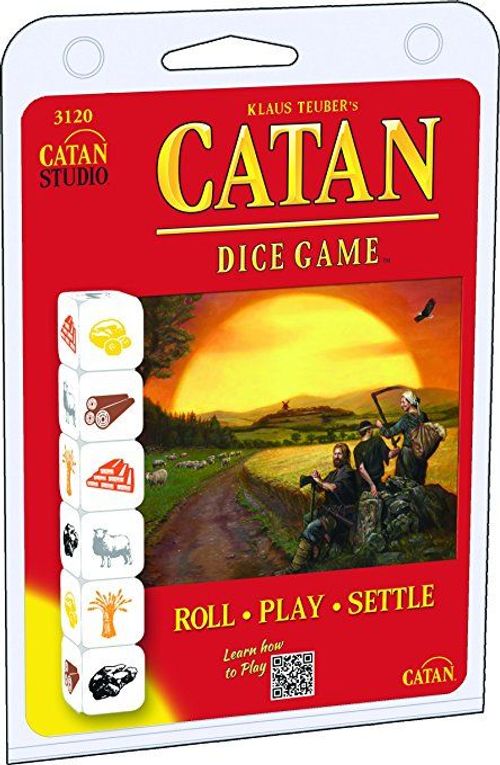
Catan Dice Game
Catan Dice Game Rulebook
Table of Contents
Table of Contents
Components
- 6 resource dice
- 1 double-sided pad
Setup
Players decide whether they want to play the normal "The Settlers of Catan – Dice Game" or the "Plus variant." Each player takes a sheet from the pad and places it in front of themselves with the side of the chosen variant face up. The 6 dice are placed within reach. Each player also needs a pen. The starting player is determined.
The rules of "The Settlers of Catan – Dice Game" are explained first, below. For these, use the "Dice Game" side of the island sheet. The rules for the "Plus variant" are found at the end of these rules. Even if you want to try the Plus variant right away, you should read the rules of the Dice Game first, since the core elements of rolling and building are identical in both variants.
What It's About
The island sheet shows the island of Catan with symbols for roads, settlements, cities, and knights. Over the course of the game, each player tries to build as many roads, settlements, cities, and knights as possible on the island on their own sheet.
Building means marking the relevant symbol, either with a circle, a cross, or by filling in its outline.
Building costs resources. Resources are rolled using 6 dice. Each die shows wool, grain, clay, ore, wood, and gold, one of each. Building a road, for example, costs 1 wood and 1 clay each. Only if a player has rolled both of these resources can they build a road.
Whoever builds something, or marks the corresponding symbol, may credit themselves with as many points as the number shown in the symbol indicates. Whoever has credited themselves with the most points in total by the end of the game wins the game.
The six resources are: wood, clay, grain, wool, ore, and gold.
Sequence of Play
The starting player begins. They roll the dice up to three times. Afterward they build with the rolled resources and credit themselves with the corresponding points. Then the next player, in clockwise order, takes their turn.
1. Rolling
Whoever is on turn may roll the dice up to three times. After the first roll, the player sets aside as many dice as they like and rolls the remaining dice again. After the second roll, they may set aside further dice, but may also pick up dice that were set aside earlier and use them for their final roll. After the third roll, the result is final. Of course, a player may also stop after the first or second roll and keep that result. From that point on, the result may only be changed by using a resource joker (see page 5) or a gold exchange (see page 6).
2. Building
The building overview shows which resources are needed to build a road, a settlement, a city, or a knight. For example, whoever builds a knight sets aside one die each of ore, wool, and grain, and marks a knight symbol on the sheet with their pen. Building a road, settlement, or city works the same way. A player is allowed to build several things, as long as the rolled resources are sufficient.
The player then enters the points of the marked symbol in the next free box of the score track. The first entry goes in the top left box of the score track. If a player was able to build several things on their turn, they add up the numbers of the marked symbols and enter the total in the next box.
Important: If a player is unable to build anything at all on their turn, they must enter a cross, which counts as 2 minus points.
Example: On their first turn, a player built a settlement and entered 3 points for it, then on their second turn built 2 roads and entered 2 points for them. They marked the symbols of the roads and the settlement with a circle in each case. On their third turn, they rolled the resources shown. They set aside wood and clay and mark the road symbol with a circle. Then they set aside one each of wool, ore, and grain and mark the knight. Knight and road are each worth one point — the player enters 2 points in the third box of their score track.
Building Rules: What May Be Built Where?
Road: A road costs 1 clay and 1 wood and is always worth 1 point. The first road (starting road) is already built and no longer costs any resources. Roads are built in sequence, so a road that is built must always border a previously built road. A settlement or city, whether already built or not, does not block further building of the road.
Settlement: A settlement costs 1 clay, 1 wood, 1 wool, and 1 grain each. A settlement can only be built if a built road borders it. It further applies that settlements must be built in the order of their points: first the settlement worth 3 points, then the settlement worth 4 points, and so on.
City: A city costs 3 ore and 2 grain. The same procedure applies as for building a settlement: a city may only be built once a built road borders it; cities, too, must be built in the order of their points.
Knight: A knight costs 1 ore, 1 wool, and 1 grain each. Knights must be built in the order of their point values. Once a player has built a knight, they may, once during the game, use the resource shown beneath that knight as a joker (see next section). It is not necessary for a road, settlement, or city to border the corresponding landscape in order for a knight to be built there.
Resource Joker
If a player has built a knight, they may, once during the game, obtain the resource shown beneath the knight by "giving up" any other resource of their choice: after rolling, the player turns any one of their dice to the side showing the resource that is depicted beneath a built (marked) knight. The resource joker symbol is then marked as used with the pen.
Example: A player has built the first knight (with the number 1: ore). After their third roll, they have 2 ore, 2 grain, 1 gold, and 1 wool in front of them. Since the player wants to build a city, they use the knight and turn the wool die to the ore side. The player can now build the city with 3 ore and 2 grain. They then cross out the ore symbol beneath the knight. Once the last knight (with the number 6) is built, the player may, by "giving up" a resource, obtain any resource of their choice. Since there are six knights, a player can use up to 6 resource jokers during the game — provided they build all the knights. It is also permitted to use two or more jokers on a single turn.
Gold Exchange
Nothing can be built directly with gold. Gold is a pure trading currency, but it can be used to obtain any other resource. This can be very helpful, but it is also costly. For every 2 gold rolled, a player may — once the roll result is final — obtain any other resource of their choice: one of the two dice showing the gold symbol is turned to a side with any resource; the other is no longer available to the player for that turn.
Example: Once again the player wants to build a city. This time they have rolled 2 ore, 2 grain, and 2 gold. Since 2 gold lets them obtain any resource, they turn one of the two gold dice to the ore side; the second die showing gold is set aside by the player. Now they have 3 ore and 2 grain and can build the city.
Since 2 gold is always needed to obtain another resource, a single rolled gold is unfortunately useless.
End of the Game
Once every player has had 15 turns, and has thereby filled in all 15 boxes of their score track, the game ends. Each player adds up their points. For every cross on the score track, 2 points must be deducted. Whoever has reached the highest score wins.
The Settlers of Catan – The Dice Game Plus (2–4 Players)
The Plus variant is played with the reverse side of the sheets, the side marked "The Dice Game – Plus." All other preparations remain unchanged. All rules for rolling and building apply, except for the changes described below.
Whereas in the normal variant of the Dice Game each player tries on their own to achieve the best possible result, in the Plus variant the players compete directly against one another.
As can be seen on the island sheet, the roads, settlements, cities, and knights do not carry point values. That is because the goal is not to have scored the most points after 15 rounds, but to be the first to reach 10 victory points. In this respect, the Plus variant is modeled on the board game "The Settlers of Catan."
Victory Points
Every settlement a player builds is worth 1 point. Every city a player builds is worth 2 points. Points earned for settlements and cities are crossed off in the 10 boxes above the island.
In addition, there is the "Largest Army" and the "Longest Trade Route." Whoever is the first to build 3 knights holds the Largest Army, which is worth 2 victory points. This is marked in the "Army" box.
A player keeps the Largest Army until another player has built more knights. If a player loses the Largest Army to another player, they must cross out the marking in the "Army" box and lose the 2 victory points again. A built knight always counts toward the Largest Army, regardless of whether its function as a resource joker was used or not.
The same applies to the Longest Trade Route: whoever is the first to build the marked (fifth) road holds the Longest Trade Route and the associated 2 victory points, and marks this in the "Longest Road" box — until another player has built more roads. Only continuous roads count toward the Longest Trade Route; branches are not counted.
Example: Only the roads marked in green count toward the length of the trade route. The road marked in red is a branch and therefore does not count. The length of the trade route is therefore 6.
Further Changes
- Whoever begins the game rolls with only 3 dice. Each subsequent player may roll with one more die, until eventually a player is on turn who — like all following players from then on — may use all 6 dice.
- Settlements, cities, and knights may be built in any order (though settlements and cities must, of course, be connected by roads).
- The two double knights in the deserts can be used as jokers. However, both knights must be built at a desert in order for the joker function (a single use) to be used.
End of the Game
A player has won as soon as they have reached 10 victory points.
Catan Dice Game "Extra"
In fall 2007, a variant of the Catan Dice Game was already presented, the Catan Dice Game "Plus." In the Catan Dice Game "Plus," each player settles their own island and scores victory points as in The Settlers of Catan board game: 1 victory point for each settlement, 2 victory points for each city, and 2 bonus points for the Longest Road and the Largest Army, respectively.
The Catan Dice Game "Extra" takes it to the next level: in this variant, the players settle an island together and compete for the best building sites and knights.
Preparation
To play the Catan Dice Game "Extra," you first print the enclosed game map. You also need the 6 dice from the Catan Dice Game – Standard Edition and 4 pens or crayons of different colors.
In addition, you need two objects to indicate which player is the current owner of the Longest Road and Largest Army, respectively. For this purpose, you can also cut out and use the two tiles depicted below the game map.
Let's Get Started!
At the beginning of the game, each player builds a road. The youngest player starts. They choose a road as their starting road and mark it in their color. The road must be a coastal road. Then the other players, in clockwise order, also choose coastal roads and mark them. Each starting road must be at least 5 roads away from the previously built roads, meaning that the starting roads must be separated by at least 5 unbuilt roads.
Once all players have chosen a starting road, the starting player begins the game. They take 3 of the 6 dice and roll according to the established Dice Game rules: they may roll the dice up to three times, after each dice roll setting aside any number of dice and rolling the remaining dice once again. After the third dice roll at the latest, their final result is determined, and the player may use the resources rolled to build.
Each subsequent player may add another die, until one player rolls all 6 dice. From then on, all players may always roll 6 dice.
Building
Road / Settlement: You may build a road or settlement if one of your own roads leads to the building site. You are not allowed to "skip" buildings: if your road borders an unbuilt settlement site, you may not build a road behind that site — you must first build the settlement. You may never build behind a foreign settlement / city.
When you build a settlement, mark the settlement symbol with your color. Please note: some settlements can be upgraded to cities. If you build a settlement of this type, you only mark the smaller "house" part of the symbol. However, if you have built a settlement that can be upgraded to a city, you may build roads adjacent to it even though the city has not been built yet.
City: You may upgrade an already built settlement to a city. If you upgrade such a settlement to a city, you also mark the larger "tower" part of the symbol with your color.
Knight: You can "build" a knight if one of your own roads / settlements / cities is on an edge or a corner of the knight's hex. When you build a knight, mark its body and head with your color.
Use of Knights: If you have built a knight, you may use it in one of the next rounds. This is done in exactly the same way as when using knights as jokers in the Catan Dice Game – Standard Edition.
Goal of the Game and Victory Points
The goal of the game is to be the first player to reach 10 victory points. Each settlement built is worth 1 victory point, each city built is worth 2 victory points.
The player who currently has the Longest Road receives 1 victory point. The player who currently has the Largest Army receives 2 victory points.
Longest Road: As soon as a player has a continuous road of at least 5 individual road pieces (branches do not count), they have the "Longest Road." Foreign settlements / cities interrupt the continuous road — own settlements / cities do not. This player receives the tile or the above-mentioned object symbolizing the Longest Road. If another player builds a longer continuous road, they receive the Longest Road.
Largest Army: The first player to build 3 knights has the "Largest Army." A knight counts toward the Largest Army, regardless of whether its function as a joker has been used. This player receives the tile or the above-mentioned object symbolizing the Largest Army. If another player builds more knights than the current owner of the Largest Army, that player receives the Largest Army.
Optional Rule: Castles: In the corners of the game map, four castles are depicted. To build a castle, you need to roll 6 symbols of the same type. All players may try to build castles. There are no prerequisites for building a castle, i.e., if you have rolled the required resources (also gold), you may mark any unbuilt castle with your color. A castle is worth 2 victory points.
Hint: without a joker it is very difficult to roll the resources required to build a castle. It is likely that in many games no castle is built at all. Castles are meant to provide players who are surrounded and can't move, or who are lagging behind, with an opportunity to turn the game around — if they get lucky.
Please note: the two joker knights in the desert are very valuable for building a castle. Should you be able to build both joker knights, it will be very easy for you to build a castle.