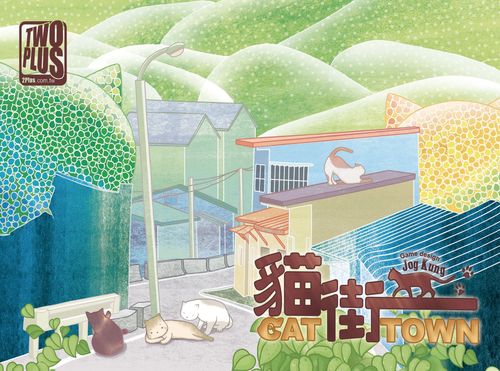
Cat Town
Cat Town Rulebook
Table of Contents
Table of Contents
Goal
Players score points in three ways: finding cats, collecting items, and playing Travel notes cards. The first player to score 6 points wins.
Game Mode
There are 3 game modes in Cat Town, each with different levels of difficulty. For beginners, "Easy mode" is recommended. After getting familiar with all card effects, players can pass to "Normal Mode" then "Advanced Mode" to add some challenge. If players want a challenging game, they may try "Advanced mode".
The main rules are written in "Normal" mode, while "Easy" and "Advanced" mode are written as variants.
Game Set-Up
Component and Set-Up
Example for 4 players set-up.
Component labels from the illustration: Help cards x4; Game cards x 100 (Cat x 10, Item x 30, Action x 60); Player tokens x 4 sets; Scene cards x 7; 5 cards face-up (Station); 5 cards face-down aside (Discard pile).
Scene cards under the card piles are only a reminder for players, there is no in-game difference among them (except for "Station"). Scene cards apart from the one representing "Station" can be removed from the game if everyone agrees.
- Dealing Cards
Shuffle all 100 game cards and deal 2 cards face-up to each player. If any player receives Cat card(s) or two Item cards in this way, he has to re-shuffle these cards to the deck and draw replacement(s) card(s) until he has two cards in his/her hand.
- Building the town
Deal game cards into a pile on each Scene card. This is called a "Block".
With 2 players, there are 4 Blocks (with 15 cards each) in the game; with 3 or 4 players, there are 6 Blocks (with 12 cards each) in the game. Arrange all Blocks in a circle.
- Station and Discard pile
Deal 5 cards face-up in the center of the town on the Station scene card. This is called "Station". Then deal 5 cards face-down next to the town, this is called "Discard pile".
Remove the remaining cards from the game. Players may agree on revealing these cards or not.
Game Set-Up (continued)
- Cats and Mice
Each player chooses a Cat and a Mouse token of the same color. The cats are used to indicate the locations where the players are. Place all Cats as in the example pictures.
The Mice are put in front of players to indicate the players' colors. Mice also indicate effects of cards, explained later.
-
In 4-player games, players are divided into two teams with teammates sitting in the opposite positons. As in the example on page 2, yellow and green player are teammates.
The team's score is the combination of both teammates' scores.
-
In a 2 or 3-player game, cats are set as pictured below.
- The player who has touched a cat most recently is the first player.
How to read a card
Action cards are green framed, Item cards are blue framed.
- Name of the card: shown on the title banner at the top of the card.
- Item card icon: indicates this card is an Item card.
- Broken item icon: applicable only for Advanced Mode.
- Bonus icon: bonus action can be executed after the effects of this card have been performed.
- Card effect: players perform what the text describes when playing this card.
Example cards shown in the rulebook: "Cat map" (Look at all cards from 1 chosen Block.) and "Sweeping the street" (Shuffle 2 Blocks together and then divide them into 2 Blocks evenly.)
Game process
On a player's turn, he must choose one of the actions below:
- Take a walk. (Draw a card)
- Take a walk. (Search a Block)
- Play a card.
- Search his own hand cards.
After performing one Search action, check if he or his team reached 6 points? If not, the next player takes his turn.
Take a walk
Player chooses to move his cat in clockwise or counter-clockwise direction, crossing a Block.
As pictured right, Orange player may choose to cross Block 1 or Block 2.
A player must announce whether he wants to Draw a card or Search a Block before he takes a walk.
When announced "Draw a card", the player draws the top card from the Block he just crossed. There is no hand limit in this game.
When announced "Search a Block", the player reveals the top card of the Block he just crossed:
-
If it is an Action card, discard it face-down to the Discard pile.
-
If it is a Cat or Item card, this player earns it, and places it face-up in front of himself.
-
If a player FORGETS to announce his choice before taking a walk, he may only choose to draw a card.
-
When a player can "take a walk" consecutively for several times due to the effect of cards, he has to announce in advance what action he chooses each time before he "takes a walk".
Play a card
Play an Item or Action card, performing what the card text describes, and then execute the bonus icon.
Playing a Cat card is legal, but it has no effect and is discarded!
After playing a card, put the card face-down on the "Discard pile". The order of cards in Discard pile cannot be changed.
When performing the effects of Item or Action cards, all cards drawn or put back must be done on "Neighboring Blocks".
Neighboring Blocks
The four nearest Blocks to a player's token are called his "Neighboring Blocks".
As pictured in the rulebook, Blocks 2, 3, 4 and 5 are Neighboring Blocks to Purple player; Blocks 1, 2, 5 and 6 are Neighboring Blocks to Yellow player.
All Blocks are Neighboring Blocks in 2 player games.
Removing a Block
During the game, cards in Blocks will be depleting.
When a Block runs out of cards, remove the empty Scene card from the game, and this "empty Block" cannot be rebuilt.
Search his own hand cards
To Search his own hand cards, the player shuffles his hand cards and randomly reveals one card from his pile of hand cards:
- If it is an Action card, Discard it face-down to the Discard pile.
- If it is a Cat or Item card, this player earns it, and places it face-up in front of himself.
Suggestion: to reveal a random hand card, you may just choose an opponent to draw one of your hand card and reveal it.
Bonus icons
- Blue paw icon with "1": After performing the effect of this card, the player has a "take a walk" bonus action. The number indicates how many times the bonus action should be executed.
- Green train icon with "2": After performing the effect of this card, the player has a "draw a card from Station" bonus action. The number indicates how many times the bonus action should be executed.
- Red icon with "1": After performing the effect of this card, the affected opponent has a "draw a card from Station" bonus. The number indicates how many times the bonus action should be executed.
When drawing cards from "Station", players must draw from the top of the pile.
Players may check the cards in "Station", but are not allowed to change the order of cards.
Whenever "Station" runs out of cards, players should flip over the "Discard pile" and replenish "Station" with the pile.
- Grey mouse icon: After performing the effect of this card, the player has a bonus action of "choose an opponent and make him hold his Mouse in hand".
A player may hold at most one Mouse at a time. This effect cannot be accumulated.
When a player holding a Mouse, he may only choose to play a card in his turn, until then can he put the Mouse back in front of him.
When a player holding a Mouse has no hand cards in his turn, he may only choose to take a walk and draw a card, but he should continue to hold the Mouse in his hand.
Scoring
Players only earn points in 3 ways:
- Searched a Cat card. (through a Block or hand card)
- Searched two Item cards of the same name. (through a Block or hand card)
- Played a "Travel notes" and paid 3 additional hand cards.
Either way above is worth 1 point.
Only a pair of Item cards of the same name is worth 1 point. Every single Searched Item card of different name is worth 0 point.
Game end
The game ends when one of the following conditions is met:
- Any one player (team) earns 6 points, he (that team) wins.
- There are only 3 Blocks left in the game, the player (team) with the highest score wins.
Tie-breakers, in order:
- If there is a tie, the player (team) who has played the highest number of "Travel notes" card wins.
- If there is still a tie, the player (team) who Searched more "Cat" cards wins.
- If there is still a tie, the player (team) who has more cards in hand(s) wins.
- If there is still a tie, players share victory.
In 4-players games, Item cards from two teammates are not counted together. Two Item cards of the same name must be owned by one single player to be worth of 1 point.
Easy mode
In this mode, players choose one of the following actions in his turn:
- Take a walk. (Draw a card)
- Play a card.
Players don't have to "Search a block or hand cards". Instead, each player may reveal from his hand any Cat card(s) or a pair of Item cards of the same name at the end of his turn, place the revealed cards in front of him, and these cards shall count as part of his score.
Other rules are applied as normal.
Advanced mode
All rules in the Normal mode apply in Advanced mode, with the following additions:
- When a player plays an Item card, he may choose not to use the effects. Instead, he places this card in front of him.
- A player may not place another Item card of the same name that is already in front of him.
- A player cannot choose "Search" action unless he has at least one Item card in front of him.
- For each type of Item card a player has, he may reveal one card during a "Search" action.
For example:
Player A has three different Item cards in front of him. ("Cat house", "Tourist ticket" and "Souvenirs")
He may ask an opponent to reveal three cards from his hand if he chooses "Search his own hand cards".
He may also reveal the top three cards of a Block if he chooses "Search a Block".
Each action of revealing a card is executed once at a time, a player may also choose to stop "Searching" before he reveals the next card from his hand or from a Block.
- If a player has two Item cards of the same name in front of him, he must set this pair of cards aside as 1 point scored. Scored Item cards won't provide "Search" action.
Do not mix up the scored Item cards with those not scored yet.
- If a player reveals any "Broken" card, he must stop "Searching" immediately, and discard this card and ALL unscored Item cards in front of him.
"Broken" cards are Action cards with the Broken Item icon.
Continuation of example
Player A has three different Item cards in front of him ("Cat house", "Tourist ticket" and "Souvenirs") and chooses to Search a Block.
First, he revealed a "Tourist ticket", so he scored this card with another Tourist ticket in front of him.
Then he chooses to reveal the next card.
The second card he revealed is "Shelter from rain" which is a "Broken" card, so he stops Searching immediately and discards "Shelter from rain", "Cat house" and "Souvenirs".
Details of card effects
Q1. How should I operate "Guiding tourists"?
A: You reverse the order of all cards in a Block, refering to the picture below. (Reversing the order of cards one by one.)
Q2. What if I can't divide 2 Blocks evenly with the effect of "Sweeping the street"?
A: It is OK to have a Block divided with one more card.
Q3. What if I don't have two hand cards when I played "Cat house"?
A: You just put the only hand card (or even no card) on one Block. No matter what, You still draw three cards from the Station.
Q4. May I put cards back to the original Block when using "Feeding"?
A: Yes.
Q5. May I choose my teammate as an "opponent" when using "Town stamp", "Teaser", "Taking a photo" or "Souvenirs"?
A: No, teammate is not your opponent.
Q6. What if all Neighboring Blocks are of fewer than 4 cards when I play "Tourist ticket" or "Picking up litters"?
A: Look at as many cards as it is possible to look at on the Block.
Q7. What if both Station and Discard pile run out of cards?
A: This is a very rare situation. If this happens, no one may draw card(s) from Station when getting a if they got bonus action.
Besides, the card(s) put into Discard pile in this situation will be put into Station immediately.
Q8. What if I'm forced to play a "Travel notes" or "Imitating Meow" because of the Mouse effect while I don't have other hand cards?
A: You may choose not to play additional card even if you have any, and "Travel notes" or "Imitating Meow" will take no effect.
Q9. In what order should the used or discarded cards be put into Discard pile?
A: It's up to the current player. He may put these cards into Discard pile in any order he likes.