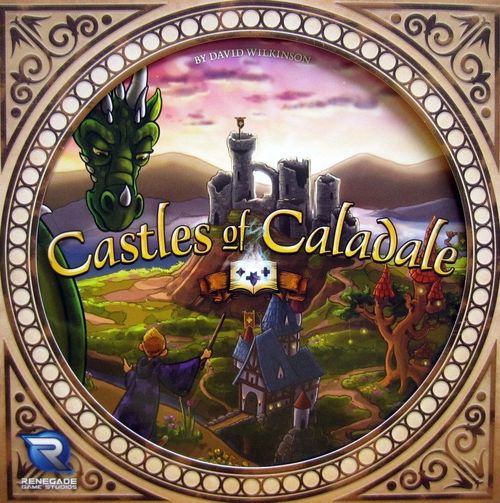
Castles of Caladale
Castles of Caladale Rulebook
Table of Contents
Table of Contents
Overview
Players compete to gain castle tiles and use those tiles to build their own castle. Scoring is based on each castle's size (number of tiles) and completeness (negative points for unfinished edges). With 80 unique tiles, there will never be two castles alike!
There are many ways to enjoy the game . . .
STANDARD This is the core game and the best place to start. Players take turns choosing castle tiles and use those tiles to build, modify, and rebuild their own castle continuously throughout the game.
SPEED A fast and exciting version with the same construction rules. All tiles are distributed evenly at the start and players build simultaneously competing to be the first and best.
SOLITAIRE Enjoy the challenging puzzle of building the largest complete castle you can!
FREE-PLAY No rules! Just have fun with your family and friends building magical castles with a lot of unique and beautifully illustrated tiles. For example, try to build a huge castle using all of the tiles (except the Wild tiles) with a few simple rule modifications: all four gates must go on the bottom row, and you can use two grass strips. We have not been able to use every single tile and make the castle complete. Our record for largest complete castle is all tiles used except two! Can it even be done with all of the tiles?
IMPORTANT!: In all games, you can and should build and modify your castle throughout the game whether it is your turn or not. Castle construction is reversible – you can move tiles around that have already been placed. As you gain experience, patterns will emerge and you will find yourself making fewer changes to your Castle.
Components
A. 80 Castle Tiles
- 54 Standard Tiles in 3 Themes (18 per theme)
- Wizard's Stone Castle
- Fairies' Tree Castle
- Gnomes' Tudor Manor
- 4 Gate Tiles (1 per player)
- 18 Enchanted Tiles (6 per theme-pair)
- 4 Wild Tiles (1 per player)
B. 1 Supply Board / Score Track
C. 4 Character Figures / Score Markers
- Wizard, Wizard's Apprentice, Gnome, and Fairy (1 per player)
D. 4 Grass Strips (1 per player)
- 1 30-Second Sand Timer (Speed Variant Only)
- "The Legend of Caladale"
Gate (Start) Tiles: Wizard's Stone Castle, Fairies' Tree Castle, Gnomes' Tudor Manor, Apprentice Stone/Tudor.
Tile counts: Enchanted Tree/Stone (x6), Wizard's Stone Castle (x18), Enchanted Stone/Tudor (x6), Fairies' Tree Castle (x18), Enchanted Tudor/Tree (x6), Gnomes' Tudor Manor (x18), Wild Tiles (x4).
For more information about Castle Tiles see the Tile Reference section.
Standard Game Setup
-
Find the 4 double-sided Gate tiles and give 1 to each player. For 2-3 players use the "single-theme" sides. For 4 players use "mixed-theme" sides and the Apprentice Gate tile. For 2 and 3 player games, do not use the "Apprentice Gate Tile". Players may chose their own Gate tiles. Return unused Gate tiles to the box.
-
Find the 4 Wild tiles and 4 Grass strips and give 1 of each to each player. Place your Grass strip directly in front of yourself, near the edge of the table (you will build your Castle on this "ground"). Place your Gate tile anywhere on your Grass strip (you can always move it later). Leave your Wild tile off to the side. Return unused Wild tiles and Grass strips to the box.
-
For 2-player games, remove the 24 tiles marked with the brown plus symbol on the back and place them back in the box. Note: 2-player games may be played with all tiles, but the castles get to be quite big and can be overwhelming for first-time players.
-
Place the Supply Board on the table. Shuffle the remaining tiles and set them up as shown: 9 tiles face up, the rest forming 2 or 3 face down stacks. All of the tiles in the middle, 9 face up plus the "blind" stacks, form the "Supply".
-
Set the Score Markers aside for now. Select a random 1st player and begin!
Gate Tiles: 1 to each player. Defines your identity. Each Gate tile has a "single-theme" FRONT and a "mixed-theme" BACK.
Grass Strip: 1 to each player. Represents (and limits) the ground your Castle can sit on!
Wild Tile: 1 to each player. Helps you finish your Castle, but with a -1 penalty.
Standard Gameplay
Each player builds their own castle, drawing one tile at a time from the supply on their turn, while building and rearranging their own castles throughout the game. Scoring is based on each castle's size (# of tiles) and completeness (negative points for unfinished edges). See the Scoring section.
There are three different themes: the Wizard's Stone Castle, the Gnomes' Tudor Manor, and the Fairies' Tree. Each tile will have 1 or 2 themes and each edge of each tile shows either a castle theme or blue sky. Match edges of tiles as you build your own castle. Use the Wild tile if necessary to close off any Castle theme. It helps to "complete" a Castle, but you lose 1 point for using it. You are not required to use your Wild Tile. See the Castle Construction Rules section.
Turn-Based Drawing of New Tiles
Starting with the 1st Player and proceeding clockwise each player:
-
Must draw 1 tile from the Supply choosing either one of the 9 face up tiles or a random tile from the face down stacks. When a face up tile is drawn from the Supply board, replenish the Supply board with a tile from one of the stacks.
-
Choose to either:
- Keep the tile face up for using in the Castle. Note you do not have to build it in immediately, but the decision to keep it face up is permanent.
- OR flip it face down for a +1 bonus point. This action should be used sparingly and only towards the end of the game, when you feel you can no longer add tiles to your Castle (a tile in your Castle is worth 2 points). A "flipped" (face down) tile cannot be unflipped.
Play proceeds clockwise until all tiles are drawn from the Supply board and face down stacks. Each player will have an equal number of tiles at the end of the game (see Game End below).
Simultaneous and Reversible Castle Construction
While drawing new tiles is turn-based, players will build their own Castles simultaneously throughout the game. Construction is also reversible meaning tiles you own may be rearranged throughout the game. We suggest you start building right away as you gather tiles on your turn. This will help guide you in selecting new tiles. See the Castle Construction Rules section.
Game End
The game ends when all tiles have been drawn (each player will have the same quantity of tiles). Allow a reasonable window of time for players to finish constructing their Castles; however, feel free to use the included 30-second sand-timer to force slower players to finish!
Flip the Supply board over to the Scoring Track and score each Castle (see the Scoring section).
Castle Construction Rules
A. Castle construction is simultaneous and reversible - No need to wait for your turn to build and you can move tiles and rebuild your castle throughout the game at any time.
B. All tiles may be placed in any orientation with 2 exceptions:
- B1. The Gate tiles can only be placed upright and must sit on the Grass strip.
- B2. The Tower Top tiles can only be placed upright. Tower Top tiles have a "+ Flag".
C. Adjacent tile sides must match. Castle-themes must match adjacent Castle-themes. Sky must be adjacent to sky. Wild tiles can connect to any castle theme.
D. The Castle must be a single connected structure (not completely separate Castles separated by Sky).
E. All tiles in the bottom row with bottom edges that are Castle (not sky) must sit directly on the Grass strip.
F. All tiles must be supported along the length of their BOTTOM edge with THREE EXCEPTIONS:
- F1. Two-Sided tiles can "hang" off from the left or right sides of other tiles.
- F2. Single-Sided Edge tiles can "hang" from the sides of other tiles and even hang upside-down.
- F3. A single tile may form a single "bridge" meaning it is not supported along its bottom edge but is supported on both sides (left and right) by tiles that are fully supported along their own bottom edges.
G. The only tiles that can overhang the Grass strip must have sky on the bottom. The Grass strip is 4 tiles wide but does not have to be fully covered.
Note on the illustrated examples: Tower Top tiles allow only 1 orientation, not to be confused with Edge tiles in which ALL orientations are allowed. Invalid bottom rows include an incomplete "Bridge" and an unsupported tile. The properly built example castle shown in the rulebook scores 51 (assuming no tiles are left in the player's hand).
Scoring (For All Variants)
Flip the Supply Board over to reveal the Score Track. Use the Scoring Markers (1 per player) to facilitate scoring.
Scoring Breakdown
| Points | For |
|---|---|
| 2 | Per Tile in Castle, Except Wild Tiles |
| +2 | For a Complete Castle (sky all the way around) |
| +1 | Extra point per Tower Top Tile in Castle (look for the "+ flag") |
| +1 | Per Flipped Tile |
| +1 | For Flipped Sand Timer (Speed Variant ONLY) |
| -2 | Per Exposed Castle Edge (not sky) |
| -1 | If Wild Tile is Used in Castle |
Example Score for the Castle Shown in the Rulebook
| Item | Points Earned |
|---|---|
| 22 Tiles in Castle (not Wild) | 44 |
| Not a Complete Castle | 0 |
| 3 Tower Tops! | 3 |
| 1 "Flipped" Tile | 1 |
| No Points, Speed Variant Only | 0 |
| 2 Exposed Tile Edges | -4 |
| Wild Tile is Used in Castle | -1 |
| Total! | 43 |
That example castle also holds 1 Unused Tile (0 Pts.).
The player with the highest score wins! See the Score Track for tie-breakers.
Note: For 2 or 3-player games, the player using the Wizard's Stone Gate may choose to use either the Wizard marker or Wizard's Apprentice marker.
Dealing with Mistakes and Illegal Tile Placements (For Standard and Speed Games)
In the Standard game, especially for beginners, we recommend players point out each other's construction mistakes during the game (i.e: if a tile is not supported properly). In the Speed game, if time is up, that player is forced to "dissolve" the illegal section of Castle and anything the illegal tiles are supporting. Keep in mind, this will almost surely make that player lose the game. For family-friendly play, consider allowing the player to make the minimum number of changes to fix the problem.
Speed Variant Setup
Follow steps 1, 2, and 3 of the Standard Game Setup.
- Shuffle the remaining tiles and place 8 or 9 (depending on player-count) random tiles face up on the Supply Board. Make equal stacks of the remaining tiles, 1 stack per player, and distribute the stacks face down. The distribution of tiles will look like this:
| # of Players | # of Tiles Face Up on the Supply Board | # of Tiles Face Down per Player |
|---|---|---|
| 2 | 8 | 20 |
| 3 | 9 | 21 |
| 4 | 8 | 16 |
Note: If playing with all of the tiles in a 2-player game, use 32 cards face down per player.
- Set the Score markers aside for now. Place the sand timer and Supply Board within easy reach of all players. You are ready to begin!
The example 2-player Speed game setup shows the Supply board with 8 random face-up tiles.
Speed Variant Gameplay
One player says "GO" and all players flip over their tiles and begin building!
- At any point in the game, players can Exchange one of their own tiles with a tile in the Supply. Players may Exchange tiles as often as they want, there is no limit. Players must always have the same number of tiles as when they started and the number of tiles in the Supply will remain unchanged throughout the game.
- There is no "flipping" of tiles allowed; all tiles must remain face up.
- Follow the same Castle Construction Rules as in the Standard game.
Game End
At any point, one player may flip over the sand timer (announcing he did so). That player must stop all game-play but gets 1 Bonus point. The remaining players have 30 seconds to finish the game! They may continue Exchanging tiles and build as normal until time runs out.
Flip the Supply Board over to the Scoring Track and score each Castle (see the Scoring section).
Solo Variants
Solo Game 1
SETUP: Start with any Gate tile of your choice and use either side, placing it above and connected to your Grass Strip. Place a Wild tile nearby. Put the remaining Grass Strips, Gate tiles, and Wild tiles back in the box. Set up the Supply as you do in the Standard game (9 face up, the rest stacked face down).
PLAY: Take a face up tile from the Supply and place it, connecting to your Gate tile. Add a new face up tile to the Supply board from the face-down stacks. Unlike the other game variants, once you place a tile in your castle you cannot move or rotate the tile. Also, unlike other variants, you cannot choose a tile from the face down stacks, nor can you choose to flip a tile over (for the +1 bonus). Continue drawing tiles and placing them until you can no longer draw a tile that can be added to your Castle or you choose to end the game. You may not place an unsupported tile. You may slide the Grass Strip left or right to reposition it under different tiles at any time. Score your castle as you would in the Standard game; however, there will be no bonuses for face down tiles.
Solo Game 2
Other solo variants include playing your own Speed-style game (with or without timing yourself). Place 9 random tiles face up in the Supply and take 25 random tiles for yourself. Place all remaining tiles back in the box. Build the best possible Castle with the tiles you have using the following rule modifications: no +1 bonus for flipping tiles, and you must reduce your score by 1 point whenever you make an Exchange with the Supply. Otherwise, score normally, striving to beat your previous best score.
Tile Reference
Gate Tiles (x1)
- Start Tile
- 1 Orientation
Wizard's Stone Castle, Fairies' Tree Castle, Gnomes' Tudor Manor, and the Apprentice Gate Tile (for use with 4 Players only).
Tower Tops (x5) — (2 players: x3)
- 1 Orientation (can only be placed upright)
- +1 Bonus Point
- "+" Symbol on a Flag to Distinguish Them
Available for the Wizard's Stone Castle, Fairies' Tree Castle, and Gnomes' Tudor Manor.
Other Tile Types
All Orientations Allowed. Counts shown are per theme (Wizard's Stone Castle shown in the rulebook):
| Tile Type | Count | 2-player Count |
|---|---|---|
| Four-Sided | x3 | x2 |
| Three-Sided | x3 | x2 |
| Two-Sided | x3 | x2 |
| Edge | x3 | x2 |
| MidTower/Bridge | x1 | x1 |
6 Enchanted Tiles per Castle-Pair
All Orientations Allowed. Counts shown per castle-pair (Wizard to Fairy shown in the rulebook):
| Tile Type | Count | 2-player Count |
|---|---|---|
| Enchanted A | x2 | x1 |
| Enchanted B | x1 | x1 |
| Enchanted C | x1 | x1 |
| Enchanted MidTower/Bridge | x2 | x1 |
4 Wild Tiles Total
- ALL Orientations Allowed
- Helpful in Closing Castles
- -1 Point if Used
- Can Connect to Any Castle Theme