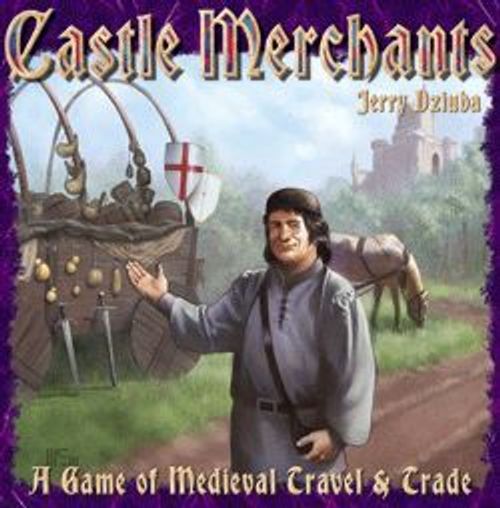
Castle Merchants
Castle Merchants Rulebook
Table of Contents
Table of Contents
Contents
- 45 Round Path Tiles
- (9) Castle Path Tiles
- (9) Village Path Tiles
- (9) Mountain Path Tiles
- (9) Field Path Tiles
- (9) Forest Path Tiles
- 60 Path Cards
- (12) of each Path Type
- 10 Rock Slide Tiles
- 1 Path Die
- 1 Game Board
- 4 Merchant Pawns
- 4 Horse Cart Mats
- 20 Wares Markers
- (4) Cheese
- (4) Jewels
- (4) Weapons
- (4) Cloth
- (4) Wine
- 29 Gold Coins
- (6) - 1 Coins
- (11) - 2 Coins
- (7) - 3 Coins
- (4) - 4 Coins
- (1) - 5 Coin
Setup
-
Place the game board on the table. All players take a merchant (player pawn) and a horse cart mat in the color of their choice.
-
Place the merchants in the warehouse to begin the game.
-
Each player loads up his cart with one of each type of ware. Leftover wares are placed back in the box. (Players may never have more than one of each different ware type in their cart at any time.)
-
Shuffle the path cards and deal six cards to each player. Place the remaining cards face down on the board to form the draw pile.
-
The gold available at the castles is dependant upon the number of players in the game. Place gold coins in the castles according to the table printed on the game board. Any remaining gold coins are returned to the box and are out of play for the game.
- Example: In a 2 player game you would put two 1-gold and one 3-gold coins into both Fromage and Muslin castles. One 4-gold, one 2-gold, and one 1-gold coins into castles Excalibur and Gemstone. Finally, one 5-gold, one 4-gold, one 2-gold coins into Chianti Castle.
-
Sort the path tiles and place each stack on its corresponding space on the board. These are the path tile supply stacks.
-
Give each player rock slide tiles according to the number of players in the game:
- 2 Players - 4 rock slide tiles
- 3 Players - 3 rock slide tiles
- 4 Players - 2 rock slide tiles
Any remaining rock slide tiles are placed as a supply stack on the board.
-
Decide who will go first by whatever method you prefer. Play then continues clockwise around the board.
The bags of gold around the outside of the board can serve as scoring tracks if desired. Simply place accumulated coins adjacent to the numbered bag to keep a running tally.
- Example: The coins show the player on this side of the board currently has a score of 7 gold coins.
Playing the Game
Player Turns
On a player's turn he has the following two options available:
-
Play cards - a player may take any of these actions, in any order, as many times as he is able (except A.):
- A. Place a rock slide tile (Exception: only once per turn).
- B. Play a card to place a path tile.
- C. Play a card to move along a path.
- D. Play 2 cards and remove a path tile.
- E. Play 2 cards and roll the path die.
- Draw replacement cards - Final action to be taken (Drawing cards ends the current player's turn)
- OR -
-
Rebuild hand size
- A. Place a rock slide tile, if desired. (only once per turn).
- B. Draw one card to end your turn.
Turn Options Explained
1A/2A. Place a rock slide tile. A player may place a rock slide tile if he has one. A rock slide may be placed onto an empty board space or on top of any unoccupied path tile on the board. Once a rock slide tile has been laid no path tile may be placed there, and no movement is allowed through the space. A rock slide tile may not be placed such that a contiguous row of rock slide tiles totally block off an area of the game board thereby not allowing access into or out of the area. A player may only place one of his rock slide tiles per turn.
Note - rolling the path die (option E) and being able to place or move a rock slide tile (rolling a 6) does not constitute using your single opportunity to place a rock slide tile, and therefore, you may still utilize this option.
1B. Play a card to place a path tile. A player plays a card and adds the matching path tile onto the board. The path tile is taken from the supply stack and placed onto any empty space on the board. If the appropriate path tile supply stack is empty, one of the unoccupied path tiles of that type is picked up from the board and relocated.
1C. Play a card for movement. A player plays a card and moves his token onto any adjacent path tile of the type matching the card played. If there is a string of adjacent path tiles of that type he may move anywhere along the entire unbroken path with the play of a single card. It is permissible for a merchant to move through or end movement on a tile occupied by one or more other merchants,
1D. Play 2 cards and remove a path tile. A player plays any two cards (they do not need to match) and removes any unoccupied path tile (not a rock slide tile) from the board and places it back onto the supply stack.
1E. Play 2 cards and roll the path die. A player plays any two cards (they do not need to match) and rolls the path die. He may perform one of the following actions with the appropriate path tile (tile above the matching die symbol):
- Place a tile from the supply (if one is available) onto the board.
- Move an unoccupied tile from one location on the board to another. The tile must be moved to an empty space unless you are moving a rock slide tile.
- Remove an unoccupied tile from the board and place it back onto the supply.
Note: The only way a rock slide token can be moved once placed onto the board is via a path die roll.
* Draw Replacement Cards. The final action of a player's turn is to draw replacement cards. He draws one card for every card played this turn up to a maximum of three cards.
Example: If a player played 2 cards, he would draw 2 cards. If he played 5 cards, he would draw 3 cards. This signals the end of a player's turn and no further actions may be taken once cards are drawn.
Note - A player may never have more than six cards in his hand at anytime.
[ It is recommended that players leave played cards in front of them until they have completed all actions they wish to implement for the turn. This will make it easy to know how many cards they are allowed to pickup during the card replenishment phase of that turn. ]
2B. Rebuild Hand Size. If a player has fewer than 6 cards (the hand maximum) he may forego playing any cards and instead draw one path card from the supply. This action constitutes his entire turn with the exception that he may still place a rock slide tile (option 2A) if he desires.
Special Board Spaces
Castles
Players are attempting to sell their wares to the castles for the best prices. Each castle is only interested in buying a specific ware: Chianti Castle - Wine, Castle Gemstone - Jewels, Castle Excalibur - Swords/Shields, Muslin Castle - Cloth, Fromage Castle - Cheese.
A player may play any type of path card to enter a castle. Upon entering a castle a player may sell wares if he desires, and if he still has the appropriate ware on his cart. To sell wares a player must end movement for that turn in a castle. He may continue to play cards but can not move any further that turn.
If a player does not want to, or cannot sell any wares (he does not have the appropriate goods on his cart) he may continue moving out of the castle or end movement there.
If a player decides to sell his wares to a castle he can either sell them for gold or supplies.
- Selling wares for gold. The player returns the proper ware token to the warehouse and receives the highest remaining gold coin left in the castle.
- Selling wares for supplies. The player returns the proper ware token to the warehouse and draws back to the hand maximum of six cards at the end of his turn.
A player ending movement in a castle (whether he sells wares or not) can then roll the path die and take the appropriate action (the same as if he had taken turn option 1E).
Warehouse
A player may play any type of path card to enter the warehouse. If a player decides to end movement for that turn in the warehouse he can resupply his cart with any wares he is currently out of. In addition, he can also draw back to the hand maximum of six cards at the end of his turn. A player may remain in the warehouse any number of turns but may not draw more than the normal maximum of three cards at the end of his turn. The privilege of drawing back to up to six cards is only available on the turn he enters the warehouse. A player may leave the warehouse and re-enter it the same turn and qualify for drawing back to six cards.
Meadow
The green grassy hex in the center of the board is the meadow. A player may play any type of path card to enter the meadow. A player ending movement in the meadow draws back to the hand maximum of six cards at the end of his turn for letting his horse graze on the fresh grass. A player may remain in the meadow any number of turns but may not draw more than the normal maximum of three cards at the end of his turn. The privilege of drawing back to up to six cards is only available on the turn he enters the meadow. A player may leave the meadow and re-enter it the same turn and qualify for drawing back to six cards.
Game Ending
The game ends when a player receives a gold coin that puts his total at 18 or over. This player is declared the kingdom's finest merchant and children will henceforth sing songs in his honor!
Example of Play
To demonstrate some of the possible moves you have during a turn, we will walk through the first couple of moves in a game with two players. (The printed example is illustrated with a board diagram marked A, B1, B2, B3 and B4; the diagram is not reproduced here.)
A. Yellow doesn't want to lay down too much of a path and give Red an easy run to Fromage Castle so he plays 2 Village Path cards, 1 to place a Village Path tile and 1 to move from the warehouse onto the path. He also plays a Castle Path card and places the tile in an out of the way place giving himself more cards to draw during the replenishment phase. Yellow decides that is all he wants to do and draws 3 cards to end his turn.
B1. Red plays 2 Village Path cards and places 1 Village Path tile on the board and uses the other card to move to the end of the Village path.
B2. Red then plays 2 Forest Path cards, 1 to place a tile and the other to move onto it. He then plays a Field Path card to move into Fromage Castle (he could have used any path card to move into the castle). When arriving at the castle, he sells his cheese ware token and places it into the warehouse. He then takes as his payment the highest gold coin in the castle, in this case it's a 3.
B3. For ending his movement in a castle, Red gets to roll the path die. He rolls a 4 (Village Path). To make the journey more difficult for Yellow he uses this roll to remove the Village Path tile directly in front of Yellow's marker. He could relocate this tile to another space on the board if he wanted to but instead decides to just place it back onto the supply stack.
B4. Finally, to make things even worse for Yellow, he places one of his rock slide tiles on top of the Forest Path tile.
With that final act of aggression Red decides he has done enough for one turn and draws his replacement cards. He can only draw the 3 card limit allowed per turn even though he played 5 cards. He will continue to play with a reduced hand size until he either lands in the meadow, returns to the warehouse, decides to sell a good for supplies instead of gold, or uses his turn to rebuild his hand size one card at a time.
It would now be up to Yellow to decide the best course of action after Red dealt out that blow to him. Does he try and work his way around the rock slide or change tactics and head over to Muslin Castle to secure that 3 gold coin? Or perhaps he heads to the meadow to regroup and have the ability to set out after any castle of his choosing.