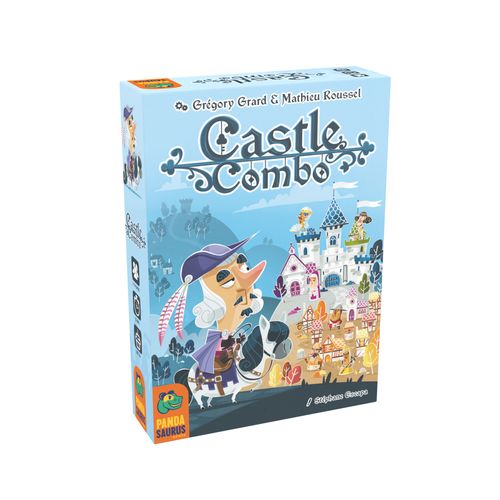
Castle Combo
Castle Combo Rulebook
Table of Contents
Table of Contents
Summary and Goal of the Game
In Castle Combo, each player recruits 9 characters and places them in their 3 x 3 cards tableau.
All 78 Character cards come from 2 places: the Castle and the Village, and the Messenger pawn's position indicates the location one can recruit characters from.
Each character grants you an immediate ability and, at the end of the game, scores points depending on their card's conditions.
After everyone has played 9 turns (i.e., everyone has 9 characters in front of them), the player with the most points in their tableau wins the game.
Components
- 39 Castle cards with a gray back
- 39 Village cards with a brown back
- 1 Messenger pawn
- 52 Gold tokens (40 with value 1 and 12 with value 5)
- 44 Key tokens (36 with value 1 and 8 with value 3)
- 1 double-sided game aid
- 1 score pad
- This rulebook
Gold and Key tokens are not meant to be limited. In the rare case you do not have enough, you are able to track these resources and find any replacement suitable.
Anatomy of a Card
Each character card shows:
- Gold cost — in the top left corner; the price you pay to recruit the character.
- Messenger Icon — in the banner. If present, it moves the Messenger pawn when you buy the card.
- Name of the character + banner — the banner shows whether the card is a Castle or Village character.
- Shield — every card carries a shield. There are 6 shield types:
- Nobility, Faith, and Scholarship (mostly found in the Castle).
- Military, Craftsmanship, and Peasantry (mostly found in the Village).
- Ability — triggered when the card is bought.
- Scoring scroll — scored at the end of the game.
Game aid for icons
Card abilities (triggered when bought) can include:
- Gain 1 Gold from the supply.
- Gain 2 Keys from the supply.
- Gain 3 points at the end of the game.
- Castle Banner (present on all Castle characters).
- Village Banner (present on all Village characters).
- Discount 1 Gold when buying Castle characters.
- Discount 1 Gold when buying Village characters.
- Discount 1 Gold when buying any character (Castle AND Village).
Card scoring scrolls (end of game) can score:
- per — For each Nobility shield in your tableau.
- per — For each different shield type (among all 6) in your tableau.
- per — For each Scholarship shield on all 3 cards of this row.
- per — For each different shield type (among all 6) on all three cards of this column.
- per — For each Faith shield on all 5 cards of this row AND this column.
- per missing — For each different shield type (among all 6) not present in your tableau.
- if [shield] is missing — If there is no Military shield in your tableau.
- per — For each set of 1 Scholarship shield and 1 Peasantry shield, wherever they are in your tableau.
- per — For each set of 3 identical shields, wherever they are in your tableau.
Setup
Shuffle the Castle cards (with a gray back) into a deck. Place that deck in the center of the table. Reveal the top 3 cards in a row besides the deck.
Do the same with the Village deck. Place it, along with the 3 revealed Village cards, below the Castle cards as shown.
Place the Messenger pawn besides the revealed Village cards.
Each player takes 2 Keys and 15 Gold. Put all remaining Keys and Gold within reach of all players: this is the supply.
Randomly select a first player.
The game can begin!
Game Flow
Starting with the first player and proceeding clockwise, everyone plays their turn until everyone has 9 cards in front of them.
On Your Turn
When it is your turn to play, take the following steps in this order:
- Spend a Key (optional)
- Buy a card (mandatory)
- Apply the card's ability (mandatory)
- Move the Messenger pawn and fill the display for both locations (mandatory)
Once all 4 of these steps are completed, the player to the left of the current active player takes their turn.
1. Spend a Key (optional)
You may spend 1 (and only one) of your Keys to take one of the following two actions:
- Move the Messenger pawn to the other location (Castle or Village).
- Discard all 3 cards in the location where the Messenger is and reveal 3 new cards from the corresponding deck.
Discarding cards: Discarded cards are placed to the left of their deck as a visible pile. Discarded cards are public information. If a deck is empty when cards should be revealed from it, shuffle the corresponding discard pile into a new deck.
2. Buy a card (mandatory)
You must take one of the 3 face-up cards in the location the Messenger occupies. Pay the cost of the card in Gold, as shown in the top left corner of the card. Then place the card in your tableau.
Discounts. Some card abilities grant a permanent discount when purchasing cards of a specific location (Castle, Village, or both). This is shown with a golden line. Make sure to add up all of the applicable discounts in your tableau! A card cannot cost less than 0 Gold; you do not gain gold if you have more discounts than the cost of the card.
Important: if the card you purchase has a discount ability, its own discount ability only applies for your next purchases, and not this one.
Flip a card face down. You may always take a card without paying its cost, and place it face down in your tableau. Doing so, you ignore its ability, its end game points and any other information printed on it, but you immediately gain 6 Gold and 2 Keys as a compensation, as shown on the back of the cards.
Placement rules
Immediately place the card you took in your tableau. For this, you must comply with 2 rules:
- Each card after the first must be placed adjacent (orthogonally) to at least one other card in your tableau.
- At the end of the game, your tableau must be a grid of 3 x 3 cards. You may never add a fourth card to a column or a row.
Important: some cards award points depending on where they are in the grid. Their position is consolidated over the course of the game, and is only fixed as your rows and columns fill up.
Example: starting your tableau with three cards in a row sets the column for each card: left for the Royal guard, center for the Spy and right for the Militiaman. However, at this stage of the game, only the future cards will determine whether this row is the top, middle, or bottom row.
3. Apply the card's ability (mandatory)
The ability of a card is applied just after the card has been placed into your tableau. The card takes itself into account for the resolution of its ability (except if that ability is a discount).
Unless mentioned otherwise on the card, an ability is always a gain for you and scales solely on what is in your tableau. Take the gained elements (Keys and/or Gold) from the supply.
Example: with a "gain 1 Key per Village Banner" ability, YOU gain 1 Key for each Village Banner in YOUR tableau (counting the card that triggers this ability).
- Whenever an ability mentions your opponents, it concerns all other players.
- Whenever an ability mentions a neighbor, you choose either the player directly to your left's tableau, or the player to your right's.
The game aid explains all card abilities.
4. Move the Messenger pawn and fill the display for both locations (mandatory)
If a Messenger icon is printed in the banner of the character that has been bought, move the Messenger pawn to the shown location (gray/up = Castle; brown/down = Village). If there is no such icon, or if the card has been taken to be placed face down, the Messenger does not move.
Then reveal cards to complete each display with less than 3 visible cards. Take cards from the Castle deck for the Castle display and from the Village deck for the Village display.
Empty location: If, after shuffling the discard of a location, it is still impossible to complete its display to 3 cards, remove from the game all cards from that location and place the Messenger pawn near the remaining display. Messenger icons on the cards that are bought or spending a Key do not move the Messenger anymore. Spending a Key still allows you to refresh all 3 cards of this remaining location.
Turn end
Once all four of these steps are completed, the next player in clockwise order takes their turn.
End of the Game
The game ends once all players have built their 9-cards tableaus.
Cards with "Purse scoring." When the game ends, players place their leftover gold on cards with Purse scoring in their tableau. Each purse may hold as much gold as printed in black on it (for example, 4 Gold).
Using the score pad, count the points on each scoring scroll shown on your cards. Each scoring scroll always refers only to the elements in YOUR OWN tableau for scoring. Face-down cards are worth no points.
- Each Key you have is worth 1 point.
- Gold that is not stored on purses is worth no points. However, keep it to break any ties that might occur.
Final Score
Add up the score of each of your cards and keys to obtain your final score. The player with the most points wins the game. In case of a tie, the tied player with the most leftover Gold wins. If the tie persists, the tied players win together.
Scoring example
For an example tableau, the LOUISON player scores:
- 3 x 3 points, for 3 sets (of a Scholarship and a Peasantry shield) = 9 (the card flipped face down gives no banner)
- 2 x 6 points, as 2 shield types are missing = 12
- 11 x 1 point, for keeping 11 Keys = 11
- 3 x 3 points, for 3 shields on this row = 9
- 2 x 2 points, for 2 Gold stored on this card = 4
- 5 points, as this card is on one of its required spaces = 5
- 6 points, as there are 2 Gold on the Sculptor and 4 Gold on the Miraculously cured = 6
- 0 points, as a face-down card is worth nothing = 0
- 4 x 2 points, for 4 Gold stored on this card (the maximum this card could store) = 8
- 11 x 1 point, for keeping 11 Keys = 11
The player's score is the sum of all the previous rows: 75.