Castle Builders
Castle Builders Rulebook
Table of Contents
Table of Contents
Preparation
- Before the first game you need to cut out the counters at the bottom of the postcard. There should be 22 counters of each color.
- Each player takes all the counters in one color and shuffles them.
- Each player then takes two random counters from his/hers draw pile. This is their starting hand.
Playing the Game
On a player's turn, he/she places a counter and then draws a replacement counter.
- Place counter: The player chooses a counter from his/hers hand to play. Most of the counters will be placed in a tower, they are building counters (see chart below). The player may place a building counter at the bottommost free space in any tower. If it is not a building counter then the player uses the counter's special ability, if possible, and then places the counter in a discard pile.
- Draw replacement counter: After a counter is played the player draws a replacement counter.
- If the played counter contained a continuation icon, the player conducts a new turn. If not, it is the other player's turn.
The Counters
Building counters:
- Ordinary building counter (a plain colored square)
- Continuation counter (a square with a circular arrow icon)
- Bonus counter (a square with an "x 2" and a double-headed arrow icon)
Special counters:
- Remove counter (a square with a lightning-bolt icon)
- Remove and continue counter (a square with a lightning-bolt icon and a circular arrow icon)
- Stop counter (a square with a circle-and-slash icon)
Special Counters
Remove counter: Select a topmost counter in any tower and then discard that counter.
Remove and continue counter: Same special rules as Remove counter plus the player may conduct a new turn.
Stop counter: Player may not do anything this turn.
Game End
When all spaces in the towers are filled the game ends and scoring takes place.
Calculate scores:
The player with the topmost counter in each tower gets as many points as stated on the roof of that tower. Also, the player with the most counters in each row gets as many points as stated on the beginning of that row.
If a player has a bonus counter in a tower which he/she gets points for and the arrows on the counter is pointing vertically then the points of that tower is doubled. The same applies to rows, but there the arrows must be pointing horizontally. The player chooses the direction of the arrows when placing the counter.
Players sum up their points and the player with the most points is the winner.
Scoring Sample
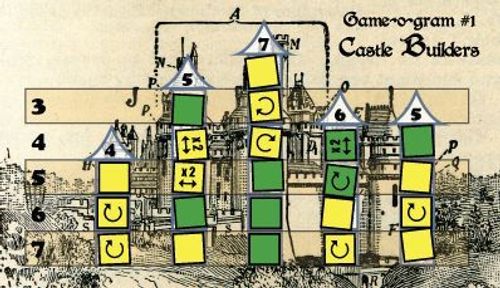
The picture below illustrates a game that has just ended. Let's count the score!
We will start with the rows: In the first row (at the bottom of the play area) there are 4 yellow and 1 green counter. This means that yellow player gets 7 points for this row since the yellow player got the most counters in that row. Moving up there are 3 yellow and 2 green counters. This means 6 more points to the yellow player. The yellow player got the most counters in the next row also, and one of the counters is a bonus counter where the arrows are point horizontally. This means that the points are doubled: 10 points more to the yellow player. In the next row there are 2 yellow and 2 green counters which mean that no one gets the points. In the top row it is also a tie which means no more points for the rows.
Let's move on to the towers: In the tower to the left the yellow player has the topmost counter. The yellow player therefore gets 4 points (as stated on the top of the tower). On the next tower the green player has the topmost counter and gets 5 points. Since the bonus counter in the tower is yellow, the bonus does not apply. The yellow player gets 7 points for the tower in the middle. Next the green player gets 12 points for the following tower, since the green player has placed a bonus counter pointing vertically there. The green player also gets 5 points for the last tower.
Summing all points up the yellow player gets 34 points (7 + 6 + 10 + 4 + 7) and the green player gets 22 points (5 + 12 + 5). The yellow player is the winner!