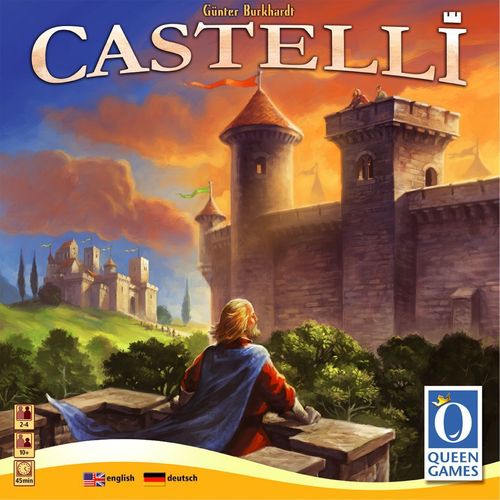
Castelli
Castelli Rulebook
Table of Contents
Table of Contents
Object of the game
Numerous castles were built in Italy during the Middle Ages. The point always was to defy the enemy at the most attractive sites. A great deal of rocks was needed (for the walls), of strong trees (for the roof structure) and last not least large quantities of grain to feed the workers. The knights could provide these resources by roaming the country and trying to gain control of the resources in as many areas as possible.
The player who establishes their castles at the most attractive sites and thus gains the most victory points will be the winner of Castelli.
Components
- 4 scoring markers, for tracing victory points, 1 each in the four player colors. Each player places their markers on the "zero" space of the victory point track.
- 22 silver cubes. Place all silver cubes on the silver mine. Any silver not owned by players is always kept on this space.
- 1 silver mine tile, needed only for the variant "Castelli-Tournament" (see page 16).
- 32 + 4 heraldic tiles bearing the players' coats of arms with values from 1 to 6, additionally showing a silver icon or a card icon. Separate the 4 "start tiles" (easily recognized by their back) and put them aside. You will need these only when playing with the expansion module "Dilemma". Shuffle the remaining 32 heraldic tiles and deal them randomly to the green square spaces of the game board, face down.
- 36 castles, 9 each in four player colors. Each player selects a color and places their castles on the table in front of themselves.
- 25 + 8 character cards, representing various characters with special abilities. Separate the 8 "battle" cards (easily recognized by their framed dark front) and put them aside. You will need these only when playing with the expansion module "Battle". Shuffle the remaining 25 cards and place the deck face down next to the game board.
- 12 resource markers, for the resource charts, 3 each in the four player colors. Each player places one of their markers on each "zero" space of the three charts.
- 13 villages, 8 cities. Place one wooden village respectively one city on each illustration of a village / city of the game board. Please note: Two cities and two villages will be left over; these can enter the game only by playing certain cards.
- 1 rules booklet. You will find rules changes for 2 or 3 players on page 14.
Set up and preparing to play a 4-player game
1 game board, composed of several pieces:
- 4 game board pieces with square green spaces and octagonal spaces, showing up to 4 landscapes each (each landscape identified by its terrain type and its corresponding resource or markets with one or two tents). A silver mine is shown on one of these spaces.
- Assemble these 4 game board pieces in such a way that they will form a square game board.
- 2 game board pieces with charts used to indicate the players' current supply of resources (one chart each for grain, wood, and rocks). Put these 2 pieces together and place them flush with the square board.
- 10 frame pieces. When assembling these pieces around the 6 inner board pieces make sure that their order is correct to form a continuous victory point track.
Playing the game
The last player who visited a castle is the start player. The game then proceeds in clockwise direction, each player performs their turn one after the other.
Each turn is made up of three actions:
- Reveal a heraldic tile
- Gain resources
- Build castle(s) and score victory points
1. Reveal a heraldic tile
The active player lifts one face down heraldic tile of their choice from the game board and reveals it. If there are any silver pieces shown, the player immediately claims from the silver mine the number of silver cubes as shown and keeps them in front of themselves. In case the silver mine is empty, the player does not gain any silver. If a card is shown, the player immediately draws the top card from the face down deck and keeps it on their hand. A coat of arms with a card on it has a value of "0".
Next, the player puts the tile back on its place, face up and in any orientation they like. If this place is bordering the edge of the game board, the player whose coat of arms points toward the edge immediately receives whatever is shown at this spot of the frame (card, resource, or silver).
2. Gain resources
The players now check if one or multiple areas are eligible to be evaluated and if resources (or cards or silver) are awarded. An area is evaluated after all adjacent tiles have been revealed. Each area is evaluated only once during the game.
Important: Each octagonal space contains a number of singular, separated areas (landscapes and/or markets). Neighboring areas of other spaces are considered singular, separated areas as well.
Please note: Some areas are adjacent to one heraldic tile only. Such an area is evaluated as soon as this tile is revealed. There are other areas which are adjacent to three heraldic tiles (this is the case if three lots of the same type of landscape make up the octagonal space). For such an area to be evaluated all three tiles must be revealed.
Resources from areas
The player who is in control of an area gains resources from this area when it is evaluated. The player with the highest total of heraldic points of the bordering tiles is in control of the area.
This player gains one unit of the area's resource for each symbol of this resource shown in the area (grain, wood or rocks) and advances their marker accordingly on the corresponding chart. In case of a tie, the tied players share the resources, rounded down.
The maximum number of units of any type of resources a player can hold is five; any surplus units are lost.
There are some neutral coats of arms (grey) on the surrounding victory point frame respectively on the resource chart board pieces. These are considered coats of arms of a revealed tile, being a visual help when evaluating an area.
Please note: Any areas bordering exclusively to
- one or more neutral coats of arms or a coat of arms with a card
or
- any icon (card, resource, or silver) on the frame/resource chart pieces will not be evaluated.
Example (resource evaluation)
The active player has revealed the heraldic tile C. This causes two areas to be evaluated, both being between A and C:
- Blue controls the rocky area (here shown blue, majority of 5 heraldic points opposed to 4 points of Yellow) and gains 2 rocks. He advances his marker on the rock chart by 2.
- Red controls the grain area (here shown red, majority of 5 heraldic points opposed to 4 points of Green) and advances his marker on the grain chart by 2.
No more areas are evaluated now, because there are no more areas adjacent to revealed tiles only.
Later tile D is revealed and three more areas are evaluated:
- Because of the tie at the market (here shown green-yellow) both Green and Yellow draw one card each from the deck.
- Green controls the grain area (here shown green) with 3 heraldic points vs. 2 of Red.
- Red controls the second grain area (shown red) because there is a card only on the other tile.
Markets and Cards
Markets are treated like landscapes, except that the players do not gain any resources from them but a number of cards.
The player in control of a market draws from the deck the number of cards as tents are shown and adds them to their hand.
Note: The cards are good for special actions, grant additional victory points etc.
During their own turn only, a player may use one of their own cards and use its special abilities (see cards for details). After the card has been used, it is shoved back face down at the bottom of the deck. Cards granting victory points are applied at once and the player advances their scoring marker accordingly, and then puts the card back at the bottom of deck face down.
Instead of using the special abilities of their cards the players may choose to discard any number of their cards anytime, instead collecting 2 silver cubes from the silver mine for each card. The discarded cards are shoved face down at the bottom of the deck.
Note: This may be useful especially near the end of the game, if a player owns many cards and is short of silver.
3. Build castle(s) and score victory points
The active player may build as many of their castles as they want resp. can, provided they own the demanded resources. To build one castle the player must pay 1 unit each of grain, wood, and rocks. The player adjusts their markers on the resource charts accordingly.
Once only during their turn the player may pay 2 silver cubes and buy any one unit of a resource they do not own currently and spend it immediately to build a castle. Put the silver back in the silver mine.
Do not forget: The player is allowed to buy only that type of resource they do not own and which they spend immediately for building a castle.
A castle must be placed on the game board obeying the following rules:
- A castle may be built on available rocky areas (= mountains) only (one castle per symbol).
- The player building the castle must have influence on any one area of the octagonal space they want to build on with at least one of their coat of arms.
Please note: If there is no available space for a castle or the player has run out of castles they cannot build a castle.
The player immediately gains victory points for their new castle as follows:
- 2 additional victory points for each city in straight horizontal or vertical line of the new castle
- 1 additional victory point for each village in straight horizontal or vertical line of the new castle
The player advances their scoring marker on the victory points track accordingly.
Example: Blue has built a castle on H6. He gains 5 victory points: City D6 = 2 victory points; Village H6 = 1 victory point; Village F6 = 1 victory point; Village H2 = 1 victory point.
End of the game and winner
The game ends as soon as the last heraldic tile has been revealed and put back on its place. The active player completes their turn and a final scoring takes place:
- The player with the most heraldic points at the silver mine receives all silver remaining there. In case of a tie, all tied players share the silver, rounded down. The player now owning the most silver gains 4 victory points, the player owning the second most silver gains 2 victory points. In case of a tie, all tied players gain 3 victory points each.
- Each unused card (still on the player's hand) is worth 1 victory point for its owner.
- Each resource unit still owned is worth 1 victory point for its owner.
The players adjust their scoring markers accordingly and the player with the most victory points is the winner of the game! In case of a tie the tied player who has built the most castles is the winner. If the number of castles does not solve the tie, the tied players share the victory.
Rules changes for 2 players
- The players use only two of the game board pieces, one of which must be the piece with the silver mine, the second piece may be any of the three other ones. Insert the two remaining pieces inside the frame face down. No resources, silver, cards or neutral coats of arms are to be seen on these face down game board pieces. Coats of arms bordering these pieces do not generate any profits. As for bordering landscapes the face down pieces are treated as if neutral coats of arms were shown there.
- Put only 11 silver cubes in the silver mine during setup.
- The player colors not engaged are considered neutral. If one of these neutral colors has the most heraldic points, no player will gain the resources.
Rules changes for 3 players
- Put only 16 silver cubes in the silver mine during setup.
- The player color not engaged is considered neutral. If this neutral color has the most heraldic points, no player will gain the resources.
Expansion module "Dilemma"
Additional components: 4 "start tiles".
During set up each player takes one of the start tiles. During their turn a player always has the option, if they
- place the heraldic tile on their hand back on the board instead of the tile they just had lifted from there, keeping this on their hand, or
- put the original tile back on its place.
A start tile still on hand is worth 5 victory points for its owner when doing the final scoring.
Expansion module "Battle"
Additional components: 8 "Battle" cards.
When playing with this module players may overbuild other players' castles. The following rules must be obeyed when overbuilding a castle:
- A player may overbuild another player's castle only, if their total of heraldic points bordering the octagonal building site supersedes the other player's total of heraldic points there.
- Overbuilding a castle is more expensive than just building a castle; the player must expend 2 units of each resource type (2 each of grain, wood, rocks). Like in the basic game, still only one resource may be replaced by silver.
- Each castle can be overbuilt only once during the game.
Victory points previously gained by building a castle are not forfeited if the castle is overbuilt later.
After overbuilding a castle, the player gains victory points for their new castle as usual.
However, there are now 2 new steps during final scoring:
A. Players check for each village and each city, which player has the major influence on it. The player owning the most castles in straight horizontal and vertical line (do not count overbuilt castles) of each settlement has the major influence on it. The player with the major influence gains
- 3 victory points for a village
- 6 victory points for a city
In case of a tie, the tied players share the victory points (rounded up).
Note: Allotting victory points during this step works just the other way round than during the course of the game.
B. Each castle on the game board that is not overbuilt is worth 2 victory points for its owner.
The player owning the most silver gains 8 victory points, the player owning the second most silver gains 4 victory points. In case of a tie, all tied players gain 6 victory points each.
Example: During final scoring (playing with the expansion module "Battle") players gain extra victory points for villages and cities:
- Village A5: 3 victory points for Red (because Red has built the most castles in column A and row 5).
- City B2: 3 victory points for Green and for Blue (because both have built 3 castles in column B and row 2, more than Yellow or Red).
- Village B4: 3 victory points for Green. Village B8: 6 victory points for Green, etc., finally village H6: 3 victory points for Yellow.
Additionally the players gain 2 victory points for each of their own castle which was not overbuilt:
- Red 5 castles = 10 victory points; Blue 6 castles = 12 victory points; Green 4 castles = 8 victory points; Yellow 5 castles = 10 victory points.
Due to the majority of heraldic points at the silver mine, Red takes all 18 silver from there. Now Red owns the most silver, thus gaining 8 victory points, with Blue gaining 4 victory points owning the next
[Source note: the printed caption ends at this word; the sentence is incomplete in the source booklet.]
Castelli-Tournament
Additional components: 1 silver mine tile.
With this tournament rule 4 players can play two 2-player-games simultaneously, the second round would be winner vs. winner while the two loosers would compete for third place. Alternatively, players may play three rounds of "dog eat dog". They record their victory points on a sheet of paper and the player with the most victory points after three rounds is the winner of the tournament.
During setup, the two resource chart game board pieces are positioned between two game board pieces on either side. As for bordering landscapes one edge of the resource chart pieces and one part of the frame are treated as if neutral coats of arms were shown there.
The silver mine tile is placed on that side where no silver mine is shown. Put it on the space congruent to the original silver mine.
During the tournament both parties use the victory point track and resource charts simultaneously, this way everybody can see the current number of victory points and resource units of the other party.
The cards are used collectively as well; there is only one face down deck for all players.
The cards
- King (1x / 2x / 1x): You gain 3/4/5 victory points immediately when you play the card.
- Steward (3x): You may replace the heraldic tile just placed by another player in a different orientation (play this card during another player's turn).
- Landgrave (3x): You may build your castle in a grain area instead of a rocky area.
- Landgravine (3x): You may build your castle in a wood area instead of a rocky area.
- Robber Baron (2x): You steal half of all silver currently in the silver mine (rounded down).
- Raider (2x): You steal 1 silver from each other player. If a player owns no silver, you get nothing from them.
- Brigands (1x): You steal 2 silver from each other player. If a player owns no silver, you get nothing from them. If a player owns 1 silver only you steal this.
- Traitor (2x): You buy one card from one other player of your choice, paying them 1 silver. Draw the card randomly from that player's face down cards.
- Master builder (3x): You may build a castle even if one or more resources are missing. You must pay 1 silver for each missing resource.
- Peasant (2x): You are the founder of a new village. Place a new village (from the game box) on a vacant octagonal space of your choice.
Battle cards for the expansion module "Battle"
- Duke (2x): You are the founder of a city on a vacant octagonal space of your choice.
- Guard (2x): Once only, the guard prevents one of your castles from being overbuilt (play this card during another player's turn).
- Incendiary (2x): You burn one city down. Remove it from the game board.
- Abbot (1x): You gain permission to overbuild one castle paying only 1 of each type of resources (instead of 2).
- Army of Knights (1x): You may overbuild one castle even if you do not supercede the other players heraldic points.