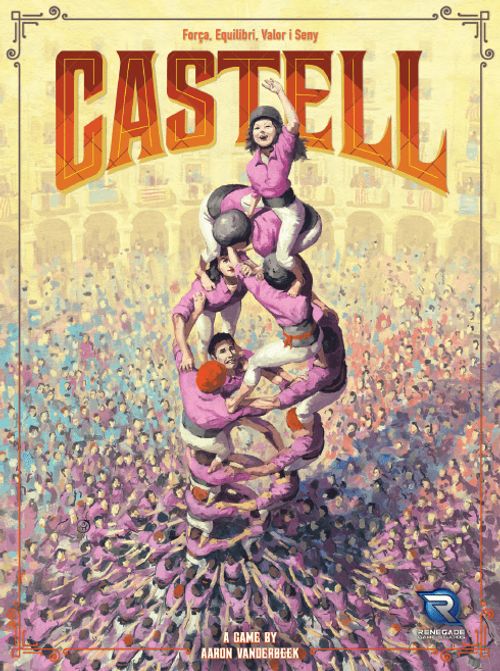
Castell
Castell Rulebook
Table of Contents
Table of Contents
Components
- 1 Game Board
- 4 Player Boards
- 1 Skill Wheel
- 150 Castellers
- 4 Player Pawns
- 28 Special Action Tokens
- 30 Size Tokens
- 8 Board Skill Tiles
- 20 Player Skill Tiles
- 4 Player Aids
- 14 Festival Location Tiles
- 32 Local Performance Tiles
- 40 Prize Tokens
- 4 Score Markers
- 1 Round Marker
- 1 First Player Marker
- 1 Cloth Bag
Setting Up the Game
A. Distribute the Castellers
- Put all 150 castellers into the cloth bag, and shake the bag to ensure they are thoroughly randomized within the bag.
- From the bag, draw castellers randomly and place the appropriate number of them in each of the board's 7 regions. The number varies according to player count:
- 4 players: 5 castellers per region
- 3 players: 4 castellers per region
- 2 players: 3 castellers per region
B. Set the Skill Wheel
-
Set the skill wheel in its designated spot on the right half of the game board. Which side to use depends on your difficulty preference:
- Standard Game: place with the "All Regions" side face up
- Advanced Game: place with the "No Regions" side face up
Place the wheel so that the "All Regions" or "No Regions" is facing north.
-
Shuffle the 8 board skill tiles and place them randomly in the 8 slots surrounding the skill wheel, face up.
C. Create the Festival Calendar
- Sort the festival location tiles into 2 types, according to their backs: "I" and "II."
- Shuffle all of the "I" tiles face down, then deal 1 face up to each "I" space of the game board's festival calendar. Then do the same with the "II" tiles, dealing 1 to each "II" space of the festival calendar.
- Shuffle the 30 size tokens face down, then deal 1 face up to each space below a festival location tile.
IMPORTANT! Certain spaces of the festival calendar are only used at higher player counts. If playing with 2 or 3 players, you will have extra festival location tiles and size tokens. Return these extras to the game box; they will not be needed.
D. Schedule the Local Performances
- Shuffle the 32 local performance tiles face down, then deal 2 face up to each row of the local performance area, along the left edge of the game board.
- Return the 18 unused local performance tiles to the game box; they will not be needed.
E. Prepare the Player Areas
- Give each player a player board and player aid, and the following game pieces in the color of their choice: 1 player pawn, 1 score marker, 7 special action tokens, and 5 player skill tiles. Stack the special action tokens on the corresponding icon of the player board.
- Place all players' score markers on the "★" space of the game board's score track.
- Each player takes 7 castellers randomly from the bag.
F. Final Steps
- Set aside the 40 prize tokens for now. They will come into play during the game.
- Place the round marker on the "1" space of the game board's round track.
- Give the first player marker to whoever has most recently visited Catalonia.
How to Play
A game of Castell takes place over the course of 10 rounds. Your goal is to recruit castellers from the regions of Catalonia, then build towers with those castellers to compete in the festivals. You'll need to train your castellers in various skills so that you can build taller, wider, and more creative towers. The more diverse your performances and the better you tailor your towers to each audience, the higher your final score will be.
Round Structure
Each round follows the same basic structure.
- Add New Castellers: This step occurs ONLY in rounds 3, 5, 7, and 9. (There are icons on the round track to remind you of this.) When adding new castellers, draw castellers randomly from the bag to refill each region until it reaches capacity:
- 4 players: 5 castellers per region
- 3 players: 4 castellers per region
- 2 players: 3 castellers per region
- Rotate the Skill Wheel: Turn the skill wheel exactly 1 space clockwise.
- Player Turns: Each player takes 1 turn. Whoever has the first player marker goes first, then each other player in clockwise order.
- Festival Scoring: This step does NOT occur in rounds 1 and 2. There will be 1 or 2 festivals held in each round — the festival calendar indicates this. If there are 2 festivals, score them individually, in either order. (See FESTIVAL SCORING, p. 10 for details.)
- Round End: Skip this step in round 10. Pass the first player marker to the left. Advance the round marker 1 space on the round track.
Taking Your Turn
On your turn, there are 4 different actions you may (but are not required to) take, in any order you wish. You cannot take the same action more than once per turn.
-
Move: When you take this action, move your pawn to an adjacent region. A region that is touching another region, or connected by dotted line, is considered adjacent to that region.
(The very first time you take this action in the game, you will instead simply add your pawn to the game board, in a region of your choice.)
-
Recruit: When you take this action, recruit up to 2 castellers of your choice from the region where your pawn is located, moving them to your player area.
-
Train: When you take this action, you will increase the rank of 1 of your skills. Look at the skill wheel to determine which skill(s) are currently available to you.
- Standard Game: You may select either the skill in the slot corresponding to your pawn's current region OR the skill in the "All Regions" slot.
- Advanced Game: You may only select the skill the slot corresponding to your pawn's current region.
To increase your chosen skill, move that skill tile up by 1 space on your player board's skill track. If you do not yet own that skill, add the skill tile to the "1" space of your skill track. (See USING YOUR SKILLS, p. 7 for a complete list of the skills and their effects.)
-
Special Action: To take this action, you MUST have 1 special action token available. When you take this action, choose 1 of the 3 options below:
- Single Recruit: Recruit any 1 casteller from your pawn's current region.
- Move: Move your pawn to an adjacent region.
- Local Performance: Build a tower that matches the requirements of 1 of the local performance tiles for your pawn's current region. (See LOCAL PERFORMANCES, p. 9 for details.)
After taking the special action, you must place 1 of your available special action tokens onto the local performance area of the game board. Be sure to put it in the space that matches your pawn's current region.
Building Towers
There are 3 basic rules that you must follow when building towers.
Rule 1: Each level in your tower must be made up of castellers of a single size. Rule 2: Each level built on top of another level must have castellers of a smaller size (i.e., lower number) and must have fewer castellers than the level below it. Rule 3: The maximum width of a level in your tower is 3 castellers.
You can always tear down your tower in order to build a new one for the next festival or local performance. You are never locked into a specific tower configuration.
These are the basic rules for tower building. However, by training in new skills, you can alter these rules in strategic ways to build much more impressive towers. (See USING YOUR SKILLS, p. 7 for details.)
Using Your Skills
Each of your player skills has a current rank (0-5), indicated by that skill tile's position on your player board's skill track. Your rank in a skill indicates how many times you can use that skill in a single tower.
Balance → The Balance skill allows you to build 1 level in your tower with the same number of castellers in it as the level just below it.
Example A: In the base level of Fernanda's tower, she has 3 castellers. Because she is rank 2 in the Balance skill, she is allowed to have up to 3 castellers in each of the next 2 levels also. This makes it possible for her to build a tower 5 levels high.
Base → The Base skill allows you to have 1 level in your tower with an unlimited number of castellers (i.e., ignoring the maximum width restriction for that level). All other levels must adhere to the maximum width restriction, however.
Example B: Because he is rank 1 in the Base skill, Arno can put as many castellers as he wishes in his base level, ignoring the maximum width restriction. This works out well for him because he has a lot of size-8 castellers, which are required for the current festival.
Mix → The Mix skill allows you to have 1 level in your tower in which the castellers can be of mixed sizes. All castellers in a single mixed level must be the same height, which you can determine by comparing the physical height of the castellers. The allowed mixes are 10/9, 8/7, 6/5, 4/3. You can consider a mixed level to be either size (whichever is more advantageous to you) for the sake of building the next level up.
Example C: Jordan doesn't have enough size-9 castellers to build the base she wants. However, because she is rank 1 in the Mix skill, she can add her lone size-10 casteller to make up the difference. Then, using her Balance skill, she can build a level of size-8 castellers that is the same width, directly above that.
Strength → The Strength skill allows 1 level in your tower to support a level of castellers 1 size larger than normal. If you have multiple ranks of the Strength skill, they may be applied to separate levels or combined for the same level.
Example D: Ramani has more size-5 castellers than he can use in a single level. He is rank 2 in the Strength skill, though, so he is able to split his 6 castellers of that size into 3 different levels of 2 castellers each, stacked on top of one another. This is possible because he is also rank 2 in the Balance skill.
Width → The Width skill increases the tower's maximum width by 1. This increase applies to the entire tower, not just the base.
Example E: Because she has so many size-10 and size-9 castellers, Fernanda trained her Width skill to rank 4. She can now have up to 7 castellers on her base level and up to 6 castellers on the level above that. (This is before taking into account her other skills!)
On the skill wheel, there are 2 more skills (Practice, Special) available for which you cannot increase your rank. Instead, when you take the Train action and choose that skill, you immediately carry out the corresponding ability.
Practice → When you choose the Practice skill, increase the rank of any of your currently owned skills by 1. (You cannot practice a skill that you do not yet own.)
Special → When you choose the Special skill, you immediately take a special action. (See the rules for special actions on page 6.) However, you do NOT place a special action token when taking a special action via the Special skill.
Local Performances
Each must be put on in a specific region, indicated by which row that tile occupies on the game board. If your pawn is in that region and you take a special action, you can put on that local performance.
There are 2 different types of local performances: tower shapes and skill exhibitions.
Tower Shapes To put on a local performance of this type, you must build a tower that makes the shape exactly as pictured on the local performance tile, using your castellers and available skills.
Skill Exhibitions To put on a local performance of this type, you must build a tower that meets 2 different requirements, indicated by the local performance tile:
- The tower must have at least as many levels as the tile's point value.
- The tower's construction must utilize all of the indicated skills.
Example F: On her turn, Jordan decides to put on a local performance. Her pawn is in Terrassa, so she chooses a skill exhibition that is available in that region. To meet the requirements of this local performance, Jordan must build a tower that is at least 6 levels high and that uses the Strength skill (1x), Base skill (1x), and Mix skill (2x).
After proving that you can build the tower required for a local performance, claim that local performance tile by moving it to your player area. In addition, take all special action tokens (including your own!) that are in that region of the game board, moving them to the corresponding region of your player board.
Remember: Because putting on a local performance is a special action, after you have finished claiming the special action tokens from that region, you must then add 1 of your available special action tokens in that region.
Festival Scoring
There are festivals that occur at the end of rounds 3-10. If there are multiple festivals occurring in a single round, score each festival individually. In each festival, the participating player who builds the best tower will take the top available prize.
Participation Requirements
There are 3 requirements you must meet in order to participate in a festival:
- On the game board, your pawn must be in the region where the festival is occurring, as indicated by the festival location tile.
- Your tower must contain castellers that match all of the size tokens for that festival. (These castellers must be present in your tower, not just recruited to your team.)
- Your tower must have at least 4 levels.
Example G: It's the end of round 5, and there is a festival occurring in Vilanova. Ramani's pawn is in that region. However, the festival requires castellers of sizes 6 and 8. Ramani has some of both, but not enough size-8 castellers to build a legal tower that includes them. Therefore, he cannot participate in the festival.
Calculating Tower Scores
To calculate the score of the tower you built, add together your scores in these 2 categories:
- +1 VP for each level in your tower (i.e., your tower's height).
- +1 VP for each casteller in your tower that matches a size token for this festival. (If there are multiple of the same size token, score each of them for each matching casteller.)
If this tower score is your best tower score, adjust your score marker on the score track to indicate that score. IMPORTANT: Do not add your tower score to any previous tower score! During the game, your score marker tracks only your single BEST tower score.
Example H: Fernanda is participating in a festival in Valls, where the size tokens are 9 and 3. The tower she builds is 6 levels high, with four size-9 castellers and two size-3 castellers. All told, her tower score is 12 (6 + 4 + 2). This is Fernanda's best tower score yet, so she moves her score marker to the "12" space on the score track.
Earning Prizes
After all participating players have calculated their tower scores for a festival, it's time to award prize tokens, based on final placement in that festival. Use the prize chart below:
| Players at the Festival | Prize Earned |
|---|---|
| 3+ players | 1st place: Trophy (5 VPs) |
| 3+ players | 2nd place: Medal (3 VPs) |
| 3+ players | 3rd place: Ribbon (1 VP) |
| 2 players | 1st place: Medal (3 VPs) |
| 2 players | 2nd place: Ribbon (1 VP) |
| 1 player | 1st place: Ribbon (1 VP) |
If 2+ players are tied for a place, then they each receive the prize for the next lowest place.
Example I: Arno, Fernanda, and Jordan are all participating in a festival. Arno and Jordan tie with a tower score of 17, while Fernanda manages a tower score of 9. Because they tied for first place at the festival, Arno and Jordan each receive a medal. This pushes Fernanda down to third place, so she receives a ribbon.
Claiming Size Tokens
For each festival, there will be 1-3 size tokens available. These represent the casteller sizes wished for by the audience. Among all players participating in that festival, the player who has the most castellers of that size in their tower claims that size token. (If there is a tie, nobody earns the token and it should be discarded to the box.) When claiming a token, immediately put it on your player board, in the region where that festival took place.
Example J: In this festival in Mataró, the size tokens are 10, 7, and 2. Only Ramani and Jordan are participating in this festival. Jordan claims the 10 token, as she had more size-10 castellers in her tower. Likewise, Ramani claims the 2 token, as he had more size-2 castellers. They tied for the number of size-7 castellers, so neither player claims the 7 token.
End of the Game
After festival scoring has occurred at the end of the 10th round, the game is over, and it is then time to calculate final scores. To do so, each player will separately evaluate 5 categories:
1. Best Tower Score
Your best tower score should be marked already, by the location of your score marker on the score track. Remember: You do not score every tower you build during the course of the game, only your single BEST tower!
2. Region Variety Bonus
Count the total number of regions where you have earned prizes, size tokens, and/or special action tokens. You score bonus victory points according to the chart below:
| Regions | 1 | 2 | 3 | 4 | 5 | 6 | 7 |
|---|---|---|---|---|---|---|---|
| VPs | 0 VP | 1 VP | 3 VPs | 5 VPs | 7 VPs | 10 VPs | 14 VPs |
3. Earned Prizes
Score victory points for all of the prize tokens you earned during festivals. Each trophy you have is worth 5 VPs, each medal you have is worth 3 VPs, and each ribbon you have is worth 1 VP.
4. Size Tokens
Score 2 VPs for each unique size token you have, then 1 VP for each duplicate size token.
5. Local Performances
Count the total number of VPs listed on all of the local performance tiles you have claimed, and add them to your score. Score 1 VP for each special action token that you collected via putting on local performances.
Example K: Arno is calculating his score at the end of a 4-player game. His best tower score was 18 VPs. He scored a bonus 5 VPs for claiming tokens from 4 different regions. His 2 trophies, 1 medal, and 3 ribbons translate to 16 VPs. He has 5 unique size tokens and 2 duplicates for 12 VPs. Lastly, the 3 local performance tiles he claimed are worth 14 VPs. Arno's final score is 65 VPs.
After player scores across all 5 categories have been added up, the player with the highest total score is named the winner, and their castell team is crowned the champions of Catalonia! (If there is a tie for highest total score, the tied players share the victory.)