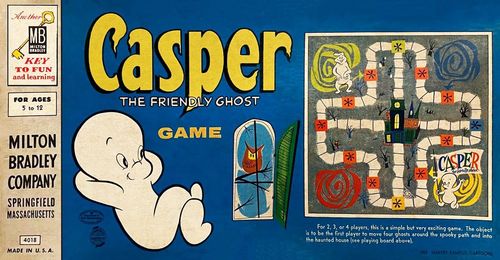
Casper the Friendly Ghost Game
Casper the Friendly Ghost Game Rulebook
Table of Contents
Table of Contents
Object of the Game
The object of the game is to be the first player to move all 4 of his playing pieces (ghosts) around the spooky path and enter the haunted house.
To Play
- Each player selects 4 discs of one color and places them in the ghostly circle at his right. (Be sure to sit around the playing board so that the circle to your right matches the color of your 4 discs.)
- All players spin the dial. High spin wins first play.
- The number spun is determined by the small figure in the second circle to which the arrow points, plus the large figure in the adjoining space in the inner circle. When these two figures are the same they count as Doubles.
- Players play in turn, clockwise around the board.
- Each player first attempts to enter one or more of his discs on the black star space to the left of his circle. This is done by spinning the dial and when the total sum of both numbers equals five, he enters one disc. If double 5 is spun, two discs may be entered. If five and some other number is spun, enter one disc for the five and move that disc, or any other in play, as many spaces as the other number indicates. It is advisable to enter all the discs as soon as possible.
- When a player has entered a disc, he moves it around the board from space to space until it reaches its matching colored star space directly in front of the player. (Example, if your discs are yellow, you started them from the yellow circle, and moved them around the board to the yellow star space in front of you.)
- Then from the matching colored star space, the disc is moved up that path to the "Home" space in the center of the board.
- In making the moves the numbers in the two circles may be added together, and one disc moved the total number of spaces, or two discs may be moved, one as many spaces as the number in one circle and another as many as the number in the other circle.
- Doubles . . . If doubles are spun, it is used as that number four times; as when "Double 6" is spun all four discs may be moved 6 spaces each, any two discs 12 spaces each, or any one disc 24 spaces. When it is impossible for a player to move his disc or discs the full number of spaces to which he is entitled his turn is lost. If doubles are spun 3 times in a row, the player must bring his disc that is nearest "Home" back to his starting circle, and his turn ends.
- Capturing . . . When a player's disc lands on one of the white spaces occupied by one disc of another player, the latter is captured and sent back to his own starting circle to reenter the game as in the beginning. The captor is credited with 20 extra moves which he must take in this turn by moving any one disc the whole 20 spaces. A player is not obliged to capture an opponent's disc, but it is usually for his interest to capture as often as possible, in order to delay his opponents.
To Win the Game
The first player to succeed in landing all four of his discs in the "Home" space wins the game.