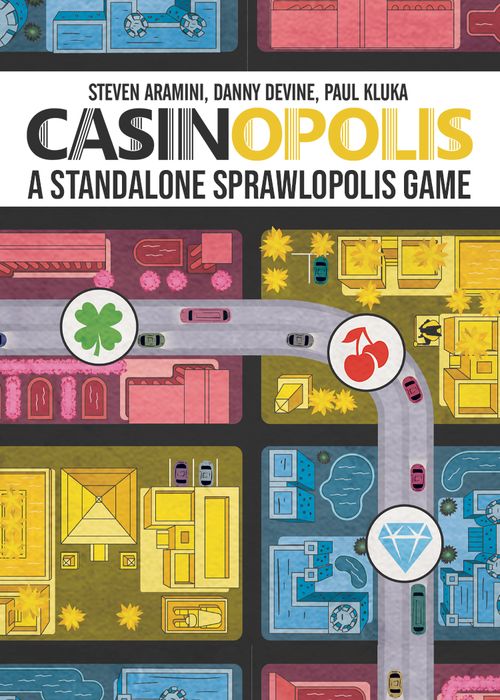
Casinopolis
Casinopolis Rulebook
Table of Contents
Table of Contents
COMPONENTS
18 cards with blocks and scoring conditions
SETUP
- Shuffle the cards. Draw 3 cards, one at a time, placing them in a row from left to right with their scoring conditions face up. Do not rearrange them, as their positions matter! From left to right, they are your one-chip, two-chip, and three-chip scoring conditions that apply to this game. Each of the scoring condition cards has a unique number on it. Add these three numbers together. This gives the Target Score (the total points your team must equal or exceed to win).
- Choose a start player and deal them 3 cards, keeping their "blocks" side face down. Deal 1 face-down card to all other players. Take your card(s) into your hand without revealing the "blocks" side to your fellow builders.
- Set the remaining cards off to the side with the "blocks" side face up to form the draw deck. Note that this gives all players a preview of the top card in the deck.
- Place the top card of the deck into the Build Area to start your map.
- Play begins with the start player and continues clockwise.
TWO PLAYER EXAMPLE SETUP
One-chip, two-chip, and three-chip scoring condition cards are laid out in the Build Area row, showing Target Score: 5 + 17 + 9 = 31. Player 1 and Player 2 each hold a hand of cards (do not reveal), and the remaining cards form the deck.
BLOCKS
A "block" is defined as a rectangular quadrant in one of three casino types: Egyptian (gold), Medieval (blue), and Roman (red). Each card has four blocks: two blocks of one type, and one block each of the other two types.
CASINOS
A casino is a group of blocks of one type connected by at least one edge.
ROADS AND THE STRIP
Each card contains one or two roads. A road is defined as a continuous stretch of roadway that may be as short as one block (before it dead ends at a block edge or the edge of the map) or several blocks long. Your longest road is called the Strip. If you have two roads that are tied for longest, choose one of them to be the Strip.
SLOT ICONS
Each section of road has 1 slot icon on it:
| Fruit Icon | cherries, lemon, plum |
|---|---|
| Luck Icon | four-leaf clover, diamond, horseshoe |
RESORTS
While roads and icons play an important role in scoring, some blocks called "Resorts" have neither roads nor icons. A resort may be connected to a casino and counts as a block in that casino.
BUILDING THE MAP
If you are the start player, choose 1 of your 3 cards in hand, reveal it and add it to the map with the block side face up. After playing your card, pass your 2 remaining cards to your left neighbor. They now have 3 cards in hand and become the start player for the next turn.
Finally, draw the top card from the deck so that you have 1 card in hand. If there are no more cards in the deck, continue playing with an empty hand. If you have fewer than 2 cards to pass when your turn is over, pass the remaining cards you have.
Continue until all 15 cards have been added to the map.
PLACEMENT RULES
On your turn, you must place a card so that at least one block edge meets an existing block edge or you may place your card so that it overlaps or covers a block (or multiple blocks) with your new card.
You may NOT tuck a card under a card in your map.
You may NOT place a card so that it only connects to your map by a corner.
When placing a card, you may rotate it 180°, but you must place the card horizontally.
Creating an open space or gap in your map is allowed, so long as you adhere to the above placement rules.
TABLE TALK
Discussing cards is not only legal, but encouraged! You may discuss anything you want, but do not show your hand to anyone. Once you choose your card and reveal it, you must play it. But feel free to discuss placement!
FINAL SCORING
When all 15 cards have been played, your map is complete! Tally your team's final score.
Casinos: Score 1 point per block in your largest casino of each type that is on the Strip. If 2 or more casinos tie for largest, choose one to score.
Example (see map diagram below): 7 Egyptian, 2 Medieval, and 1 Roman = 10 points.
Jackpots: Check your roads for any jackpots: 3 or more of the same slot icon adjacent to one another along the same road. Score 1 point per icon in each jackpot.
4 points for the adjacent cherry icons on a road and 3 points for the adjacent lemon icons on a road = 7 points.
Scoring Conditions: Score points for each of the 3 scoring conditions revealed during setup. Score 1 point each time you achieve the one-chip scoring condition, 2 points each time you achieve the two-chip condition, and so on.
2 points (2×1) for the one-chip condition, 18 (9×2) for the two-chip, and 3 (1×3) for the three-chip = 23 points.
Roads: Subtract 1 point from your total score for each road in your map, including the Strip.
8 roads = -8 points.
Add the points earned from your casinos, jackpots, and scoring conditions, then subtract for your roads to get your final score. If this final score equals or exceeds the Target Score from your 3 scoring condition cards, you win!
Scoring Example
Scoring condition cards used in the example: 5 ROADS TO RICHES (points per road with at least 2 turns), 17 FRUIT LOOPS (points per fruit icon in each road that forms a complete loop), and 9 LIVIN' ON THE EDGE (points per corner block in your largest casino; corner blocks have 2 exposed edges).
TARGET SCORE: 5 + 17 + 9 = 31
FINAL SCORE: 10 + 7 + 23 - 8 = 32
SOLO PLAY
Play is identical to the cooperative game, except you have one hand of 3 cards to work with each turn. After placing each card, draw a new card if possible and take your next turn.