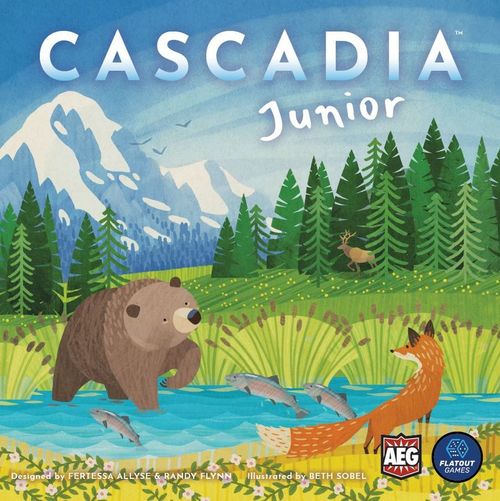
Cascadia Junior
Cascadia Junior Rulebook
Table of Contents
Table of Contents
Components
Your game of Cascadia Junior should include the following. If it doesn't, please visit: alderac.com/customer-service
50 Habitat Tiles — Each Habitat Tile is made up of two hexagons, each with a habitat type and a wildlife type that can live in that habitat!
90 Wildlife Markers (18 Bear, 18 Elk, 18 Fox, 18 Hawk, 18 Salmon) — These markers are placed on the Habitat Tiles when you make groups of 3 animals!
30 Habitat Sighting Tokens (6 Forests, 6 Wetlands, 6 Prairies, 6 Mountains, 6 Rivers) — Earn these tokens at the end of the game by connecting groups of 3 or more of the same habitat - place them on your Panorama Board!
30 Wildlife Sighting Tokens (6 Bear, 6 Elk, 6 Fox, 6 Hawk, 6 Salmon) — Earn these tokens by connecting groups of 3 of the same animal - place them on your Panorama Board!
5 Wildlife Cards — 1 card for each of 5 different wildlife types with advanced scoring rules on the back!
4 Panorama Boards — Place your earned Sighting Tokens here to build your picture of Cascadia!
1 Rulebook — To learn how to play the game!
Setup
1. Give each player a Panorama Board. If players would like a reminder of how to score, they will use the side with the scoring aid; otherwise, they will use the other side. Each player places their own Panorama Board in their own play area.
2. Shuffle the Habitat Tiles facedown in the center of the table and:
a. Gather a number of facedown Habitat Tiles based on the player count (11 tiles per player, plus 1):
| Players | Habitat Tiles used |
|---|---|
| 2P | 23 tiles (or remove 27 of the 50 Habitat Tiles) |
| 3P | 34 tiles (or remove 16 of the 50 Habitat Tiles) |
| 4P | 45 tiles (or remove 5 of the 50 Habitat Tiles) |
Place these Habitat Tiles in the center of the table in facedown stacks.
Return the removed Habitat Tiles to the game box - they will not be used this game.
b. Give each player one random Habitat Tile from the facedown stacks. They will flip it over and place it faceup to start their Environment on the table in front of them. Be sure to leave some space around it to grow your Environment during the game!
c. Flip 2 Habitat Tiles from the facedown stacks faceup and place them in the center of the table to form the market. The market is where players will draw tiles from each turn.
3. In the center of the table next to the market: Arrange the 5 Wildlife Cards in a row, with side 'A' faceup. (Note: for advanced scoring rules, see the Advanced Mode section.)
d. Place the Wildlife Markers next to their matching Wildlife Cards.
e. Shuffle the Wildlife Sighting Tokens and place them next to their cards in stacks so that their backs (side with Conifer Cones) are not visible.
f. Shuffle the Habitat Sighting Tokens and place them in stacks so that their backs (side with Conifer Cones) are not visible.
You're now ready to play Cascadia Junior!
Gameplay
Starting with the youngest player, players take turns one at a time, carrying out the following steps each turn, in order:
1. Choose Land
Select one of the two faceup Habitat Tiles from the market in the center of the table.
2. Add Land
Add the selected tile to your Environment (the Habitat Tiles in your play area in front of you) with at least one side touching another tile. (Try to group wildlife of the same type and habitats of the same type together in order to get the most sightings and score more points!)
3. Check Wildlife
Do the wildlife icons on any three connected uncovered hexagons match? (They can be in any shape of three, as long as all three are connected to one another and not yet covered.) If they do:
- Take 3 matching Wildlife Markers and place them on those hexagons, covering the wildlife icons on each.
- Take a Wildlife Sighting Token for that animal and place it on your Panorama Board! (You can't look at the back of the token until the end of the game, but you can decide where to place it to create your perfect Cascadian nature scene!)
4. Refill the Market
Draw a single facedown Habitat Tile from any of the facedown stacks and flip it faceup into the market so there are 2 tiles for the next player.
Play then passes to the next player in clockwise order and they take their next turn.
Game End
The game ends when each player has taken 10 turns and placed 10 Habitat Tiles in their Environment in addition to the one they started with. (This will happen after the last player in turn order has taken their choice of the final 2 Habitat Tiles. One Habitat Tile will remain in the market at the end.) Now you will check to see how many Habitat Sightings you have earned!
Check Habitats
For each of the 5 habitat types (Forests, Mountains, Prairies, Wetlands, Rivers) each player checks to see if they have 3 or more of the same habitat hexagons next to each other in connected groups. (They can be in any shape, as long as they are connected to one another.) If they do:
a. For groups of 3, 4, or 5 hexagons: take 1 Habitat Sighting Token of the matching habitat type and place it on your Panorama Board.
b. For groups of 6 or more: take 2 Habitat Sighting Tokens of the matching habitat type and place them on your Panorama Board.
Scoring
Check Sightings
Players flip over all of the Wildlife and Habitat Sighting Tokens on their Panorama Board and count the total number of Conifer Cones (1 or 2) on their backs. The player with the most total Conifer Cones wins! If any players are tied, then the tied players share the victory! See the Scoring Example for more details.
Scoring Example
Wildlife Sightings:
- 2 Salmon groups
- 1 Bear group
- 1 Elk group
- 1 Hawk group
- 1 Fox group
Habitat Sightings:
- Group of 7 Wetlands
- Group of 5 Forests
- Group of 4 Prairies
= 15 Conifer Cones
Advanced Mode
Play the game using the standard rules, except during setup, flip over each of the Wildlife Cards so that their side 'B' is faceup. This side of the card shows hexagon shapes in patterns. In the Advanced Mode of Cascadia Junior, when players Check Wildlife each turn, they must have 3 wildlife of the same type in the shape shown on the matching Wildlife Card. These patterns may be mirrored or rotated.
Quick Scoring Reference
During game: Group of 3 (matching wildlife) = 1x Wildlife Sighting Token (Bear / Elk / Salmon / Hawk / Fox).
At game end: Group of 3/4/5 (matching habitat) = 1x Habitat Sighting Token; Group of 6+ = 2x Habitat Sighting Tokens (Forest / Wetland / Prairie / Mountain / River).
MOST Conifer Cones = 1st place.
Wildlife Facts
Grizzly Bear — The Grizzly Bear is also called the Brown Bear. These bears mostly eat berries, fruits, nuts, roots, and salmon! They are hungry creatures and can eat nearly 100 pounds of food in a single day! Sometimes they stand on their hind legs, to get a better view of the landscape. Today they are mainly found in the northern part of Cascadia (British Columbia and Southeast Alaska).
Roosevelt Elk — Roosevelt Elk are very large! They live in coastal forests and mountains throughout the Pacific Northwest and were named after United States President Theodore "Teddy" Roosevelt. Elk are herbivores, which means that they only eat plants. They like to eat all kinds of plants from ferns to flowers. They communicate by bugling, which is a combination of roaring and whistling at the same time!
Red Fox — While extremely common across most of North America, the Red Fox is a rarer sight in Cascadia. The Cascade Red Fox is found in the prairies and subalpine areas of the Cascade Mountains. Foxes are clever hunters and have a very diverse diet of many different foods - small rodents, birds, eggs, and even insects!
Red-tailed Hawk — Red-tailed Hawks are found across North America and are one of the region's most common birds. They build large stick nests that may be reused for several years. They are birds of prey, eating mostly mice or rabbits.
Chinook Salmon — Just one of the many salmon species in Cascadia, Chinook Salmon are the largest. They are born in the rivers, spend a few years out in the ocean, then return to the same river to spawn - laying eggs to create baby salmon! Salmon are under threat due to human settlement and changes to their environments.