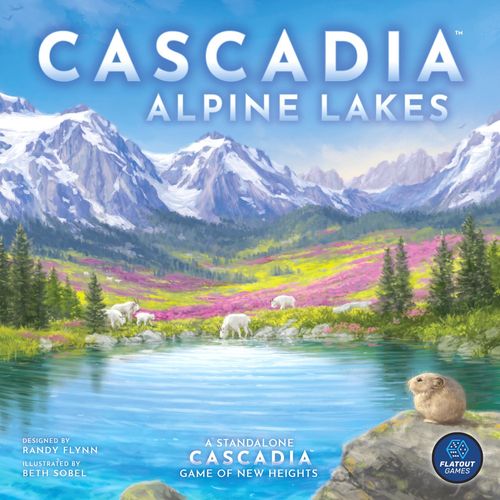
Cascadia: Alpine Lakes
Cascadia: Alpine Lakes Rulebook
Table of Contents
Table of Contents
Components
Your game of Cascadia: Alpine Lakes should include the following. If it doesn't, please go to: alderac.com/customer-service
- 4 Starter Habitat Tiles (quadruple hexagons)
- 84 Habitat Tiles (double hexagons with a combination of forest, meadow, and glacier habitats)
- 1 Family/Intermediate Scoring Card
- 27 Environment Scoring Cards (9 Wildlife, 9 Habitat, 9 Spatial)
- 90 Deluxe Wooden Wildlife Tokens (18 Cougar, 18 Eagle, 18 Marmot, 18 Mountain Goat, 18 Pika)
- 1 Wildlife Elevation Scoring Card
- 1 Lake Scoring Card
- 12 Habitat Scoring Cards (4 Forest, 4 Meadow, 4 Glacier)
- 34 Nature Tokens (Cones from the mighty Douglas Fir)
- 1 Deluxe Cloth Bag (for Wildlife Tokens)
- 1 Alpine Animals Cascadia Mini-Expansion Card (For use with the original Cascadia game)
- 1 Full Color Scorepad
- 1 Rulebook
Setup
- Place all Wildlife Tokens in the Cloth Bag and shuffle them thoroughly.
- Determine how many Habitat Tiles you need, based on the number of players. Randomly select these tiles (do not look at the tiles you include or exclude).
- 2 players: 43 (or remove 41)
- 3 players: 63 (or remove 21)
- 4 players: 83 (or remove 1)
- Shuffle the Habitat Tiles and stack them facedown (any number of stacks) within easy reach of all players. Place any excluded Habitat Tiles back into the box, they will not be used this game.
- Randomly select 1 Habitat Scoring Card for each of the three habitats (Forest, Meadow, and Glacier), then place those three cards in the center of the play area within easy view of all players. Place the other Habitat Scoring Cards back in the box, they will not be used this game. (For your first game, we recommend using Habitat Scoring Card 'A' for each Habitat).
- Place the Lake Scoring Card and Wildlife Elevation Scoring Card in the center of the play area within easy view of all players.
- Randomly distribute one Starter Habitat Tile to each player, placing it faceup in front of them. If any are left over, place them back in the box, they will not be used this game.
- Reveal 4 Habitat Tiles from the facedown stacks and place them faceup in the center of the play area, within easy reach of all players.
- Draw 4 Wildlife Tokens from the Cloth Bag and pair them, in order, with each of the 4 Habitat Tiles to form 4 combinations of 1 tile and 1 token.
- Place the Nature Tokens within easy reach of all players to form the supply.
- The player who most recently saw an alpine lake or one of the wildlife in the game, will be the first player. Or, you may select randomly.
[Optional] Advanced Setup: Environment Scoring Cards are used in the Advanced Mode and can be added to any game of Cascadia: Alpine Lakes to add variable scoring goals. These are divided into 3 decks - Wildlife, Habitat, Spatial - each with their own unique goals. Each of these goals are shared between all players - any player may score based on the conditions (see the Environment Scoring Card Clarifications section for further clarifications).
To play with Environment Scoring Cards, select 1, 2, or 3 cards to use in the game, then place those cards in the play area within easy view of all players. Select no more than 1 card from each of the 3 Environment Scoring Card types (Wildlife, Habitat, Spatial) - do not play with multiple of the same type.
You may select the cards by shuffling each of the decks and drawing randomly, or simply choose cards based on the players' preference. Place the other Environment Scoring Cards back in the box, they will not be used this game.
(Note: for your first game we recommend not using any Environment Scoring Cards)
Gameplay Overview
Beginning with the first player and proceeding clockwise around the table, players will take turns drafting Habitat Tiles and Wildlife Tokens and adding them into their expanding environment, until the end of the game.
Each turn is played in phases: 1. Select a Habitat Tile and a Wildlife Token and 2. Place the Tile and Token into your environment. (Note: An environment is the full arrangement of tiles and tokens in front of each player that includes their Starter Habitat Tile).
At the end of each player's turn, both the Habitat Tile and Wildlife Token selected will be replaced with new ones from the Habitat Tile stacks and Cloth Bag, respectively.
The object of the game is to score the most points by:
- Completing Habitat Scoring goals as outlined on the Habitat Scoring Cards.
- Placing lakes as high as possible in their environment and surrounding them by other tiles.
- Placing each of the 5 Wildlife types as high as possible to score the most points and compete against other players for the highest animal of each type.
- Collecting Nature Tokens by playing Wildlife Tokens onto Keystone hexagons.
- (If playing the Advanced Mode) Gain points from successfully completing the Environment Scoring goals as outlined on the Environment Scoring Card(s).
The game ends when there are no more Habitat Tiles available to replace one selected by a player. (Note: at the end there will be 3 Habitat Tiles remaining in the center and each player will have played exactly 20 turns). The game then proceeds to final scoring and the player with the most points is the winner!
Turn Summary
1. Select a Habitat Tile and Wildlife Token
At the start of each turn, there will be four Habitat Tiles and four Wildlife Tokens in the center of the play area. They will be arranged in four distinct combinations, each with one Habitat Tile and one Wildlife Token - providing four choices.
Before you make a selection, check to see if any of the wildlife are overpopulated:
(A) If all 4 of the available Wildlife Tokens are the same, they are automatically wiped. Set aside all 4 tokens, then draw 4 new tokens one-at-a-time from the bag. Pair each one, in order, with a Habitat Tile. (Note: this could happen multiple times on any given player's turn).
(B) If 3 of the available Wildlife Tokens are the same, then the active player may choose to wipe these tokens. Set aside only those 3 tokens, then draw 3 new tokens one-at-a-time from the bag. Pair each one, in order, with a Habitat Tile. (Note: You may only do this once per turn).
Once all over-populations have been resolved, place all wiped tokens back into the Cloth Bag.
You will now select one Habitat Tile + Wildlife Token combination. Typically, you must take an existing combination.
However, before you do, you may optionally spend a Nature Token (You will acquire these when placing wildlife tokens on specific tiles, see the Tile/Habitat Overview below) to do one of the following:
- Take ANY one of the four Habitat Tiles and ANY one of the four Wildlife Tokens. (Note: this replaces your primary action this turn, you still only draft one Habitat Tile and one Wildlife Token per turn, you may simply select any available, disregarding their pairings).
- Wipe ANY number of Wildlife Tokens and replace them. (See overpopulation rules above for replacement process).
The spent Nature Token is placed back into the supply. There is no limit to the number of Nature Tokens you may spend on your turn to wipe Wildlife Tokens. If you do not have any remaining Nature Tokens, you must take an existing combination.
At the end of the game, any unused Nature Tokens you have are worth 1 point each.
2. Place the Tile and Token into Your Environment
Once you have selected your Habitat Tile and Wildlife Token, you will place them into your environment in any order. You will want to pay attention to the Habitat Scoring Cards when making your decision about where to place them. The Habitat Tile must be placed into your environment according to one of the following two placement rules:
- On the first level, the Habitat Tile may be rotated and placed adjacent to any Habitat Tile already in your environment, that is, the Habitat Tile must touch at least one side of another previously placed tile, or the Starter Habitat Tile.
- The Habitat Tile may be rotated and placed on top of one or more tiles already in your environment as long as these rules are followed:
- The new tile must be placed on two hexagons in your environment that are at the exact same elevation/level (the hexagons may be on a single tile, or on two separate previously placed tiles).
- If either of these existing hexagons in your environment has a wildlife token on it, the new tile's hexagon(s) that will cover it must also allow that type of wildlife to be placed on it.
- A new tile must be placed such that its elevation/level is no more than one elevation/level higher than at least one space adjacent to it.
(In the rulebook's diagram, a new tile cannot be placed on top of the elevated tile, because the new tile would be more than one level higher than all other surrounding spaces.)
If, when placing a new tile, it will cover a hexagon or hexagons that already have Wildlife Tokens on them, any tokens must be elevated onto the new tile (remember, this may only be done if the wildlife type(s) on the new hexagon(s) also allow that type of wildlife). If one of those tokens ends up on a Keystone hexagon on the new tile, the player also earns a Nature Token just as they would have, had they placed the Wildlife Token that turn (see the Tile/Habitat Overview below).
PIKA TIP! Remember, as you increase the height of your environment, there is a good chance you will change the habitat type under animals over the course of the game!
The Wildlife Token may be placed onto one hexagon of a Habitat Tile according to the following placement rules:
- The hexagon must not already have a Wildlife Token on it. (Note: this means you will only ever have, at most, one Wildlife Token per hexagon on a Habitat Tile).
- The hexagon must show the matching wildlife (most hexagons display 1-3 options on them, but hexagons with lakes do not show an option). (Note: this means you may never place a Wildlife Token on a hexagon with a lake).
If you cannot legally place the Wildlife Token because no open Habitat Tile can support that wildlife, or if you choose not to place the Wildlife Token, return this token to the Cloth Bag. (Note: this is the only point at which you may discard a Wildlife Token. Once it is placed in your environment, it cannot be moved or discarded.)
You may place the Wildlife Token onto the Habitat Tile you just selected on your current turn, or you may place it onto any other available Habitat Tile, according to the placement rules, above.
If you place your Wildlife Token onto a Keystone hexagon, take a Nature Token from the supply. (See Tile/Habitat Overview below and the Scoring Example section)
PIKA TIP! Remember, if you place your selected new Wildlife Token first, it is possible to earn two Nature Tokens - one when placing, and one if elevating an animal, if the new tile has a Keystone hexagon and is placed on top of any hexagon already occupied by a Wildlife Token of that type!
Tile/Habitat Overview
- A Forest hexagon that is also a Keystone Tile: whenever you place or elevate the matching Wildlife Token onto a Keystone Tile, you gain a Nature Token. EACH separate Forest corridor (contiguous group of hexagons, regardless of height) scores, so it MUST be separate and scores based on the number of unique animals within it.
- A Meadow hexagon: you can place a Marmot, Eagle, or Cougar Wildlife Token on this tile. Meadow habitats are the simplest and most forgiving - Wildlife Tokens generally score points for being in contiguous groups and multiple groups may be in the same Meadow corridor.
- A Glacier hexagon that also has a Lake on it: you score more points for Lakes by placing them on higher elevations and by surrounding them with other hexagons. You cannot place Wildlife Tokens on Lakes. EACH Glacier corridor scores, so they MUST be separated and they each score if the conditions are met.
IMPORTANT NOTE: Each of the Habitat Scoring Cards has a diagram depicting how to score the habitat. These diagrams show different wildlife types, but are only one example of how they may be scored. Unlike the Wildlife Scoring Cards in the original Cascadia game, for example, Habitat Scoring Cards generally do not require SPECIFIC wildlife types to score, rather specific configurations of the SAME or DIFFERENT wildlife.
See the Habitat Scoring Cards and the Clarifications section below for clarification on the specifics of how each different Habitat Scoring Card scores.
After you have placed the Habitat Tile and Wildlife Token you selected, replace each one in the center of the play area. The Habitat Tile is replaced from the top of any face-down stack. The Wildlife Token is replaced by randomly selecting one from the Cloth Bag. (Note: when replacing tiles and tokens in the play area, do not move the existing tiles and tokens. Simply refill the empty spots.)
Your turn is now complete. Play passes clockwise to the next player.
If, at the end of any player's turn, there are no face-down Habitat Tiles left in the stacks to replace the one taken, the game ends immediately and scores are tallied. (Note: each player will play exactly 20 turns).
End Game & Scoring
Record scores on the Scorepad for the following:
- Habitat Scoring Cards - each of the 3 types
- Lakes
- Wildlife Elevation - each of the 5 types
- Nature Tokens
- Environment Cards (if playing Advanced Mode)
Habitat Scoring Cards
For each player, score each Habitat based on the Habitat Scoring Cards used in the game. Habitat Scoring Cards refer to contiguous habitat corridors (groups of contiguous, adjacent hexagons of the same habitat type, regardless of height). Each card has different ways to score the habitats.
(Reminder: each card has diagrams depicting examples of wildlife that may score the Habitat Scoring Card, however, the wildlife type is generally not specific. Habitat Scoring Cards generally score based on having configurations of the SAME or DIFFERENT of any wildlife type - see the Habitat Scoring Card Clarifications in the Clarifications section)
Lakes
For each player, score each lake visible in their environment. Each lake scores 1 point per level of its height/elevation. (For example, a lake on level 3 is worth 3 base points). This number of points is doubled if the lake is completely surrounded by other tiles. (For example, a lake on level 3 that is completely surrounded by other tiles - regardless of whether they are populated with Wildlife Tokens or not - scores 3 X 2 = 6 points.)
Wildlife Elevation
For each player, score each wildlife type based on the height/elevation of the Wildlife Tokens of that type in their environment:
First, each Wildlife Token of that type on level 3 or higher scores 2 points.
Then, according to the player count, score bonus points for having the HIGHEST wildlife of that type. To do this, determine which player has the highest wildlife of each type, with ties broken by quantity of that wildlife at each level. If two players have the same number of Wildlife Tokens at the same highest height/elevation, then the tied players' Wildlife Tokens at the next highest height/elevation are used to compare, if still tied, the next highest is used, and so on. If players are completely tied, see below for resolving points based on ties.
- Solo game: 2 point bonus for each wildlife type with either 2+ Wildlife Tokens at level 3 or 1+ Wildlife Token at level 4.
- 2-player game: 2 point bonus to the player with the HIGHEST wildlife for each of the wildlife types. If tied, 1 bonus point each. No bonus points for second highest.
- 3/4-player game: 3 point bonus to the player with the HIGHEST wildlife for each of the wildlife types. 1 point bonus to the player with the second highest (any ties for second highest result in 0 points each). If two players tie for the highest, 2 points each, no points for next highest. If three or four players tie for highest, 1 point each, no points for next highest. Any ties for second highest, 0 points each.
Nature Tokens
For each player, score 1 point for each unused Nature Token.
Environment Scoring Cards [Advanced Mode Only]
For each player, score each Environment Scoring Card used in the game. (See the Environment Scoring Card Clarifications in the Clarifications section)
Finally, tally all points and the player with the most points wins! In the case of a tie, the tied player with the most Nature Tokens wins. If still tied, the tied players share the victory.
See the Scoring Example below for a scoring example with further clarifications.
Scoring Example
Scoring this Environment:
- FORESTS: One forest corridor with 3 unique animals, one with 2, and two with 1 for 7 + 4 + 2 + 2 = 15 points (Note: forest corridor that contains 2 Pikas only scores for 3 unique animals - one of the Pikas does not count for Forest scoring)
- MEADOWS: One group of 3 animals (Mountain Goats) and two groups of 1 animal each (Eagle and Marmot) on meadows for 8 + 2 + 2 = 12 points (Note: multiple different groups may exist within the same Meadow corridor)
- GLACIERS: Three glacier corridors that have adjacent pairs of the same animals (Marmots, Eagles, and Cougars) for 18 points (Note: the Glacier with a single Marmot does not score because it does not contain a matching adjacent pair of Marmots)
- LAKES: 4 Lakes - 1. Forest Lake at height/elevation level 2, completely surrounded by tiles (2 X 2 = 4 points) 2. Meadow Lake at height/elevation level 3 and completely surrounded by tiles (3 X 2 = 6 points) 3. Meadow Lake at height/elevation level 1 and not completely surrounded by tiles (1 point) 4. Glacier Lake at height/elevation level 2 and completely surrounded by tiles (2 X 2 = 4 points) - for a total of 4 + 6 + 1 + 4 = 15 points
- WILDLIFE ELEVATION: 1 Marmot, 1 Mountain Goat, and 1 Pika at height/elevation levels 3+ for 2 points each = 6 points, and this player's Pikas were the highest of all players (3 extra points) and Marmots and Mountain Goats were the second highest of all players (1 extra point each) - for a total of 6 + 3 + 1 + 1 = 11 points
- NATURE TOKENS: Two unused Nature Tokens for 2 points
[Advanced Mode Scoring - Environment Scoring Cards] - this game was played using 3 different Environment Scoring Cards.
- Wildlife Scoring Card 1: 6 Mountain Goats = 6 points
- Habitat Scoring Card 1: 12 total habitat corridors (4 each of Forest, Meadow, and Glacier) = 6 points.
- Spatial Scoring Card 1: 3 adjacent pairs of animals on different habitat types (Eagles, Mountain Goats, Marmots) = 3 points (Note: each animal may only count towards a single adjacent pair)
- Total = 15 points
Total points from Habitats, Wildlife, Nature Tokens, and Environment Scoring Cards: 60 + 11 + 2 + 15 = 88 points
Variants
Family Variant
Setup: The Family Variant setup is the same as the Standard Setup with an exception for step 4. Use ONLY the Family Variant Habitat Scoring Card instead of the typical Habitat Scoring Cards.
Turn Summary: No changes (see Turn Summary above).
End Game & Scoring: Follow scoring as above, but for each habitat corridor, score each contiguous group of animals based on the card. You may also choose NOT to award points to the player(s) with the highest of each wildlife, only scoring for each animal on level 3+.
Family Variant Scoring Card: Score points shown for each group of the same wildlife within the same habitat corridor, depending on the group size. Groups may be in any shape.
Intermediate Variant
The Intermediate Variant plays the same as the Family Variant but uses the Intermediate Variant Habitat Scoring Card which has different scoring for different sized groups.
Solo Mode
Setup: Follow the setup for a 2-player game with the following exceptions: only give yourself a Starter Habitat Tile, remove 1 additional Habitat Tile (only use 42), and place the stacks of Habitat Tiles to the left side of the play area. (Note: you may choose to play with the Standard Setup, or Advanced Mode with Environment Scoring Cards).
Turn Summary: Follow a turn as usual, but before you replace the Habitat Tile and Wildlife Token in the display, discard the tile and token furthest from the draw stacks, then slide the remaining two tiles and two tokens away from the draw stacks. The discarded tile and token are removed from the game. Then, draw two new Habitat Tiles and two new Wildlife Tokens and place them in the display as usual.
Example: Molly used a Nature Token to select the Pika and the Glacier/Meadow tile. The double Glacier tile and the Cougar token are discarded, since they are the furthest from the draw stacks. The remaining 2 tiles and 2 tokens are slid down to fill the furthest 2 slots from the draw stacks, and 2 new tiles and tokens are drawn and placed in the closest 2 slots to the draw stacks.
End Game & Scoring: The game ends the same way as a multi-player game (Note: you will play exactly 20 turns). Go through End Game & Scoring above. For single games, use this chart and compare your score. For the full Cascadia: Alpine Lakes Solo Mode experience, try the Scenarios (see the Scenarios & Achievements section)! (Note: Score ranges vary based on combination of scoring cards. This range assumes the use of 3 Environment Scoring Cards.)
- 60+ A good start!
- 70+ You're getting it!
- 80+ Very Good!
- 90+ Excellent!
- 100+ Amazing!
- 110+ Elite!
- 120+ Ascended!!
Scenarios & Achievements
Study the Cascadian habitats and wildlife to gain Achievements as you explore the landscape to become an Alpine Lakes biologist! Cascadia: Alpine Lakes Achievements can be earned and tracked as you play multi-player & solo games. The Scorepad includes an Achievements hiking map where up to 4 players can keep track of their overall progress. You may begin gaining Achievements at any time. To do so, write your name by any of the colored hiking tracks. Each time you play, choose one of the three Achievement modes: Scenarios, Normal Game, or Rules Modifications (both below) and follow the instructions. From now on, whenever you gain an Achievement (a filled-in shape) from any of the Achievement modes, fill in your shape under the appropriate mode and then come back to the hiking map and fill in the next shape on your hike from left to right. Can you become an Alpine Lakes Biologist? (The hiking map has four milestones: 15 Hiker, 30 Wanderer, 45 Explorer, 60 Biologist.)
Scenarios
Scenarios can be played in multi-player or solo mode. Each of the scenarios will show you which Habitat Scoring Cards and Environment Scoring Cards to use, and some have 1 or 2 additional objectives that must be completed to pass the scenario. Each scenario has three scoring thresholds or levels for completion - bronze, silver, and gold. You must score at least that number of points to complete the challenge at each of the three levels. You can draw your Achievement shape next to each level you achieve to keep track. Challenge yourself to see how many of the scenarios you can achieve at the highest level!
When playing solo, we suggest starting with scenario 1 and working your way up to 20, as they get progressively more difficult. You may fill in your Achievement shape when you pass the scenario at any level. When playing multi-player, choose any scenario. All players who successfully pass the scenario may fill in their Achievement shape. Whenever you fill in a shape, fill in the next shape on your trail on the Achievement hiking map.
Each scenario row lists the Forest / Meadow / Glacier Habitat Scoring Card to use, the Wildlife / Habitat / Spatial Environment Scoring Card numbers to use (if any), the Bronze / Silver / Gold point thresholds, and any additional goals:
| # | Forest | Meadow | Glacier | Wildlife Card | Habitat Card | Spatial Card | Bronze | Silver | Gold | Goal 1 | Goal 2 |
|---|---|---|---|---|---|---|---|---|---|---|---|
| 1 | A | A | A | - | - | - | 70+ | 80+ | 90+ | - | - |
| 2 | B | B | B | - | - | - | 70+ |
Achievements (Normal Game)
Set up and play a solo or multi-player game using the standard or advanced setup. All players may fill in a maximum of one Achievement shape in their column if an Achievement was earned during the game. Whenever you fill in a shape, fill in the next shape on your trail on the Achievement hiking map.
- Score 80+ Points
- Score 85+ Points
- Score 90+ Points
- Score 95+ Points
- Score 100+ Points
- Score 105+ Points
- Score 110+ Points
- Have no Nature Tokens at game end
- Have no Pikas
- Have no Mountain Goats
- Have no Cougars
- Have no Marmots
- Have no Eagles
- Have 8+ of a single Wildlife Type
- Have 10+ of a single Wildlife Type
- Win Highest Wildlife for 3 Wildlife Types
- Score 20+ Points from Forests
- Score 20+ Points from Meadows
- Score 20+ Points from Glaciers
- Score 30+ Points from Forests
- Score 30+ Points from Meadows
- Score 30+ Points from Glaciers
- Score 35+ Points from a single Habitat Type
- Score 10+ Points from Environment Cards
- Score 15+ Points from Environment Cards
- Score 20+ Points from Environment Cards
- Have 5+ Nature Tokens at game end
Achievements (Rules Modifications)
Set up and play a solo or multi-player game using the standard or advanced setup, with one rules modification from the list below. All players who played the game will fill in their Achievement shape under the rules modification that was used. Whenever you fill in a shape, fill in the next shape on your trail on the Achievement hiking map.
- Domino Domains: At least one Habitat type must match an adjacent tile when placing tiles (Note: when a tile is layered on top and has no adjacent tiles, any Habitat type can be played).
- Short Supply: Play with only three pairs of tiles/tokens in the center of the play area.
- Habitats Aplenty: Play with 2 of each type of Habitat Scoring Card - at the end of the game, each player chooses which of the 2 to score for each.
- Reach for the Sky: Wildlife Tokens at level 4+ earn a bonus 4 points instead of 2 points.
- Natural Support: Once per turn, a Nature Token may be placed below any hexagon on a tile placed as 'scaffolding' to support the tile. This means that you may elevate a tile even if there is a 1 level gap below one of its hexagons, using the Nature Token to support the tile. (Note: Nature Tokens used in this way are considered 'spent' and do not earn 1 point at the end of the game).
Alpine Animals (Cascadia Mini-Expansion Rules)
If you have a copy of Cascadia, the original game in this series, you can use components from Cascadia: Alpine Lakes to play a brand new mini-expansion that adds new scoring conditions to Cascadia!
In order to play the Alpine Animals mini-expansion for Cascadia all you'll need is a number of Wildlife Tokens of three different types, one of each for each player.
Setup
Follow the standard Cascadia setup, with the following exceptions:
- Select (either randomly, or decide as a group) the 3 Wildlife Types that you would like to play with. You can select any 3 of the 5 (Cougar, Eagle, Marmot, Mountain Goat, Pika). Give each player 1 of each of the 3 Wildlife Tokens - they will place them faceup in front of themselves.
- Place the Alpine Animals Wildlife Scoring Card in the play area within easy view of all players. Select (either randomly, or decide as a group) which of the 2 sides of the card to play with. (Note: The 'A' side has simpler, less interactive versions of each scoring condition, while the 'B' side has more complex, more interactive versions)
Gameplay
Follow the standard Cascadia gameplay rules with the following exception:
- At any time during a player's turn, once per turn, in addition to placing their Cascadia Wildlife Token as usual, they may choose to place one of their 3 Cascadia: Alpine Lakes Wildlife Tokens into their Environment on any unoccupied Habitat Tile. Depending on the scoring conditions (see the Alpine Animals Wildlife Scoring Card) of that particular wildlife type, either carry out the scoring action, or simply place the Wildlife Token and score at the end of the game. (Note: This means that as players play their 3 Cascadia: Alpine Lakes Wildlife Tokens into their Environment, they will have fewer options for where to place their standard Cascadia Wildlife Tokens)
Scoring
Follow the standard Cascadia scoring rules with the following exception:
- At the end of the game, add up any Cascadia: Alpine Lakes Wildlife Token scoring and add that total to each player's score (See Alpine Animals Wildlife Scoring Card and clarifications below for more details).
That's all there is to it! The rest of the gameplay and scoring is the same as the standard Cascadia rules. This variant provides you with even more combinations of scoring conditions to add to any game of Cascadia, giving you many new puzzles to solve!
Clarifications
- In the case of a tie for any of the comparative scoring conditions, tied players add up the number of points from their placements, and the placement(s) below them equal to the total number of tied players, and divide the total equally by the number of tied players (rounded down). If a placement's points were used in this way, then other players may not claim that placement.
- Cascadia: Alpine Lakes Wildlife Tokens do not count as unique Wildlife Tokens for the purposes of scoring (example: for Fox, Hawk, or Pika scoring conditions.) Only the original 5 Cascadia Wildlife types count. The Marmot counts as any Cascadia Wildlife Token for scoring.
Clarifications
Forest Habitat Scoring Cards
Commonality: Forest habitats score for each individual FOREST corridor, on a scale or ramp, based on how well each corridor meets the condition(s). These conditions generally require being populated by Wildlife Tokens of unique animals or unique pairs of animals. Any additional animals do not invalidate scoring.
- (A) Each wildlife type must have 1+ animals of that type for the type to score. Corridors may be any size or shape. Animals may be anywhere within a corridor to count. Each corridor may contain any mix of unique animals.
- (B) Each wildlife type must have 2+ animals of that type for the type to score. The 2+ animals of a wildlife type do not need to be adjacent to one another to count. Each wildlife type may only be counted as a single pair, having 4 of a wildlife type within a corridor does not count as two pairs. Each corridor may contain any mix of unique animal pairs.
- (C) Corridors may be any size that makes up any portion of the exact shape depicted on the card to score. Any wildlife types may be used. A corridor with 1 or 2 unique animals counts. A corridor with 3 unique animals counts as long as it makes up some portion of the overall shape. A corridor may be larger than the shape depicted, but any additional hexagons with animals do not count unless they are part of the shape.
- (D) This card scores the same way as card A, except there is a restriction that no more than two of the animals within each forest corridor may be at the same elevation/level.
Meadow Habitat Scoring Cards
Commonality: Meadow habitats score for having contiguous groups of Wildlife Tokens of the same animal. Any wildlife type can be used, not just those depicted on each of the cards. Each individual group scores, and groups may be in the same meadow corridor, or different corridors, it does not affect the scoring of each group. This means you could have all of your groups in one large meadow, or in any number of individual meadows.
- (A) Wildlife groups of any number of any type of wildlife count. Groups need to be contiguous/connected, but they may be in any shape.
- (B) Wildlife groups of any number of any type of wildlife count. Groups need to be contiguous/connected and must be in straight lines as depicted on the card. Each animal may only count as part of a single line. Lines of the same type may touch.
- (C) Wildlife groups of 1, 2, or 3 of any type of wildlife count, as long as they are in a partial or whole triad shape. For example, a group that is a straight line of 3 animals in a row would count as a group of 2 and a group of 1.
- (D) This card scores the same way as card A, except there is a restriction that each animal within each group must be at a different elevation/level to count.
Glacier Habitat Scoring Cards
Commonality: Glacier habitats score for each individual GLACIER corridor, on a scale or ramp, based on how many corridors meet a specific condition. Any wildlife type(s) can be used, not just those depicted on each of the cards. Each Glacier corridor either scores, or it does not. Any additional animals do not invalidate scoring.
- (A) The 2 animal tokens must be adjacent to one another and be the same wildlife type. Any wildlife type may be used. Each glacier may be any size or shape, as long as it contains an adjacent pair of animals of the same type.
- (B) The 3+ unique animals of different types can be anywhere on each glacier corridor, they do not need to be adjacent to one another. Each corridor may be any size and shape and may contain any mix of 3+ unique animals.
- (C) Each corridor must simply contain an animal somewhere within it to count. Corridors with an animal may be any shape and size, but each only scores once, regardless of how many animals it has in it.
- (D) This card scores the same way as card A, except there is a restriction that each of the animals in an adjacent pair must be at a different elevation/level to count.
Environment Scoring Card Clarifications
WILDLIFE:
- If you have multiple wildlife types with the most animals, choose one to score.
- Animals of any wildlife type count. Surrounding tiles do not need to be occupied by Wildlife Tokens to count.
- Also scores for wildlife types you have no animals of.
- Must have exactly 4 of that wildlife type, more than 4 does not count.
- Must have exactly 5 of that wildlife type, more than 5 does not count.
- Animals may be at any 3 different levels, not just 1, 2, and 3 as depicted on the card.
- Each individual animal may only count towards one alignment. The order of the animals does not matter. The line must be a straight line as depicted on the card.
- Scores per complete set of 3 animals. If you have more than three wildlife types with the most animals, choose which three to score.
- 3 of the same animals of any wildlife type count. The steps need to be in a straight line and consecutive from level 1-3, as depicted on the card. Each individual animal may only count towards one line.
HABITAT:
- Corridors of any habitat type count. Corridors of any shape or size count. For odd numbers of total corridors, round down.
- Corridors of any habitat type count. Corridors of any shape count.
- Scores based on habitat type with the fewest total hexagons in each player's Environment. Count all types to determine fewest. If you have multiple habitat types with the fewest, score the number of points equal to one of them.
- 3 of the same hexagons of any habitat type count. The steps need to be in a straight line and consecutive from level 1-3, as depicted on the card. Each individual hexagon may only count towards one line.
- Corridors of any habitat type count. Corridors must contain the exact shape somewhere within them - a line of three hexagons as depicted on the card. The height of the hexagons does not matter and may vary. Each corridor only counts once, regardless of how many different lines of three it contains.
- Corridors of any habitat type count. Corridors must contain the exact shape somewhere within them - a triad of three as depicted on the card. The height of the hexagons does not matter and may vary. Each corridor only counts once, regardless of how many different triads of three it contains.
- Scores for each of the three habitat types in the Environment.
- The 4+ wildlife types present on each of the habitat types do not need to be the same 4+ types. The wildlife types may be on the same corridor, or separate corridors for each type. Each habitat type may only score once if the condition is met.
- Each of the 5 wildlife types count. The same wildlife type must have an animal anywhere on each of the 3 habitat types to score. Each wildlife type may only score once if the condition is met.
SPATIAL:
- Same animals of any wildlife type may count. Each individual animal may only count towards one adjacent pair. Animals are considered adjacent, regardless of elevation/level.
- If a lake has another lake adjacent to it, it does not count, it must be surrounded on 6 sides by animals. Surrounding animals may be of any wildlife type. Animals are considered adjacent, regardless of elevation/level.
- Corridors of any habitat type count. Corridors with multiple hexagons at level 3+ only count once. Corridor may be any size or shape.
- Same animals of any wildlife type may count. Each individual animal may only count towards one shape. Shapes must be the exact shape depicted on the card (may also be mirrored/rotated). Shapes may be created in a single habitat corridor, or across multiple habitat corridors. Animals are considered adjacent, regardless of elevation/level.
- Hexagons of any habitat type count. Multiple hexagons in the same corridor both count if they are level 3+.
- Uncovered wildlife spaces are hexagons that support a wildlife token which you have not placed a token on. Lakes do not count as uncovered wildlife spaces.
- Same animals of any wildlife type may count. Each individual animal may only count towards one group. The group may be any shape or size 3+. Animals are considered adjacent, regardless of elevation/level.
- Plateau may contain hexagons of any habitat type. All hexagons must be in a connected, contiguous group of any shape to count. Hexagons at different elevations/levels do not count, only level 2.
- Hexagons of any habitat type count. Each hexagon may only count once, regardless of how many cliffs to adjacent tiles it has.
The Habitats and Wildlife of Cascadia: Alpine Lakes
Alpine Lakes
Alpine lakes exist around the world in mountainous areas. They are characterized by colder temperatures and clear turquoise water, fed by glacial run-off, snow, and rainfall. The Alpine Lakes Wilderness Area, in Cascadia, includes hundreds of lakes across several different ecoregions. The Washington State Department of Fish and Wildlife notes that the old growth forests of this region are home to many threatened species, including the Golden Eagle and Bald Eagle, Merlin, Fisher, Wolverine, and Canada Lynx, among others.
Glaciers (aka Alpine, Tundra)
At the highest altitudes, above the treeline, the terrain is rocky and the environments the harshest. Alpine glacier areas are characterized by consistently cold temperatures where snow accumulates. Glaciers generally move slowly down slope, carving valleys into the landscape and carrying rock and debris with them. Although a relatively harsh place, this environment is still home to several hardy plants and lichen. Animals like mountain goats and pikas are adapted to the cold and rocky alpine.
Meadows
Below the bare mountain peaks and often above the tree line, the alpine meadow delights with grasses and flowers such as American Bistort, Avalanche Lily, Western Anemone, Shooting Star, Scarlet and Magenta Paintbrush, and Broadleaf Lupine. Alpine meadows are surprisingly colorful and diverse landscapes!
Forests
Generally found at lower elevations, the forest begins below the tree line. In the Cascadia region some common trees include Western Hemlock, Pacific Silver Fir, and Douglas Fir. Beneath the trees, in the low light and higher moisture areas, there is a rich undergrowth of plants, including ferns and mosses.
Bald Eagle (Haliaeetus leucocephalus)
The distinctive Bald Eagle is found across North America, including in Cascadia. Their large stick nests are usually within view of rivers, lakes, and the seacoast as they typically eat fish and waterfowl. Adult Bald Eagles have distinctive white heads and black feathers, but it takes five years before juvenile birds take on this coloring. These large birds of prey have been a symbol of the United States for centuries, but became the official bird in 2024.
Cougar / Mountain Lion (Puma concolor)
The cougar's range is the largest of any terrestrial mammal in the Americas, spanning from the Canadian Yukon to the southern tip of South America, but a single male's range averages 100 to 200 square miles. Also known as mountain lions, panthers, or pumas, they are the fourth largest member of the cat family in the world. Cougars are apex predators and their presence maintains balance in ecosystems. They typically eat deer and elk, but may also hunt smaller mammals.
Marmot / Yellow-bellied Marmot (Marmota flaviventris)
These herbivores live in the meadows, tundra, and forest edges of mountainous areas of southwestern Canada and the western United States. They are large rodents who eat grasses and other non-woody plants. Colonies of marmots live in burrows under rocks and logs. They are sometimes called whistle pigs because of the whistle they make when alarmed. The yellow-bellied marmot is one of several marmot species in Cascadia, including the Hoary Marmot, the Olympia Marmot, and the Vancouver Island Marmot, the last of which is critically endangered.
Mountain Goat (Oreamnos americanus)
Mountain goats live in the mountain ranges in Cascadia and the broader western United States. Their ability to navigate the steep and craggy zones protects them from their main predators, cougars and bears. Mountain goats eat grasses, leaves, and coniferous trees and are often in search of salt. Also, mountain goats are not actually goats! They belong to the antelope family.
Pika / American Pika (Ochotona princeps)
Most often found in the higher elevations of the northwestern United States and southwestern Canada, the American Pika is a small round mammal with round ears and no visible tail. These herbivores cache food, including grasses, leaves, ferns, flowers, moss, and conifer needles, for winter consumption. They nest in the rocky areas above the tree line and depend on the snow cover to keep them warm during the winter months. Pikas are known for their distinctive alarm call that warns other pikas of nearby predators (eeeeep!).