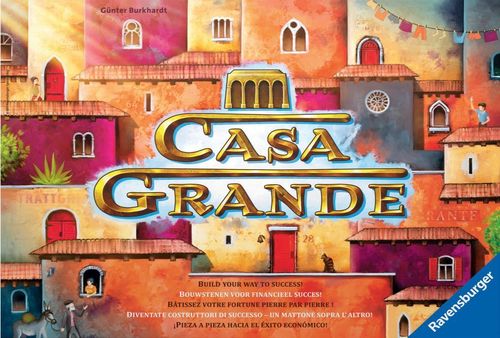
Casa Grande
Casa Grande Rulebook
Table of Contents
Table of Contents
Components
- 1 game board with building plots, track, and bonus scale
- 96 building blocks (24 each in the player colors gray, orange, purple, and beige)
- 68 platforms (17 per player color)
- 4 playing pieces in the player colors
- 4 marker pieces in the player colors
- 1 die
- 72 banknotes – 12 notes each in the values 3 CGL · 4 CGL · 5 CGL · 6 CGL · 9 CGL · 25 CGL (CGL stands for Casa Grande Lire)
Object of the Game
The players take on the role of master builders who try to erect buildings that are as large and as tall as possible — because that brings in money and leads to victory!
Setup
Before playing for the first time, carefully punch the platforms out of the die-cut sheets and push out the round holes in the platforms.
Each player receives:
- all the building blocks of one color of their choice,
- all the platforms of the same color,
- one playing piece and one marker piece of the same color.
Place the game board in the middle of the table.
Then each player places their marker piece on space 5 of the bonus scale.
The banknotes with a value of 9 go on the space above the bonus scale.
Sort the remaining banknotes by their values of 3, 4, 5, 6, and 25 and place the stacks within easy reach of everyone next to the game board.
The players start with no money!
Place your playing piece on the orange corner space closest to you. At the start of the game, only one playing piece may stand on each corner space.
Game Play
Play proceeds clockwise around the table. The youngest player begins.
A player's turn always consists of the following three steps:
- Step 1: First, the player must roll the die and move their playing piece.
- Step 2: Then they must place a building block. (Exception: they are standing on a corner space.)
- Step 3: Finally, they may place a platform, thereby completing a floor and collecting money for it.
Step 1 (Must): Roll the Die and Move Your Playing Piece
Whoever's turn it is rolls the die and moves their playing piece forward that many spaces clockwise along the track.
The player can buy additional forward steps using points from the bonus scale. For every space a player advances their playing piece this way, their marker piece moves back one space on the bonus scale.
Step 2 (Must): Place a Building Block
After a player has rolled the die and moved their playing piece, they must place a building block. They place it in the lane that borders the track space their playing piece is standing on.
A lane consists of 2 rows, so that at the start, 16 building plots are available in a lane.
Building on the lowest level
When placing building blocks on the lowest level, all free squares (= grid spaces) are buildable plots. Later, extended rules apply (see "Building on Higher Levels").
Step 3 (May): Place a Platform and Complete a Floor
At the end of their turn, the player has the option to place a platform and thereby complete a floor.
To do this, the player's building blocks must be arranged in the required pattern.
The required pattern can be recognized by the square markings on the platforms.
When placing a platform, the following must be observed:
- Platforms may only be placed if the pegs of same-colored building blocks are visible through the marked holes.
- Building blocks belonging to other players may be covered by a platform, as long as they are not underneath the marked holes.
Collecting Money
After placing their platform, the player receives their payment for a completed floor from the bank. It is calculated from the number of squares visible on the platform just placed, multiplied by the number of floors.
Example: Felix is playing with the gray building blocks and platforms. In previous rounds, he has already placed two of his building blocks on the board on the lowest level. Now he places a third building block and completes his first floor by laying a T-shaped platform on top of the three building blocks. This platform shows five grid spaces (= squares). The three gray building blocks must be positioned beneath the grid spaces that are marked with gray squares. As a check, the pegs of the gray building blocks show through the corresponding holes in the platform.
This floor covers five grid spaces on the game board and is one level high. This gives the following calculation:
5 (grid spaces) x 1 (level) = 5 (money units)
Felix therefore receives 5 Casa Grande Lire from the bank for his completed floor.
Building on Higher Levels
Later on, building blocks may also be placed directly on your own building blocks or on existing floors:
- A player may place a building block directly on a building block of their own color, as well as on a platform of their own color.
- A player may also place a building block of their color on a platform belonging to another player's color. In that case, the player whose platform was used receives a compensation payment on the bonus scale: they move their marker piece forward on the bonus scale by as many spaces as the floor just used is high (the number of floors).
The following applies to platforms on higher levels:
- Platforms may not be placed directly on top of one another. There must always be building blocks in between.
- Two identically-shaped floors may not be built directly on top of each other.
- A floor may not be "built under," meaning a platform may not be pushed underneath another one afterward.
Example: Lisa places her orange building block on a gray platform on the second level. The gray platform belongs to Felix. So in this case, Felix receives two points on the bonus scale and advances his marker piece accordingly.
The Corner Spaces
If a player's turn ends on a corner space, they may not place a building block, since their playing piece is not next to a buildable row. However, they have two options to choose from:
- They remain on the corner space, collect three bonus points on the bonus scale, advance their marker piece accordingly, and thereby end their turn.
Or:
- The player pays one or more bonus points by moving their marker piece back the corresponding number of spaces and moving their playing piece forward one or more spaces. The player then continues their turn with Step 2 (placing a building block and, if applicable, placing a platform and completing a floor).
The Bonus Scale
At the start, every player has 5 bonus points on this scale.
You can earn three more points if your turn ends on a corner space and you choose not to move further by paying bonus points.
You also receive points as compensation when a fellow player builds on your floor (= a platform of your color).
If you reach nine bonus points or more, you receive 9 Casa Grande Lire. Any surplus bonus points are lost. After that, however, you must move your marker piece back to space 0 on the scale. Exchanging money back into bonus points is not possible.
End of the Game
As soon as a player places their last building block, they trigger the final round, meaning the round already in progress is played to its end, so that everyone has had the same number of turns.
The player with the most money wins the game and is the master builder of Casa Grande.
In case of a tie, the better position on the bonus scale decides.
Tip: For a shorter round of play, the players can decide to distribute only 20 or 18 building blocks to the players.