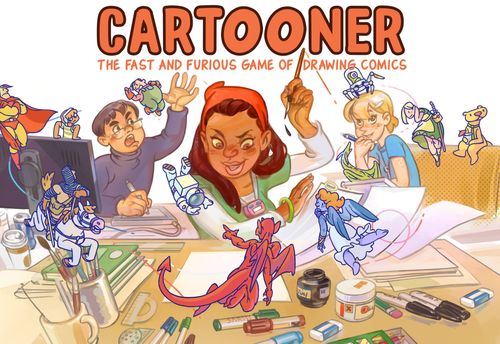
Cartooner: The Fast & Furious Game of Drawing Comics
Cartooner: The Fast & Furious Game of Drawing Comics Rulebook
Table of Contents
Table of Contents
Introduction
Welcome to the world of comics! In Cartooner, you and your friends become comic artists competing for fame and fortune.
Over the course of 4 rounds, your goal is to earn the most Fame Tokens by creating comics that express your personal Obsessions while also following ever-shifting market trends.
While this is a game that involves drawing, you won't be judged on your artistic abilities or a popularity contest of whose comic is "best." Instead, you will be awarded Fame for creative storytelling and strategic use of Trend Cards.
So relax, have fun, and please share your creations with us on social media (Instagram, Facebook, Twitter, etc.) using #cartooner!!
Overview
Component List
- 136 Theme Cards
- 52 Trend Cards
- 40 1-Point Fame Tokens
- 40 2-Point Fame Tokens
- 80 5-Point Fame Tokens
- 64 Comic Pages
- This rulebook
You will also need:
- A writing implement (pen, pencil, etc.) for each player
- A stopwatch or smartphone timer to keep track of time
- Some exciting music to play while you draw. While this is optional, music can help you keep track of time. Check out our own playlists at cartoonergame.com!
Component Overview
Theme Cards. This deck supplies you with virtually endless combinations of creative concepts and ideas for your comic. At the beginning of the game, each player draws 3 Themes that stay with them for the whole game. We refer to these 3 Themes as Obsessions. Some Trend Cards also instruct you to draw Theme Cards.
Trend Cards. This deck represents popular market trends. Trend Cards enter the game starting in round 2. Each round after round 2, you discard the previous round's Trends and draw new ones.
Trend Cards offer chances to earn more Fame by following the rules on the Trend Cards. Trends are your key to maximize your Fame and become the winner at the end of the game!
Fame Tokens. Use these tokens to keep track of your ever-growing Fame.
Comic Pages. They come in 2-Panel, 4-Panel, 6-Panel and 8-Panel pages corresponding to each of the 4 rounds of play. If you run out, you can print additional ones from cartoonergame.com.
The 3 Basic Rules
In Cartooner, you can win even if you've never drawn a stick figure in your life! Your quick wit, cleverness, and storytelling will matter much more than your drawing ability.
Each round, you'll get Fame for following these three basic rules:
Rule #1: Express Your Obsessions Each Round
Gain 1 Fame for each one of your Obsessions you include in your comic.
- You can get a maximum of 3 Fame each round this way.
- You can either draw them, or mention them in a Word Balloon.
- Putting your Obsessions in your comic's title or in your pen name, while clever, doesn't count.
You can express your Obsessions either visually or verbally. For example, if you have the "Dinosaurs" Theme Card as one of your Obsessions, you get 1 Fame whether you mention dinosaurs in a Word Balloon (example on the left) or draw them (example on the right).
[Page 5 illustrations: "Verbally" and "Visually" examples of the Dinosaurs Obsession.]
Rule #2: Draw Something in Each Panel Each Round
Gain a bonus of 2 Fame each round when you follow this rule.
- If a comic doesn't have artwork, it isn't a comic! Each Panel must contain a recognizable drawing of something.
- If it's blank, contains only text, or contains an unrecognizable scribble without any context explaining it, it doesn't count.
[Page 6 illustrations: "Panels not filled properly" and "Panels filled properly".]
Rule #3: No More Than 3 Word Balloons Each Round
Gain a bonus of 2 Fame each round when you follow this rule.
- Comics can use words, but if your comic is too wordy, it will have a limited audience. You gain this bonus when you use no more than 3 Word Balloons on the entire page.
- Even in later rounds when the number of Panels on each page increases, the Word Balloon limit stays the same.
- Any text in your comic, including numbers and letters, counts as a Word Balloon, whether it's dialogue ("I'm a robot"), narration ("Then, a robot appeared!"), or a sign ("Robot").
- You don't have to actually draw a balloon around the words.
- It doesn't matter how long the Word Balloons are. However, a Word Balloon can't cross between Panels, otherwise it counts as an additional Word Balloon.
- You don't have to use all your Word Balloons if you don't want to.
- Unused Word Balloons don't roll over to the next round.
- Your comic title and pen name don't count as Word Balloons.
[Page 7 illustrations: "Word Balloons" (examples that count toward the limit) and "Not Word Balloons" (examples that don't).]
In the Panels above, the examples on the left all count towards the Word Balloon limit. The examples on the right don't count towards the Word Balloon limit. They use either Sound Effects or Symbols.
Sound Effects (No Limit). Sound Effects (such as "BANG", "BOOM", "TA-DA" or "GASP!") must be onomatopoeia, words that express a nonverbal sound. Unlike Word Balloons, there is no limit on how many Sound Effects you may use in your comic.
Symbols (No Limit). Symbols (like hearts, exclamation points, dollar signs, or speedlines) don't count against your Word Balloon limit. There is no limit to how many Symbols you may use.
Setup
- Shuffle the Trend Cards deck.
- Shuffle the Theme Cards deck.
- Place Fame Tokens, Trend and Theme Cards in the center.
- Distribute Comic Pages. Each player gets one of each type of Comic Page: 2-Panel, 4-Panel, 6-Panel and 8-Panel.
- Distribute drawing implements to each player.
- Prepare a stopwatch or smartphone timer.
- If you like to draw to music, queue it up!
How To Play
Cartooner lasts for 4 rounds. The winner is the player who ends the game with the highest number of Fame. Each round consists of 3 phases: Card Selection, Drawing, and Scoring.
Difficulty Mode
Before you start, the players must agree on the Difficulty Mode. This determines how much time you have to draw each round and the number of Trend Cards in rounds 2-4.
Everyone has the same amount of time. Playing in Student or Apprentice Mode is good for new and younger players. Playing in Professional Mode makes the game faster, more challenging, and the time constraints might give you an added burst of inspiration.
| Difficulty Mode | Time to Draw |
|---|---|
| Student | 8 Minutes |
| Apprentice | 6 Minutes |
| Professional | 5 Minutes |
Choose a player to be in charge of setting the timer each round. When time's up, you must stop, even if you're in the middle of a sentence!
In rounds 2-4, the number of Panels you have to draw goes up, but the amount of time stays the same. Once you're a pro artist, the workload, and the reward, increases.
Does it sound hard to draw a comic in 5-8 minutes? Many comic artists draw 5-minute comics as drawing exercises. In a 5-minute comic the playing field is leveled as even experienced artists will often have to draw stick figures to finish in time.
Card Selection Phase
Cards are drawn at the beginning of each round.
Round 1: Initial Setup
To start the game, each player draws 3 Theme Cards. These cards are your Obsessions, the basic subject matter of your comic. They represent what you love to create as a comic artist.
Keep them for the rest of the game unless a Trend Card on a subsequent round (such as "Reboot") explicitly instructs you to replace them.
Place your Obsessions face up for all other players to see. You may now write down a pen name & title for your comic before the Drawing Phase begins.
Round 2-4: Trend Selection
To become a superstar, a comic artist must not only express their own Obsessions through their work. They must also give the fans what they want.
Trend Cards represent hot, yet fickle, trends in the comic market. As such, they come and go, changing each round.
In rounds 2, 3, and 4, the player with the least Fame at the beginning of the round becomes the Trendsetter.
If 2 or more players are tied for least Fame, play rock-paper-scissors to determine who becomes the Trendsetter.
The Trendsetter draws a number of Trend Cards and chooses which ones will be in effect for the current round.
The number of Trend Cards increases each round as follows:
Student/Apprentice Mode
- Round 2: Draw 2, choose 1
- Round 3: Draw 3, choose 2
- Round 4: Draw 4, choose 3
Professional Mode
- Round 2: Draw 3, choose 2
- Round 3: Draw 4, choose 3
- Round 4: Draw 5, choose 4
Trend Cards are generally played face up and affect all players, not just the Trendsetter. The exception is cards like "Trade Secrets" where only the Trendsetter has secret knowledge of the selected cards.
At the end of each round, discard the old Trends and replace them with new ones. When you discard an old Trend, also discard any Theme Cards associated with it (except new Obsessions gained from cards like "Reboot").
When the Card Selection Phase is over, start the timer; it's time for everyone to draw comics!
Drawing Phase
Each round you must create a new chapter of your comic. Each round the number of Panels you have to draw increases by 2 but the time limit stays the same!
Panels per Round
- Round 1: 2 Panels
- Round 2: 4 Panels
- Round 3: 6 Panels
- Round 4: 8 Panels
When every player is ready, start the timer to the preset time (see Difficulty Mode, page 8).
When time is up, you must immediately stop writing and drawing. You can stop before time is up by calling out "Done!" and putting down your pen or pencil. This normally doesn't matter, unless certain cards that reward finishing first (like "Deadline") are in play.
After you call out "Done!", you can change your mind and go back to drawing as long as time remains, but you lose any advantages of finishing first.
Scoring Phase
During the Scoring Phase, the players take turns showing their comics to everyone and reading them out loud to the group. If you want, you can act it out.
The player with the most Fame reads first. On the first round, or in case of a tie, rock-paper-scissors to see who goes first. Reading continues clockwise thereafter.
After each player reads their comic, the group judges and grants Fame according to the three basic rules:
- 1 Fame per Obsession drawn or mentioned (maximum 3 Fame)
- 2 Fame bonus for not exceeding 3 Word Balloons
- 2 Fame bonus for filling all Panels
If any Trend Cards are in play, award bonus Fame per the rules listed on card(s).
Count your Fame total and note it at the top of your Comics Page. At the end of Scoring Phase, go back to Trend Selection Phase and start the next round.
Professional Mode. For an even greater challenge in Professional Mode, instead of reading your own comic in the Scoring Phase, give your comic to another player and let them read it out loud. You can't say anything while the other players read it & discuss it; your comic must speak for itself. Is your storytelling clear enough that other players understand your drawings & Themes without any explanation?
End of Game
At the end of Round 4, the player with the most total Fame wins.
In case of a tie, all players not in the running for 1st place divide up their Fame between the finalists based on how creative and entertaining they thought their comic was.
Fame Meter
How good of a Cartooner player are you? Count your Fame to find out the answer!
- Under 30 Fame: Fan Artist. You need more training. Perhaps you can take classes, or work as an assistant to another artist and improve your skill. Don't give up!
- 30-39 Fame: Budding Artist. You can get a small following drawing a webcomic or a self-published comic.
- 40-49 Fame: Professional Artist. You could make a living as an artist or illustrator.
- 50-59 Fame: Famous Artist. Fans line up for your autograph.
- 60-69 Fame: Comics Celebrity. You're a truly amazing (and truly fast) artist. Movie deals, TV shows & merchandising deals are everyday events for you.
- 70-79 Fame: Comics Royalty. Jack Kirby, Bill Watterson, Raina Telgemeier, Jason Shiga... you're the equal of these hotshot artists. Your pen callous makes others shiver with awe.
- 80+ Fame: Comics Legend. You're an artist who can move nations, the kind who only comes along once in a lifetime. How did you possibly score this high?
Special Rules
Marathon
If you're a diehard artist, a marathon will test your skills! For a marathon game, you'll need to print out extra Comic Pages from cartoonergame.com. Print out at least 2 copies of each page (2, 4, 6 and 8-Panel) for each player.
- In a Marathon Game, the game doesn't end after Round 4. Each round after Round 4, your Panel count continues going up by 2. (For example, in Round 5 you have 10 Panels, in Round 6 you have 12 Panels, etc.) Since there aren't Comic Pages with more than 8 Panels (it'd be hard to draw that small anyway), take 2 or more Comic Pages with total Panels equaling your Panel Count. For example, in Round 5, you can use a 4-Panel Comic Page and a 6-Panel Comic Page, or a 2-Panel and an 8-Panel, for a total of 10 Panels.
- On Rounds 5 and up, draw new Trends just like in Round 4. Discard the Trend Cards from the previous round. The Trendsetter draws 5 Trend Cards, plays 4 Trends face-up in the middle of the table, and discards the other Trend in the discard pile.
- The marathon game ends at the end of the round when 1 or more players reach or surpass a certain amount of Fame. You choose what number to target:
- Half Marathon: 60 Fame
- Full Marathon: 80 Fame
- Deathmatch: 100 Fame
- As your Panels go up and up, but your time limit stays the same, it may become nearly impossible to draw something in all your Panels. Use your time strategically.
Teams
Cartooner is recommended for 2-8 players. There's no reason you can't play with more people, but more players slow down the game. One way to make a game with lots of players go faster, or to give inexperienced players a boost, is to have players play in teams of 2.
Playing a team is the same as playing a single player. Teams can play against singles in any combination. However, the following special rules apply:
- It can be hard for 2 people to draw on the same piece of paper at once. Teams may divide their Panels between multiple pages however they like. For instance, instead of a 4-Panel Page, the team can draw two 2-Panel Pages. Make sure you know who's drawing the beginning & who's drawing the ending! If you need extra Comic Pages, you can print them from cartoonergame.com.
- Your team can only use 3 Word Balloons, so keep track of how many your teammate is using!
- If a team and a single player are tied for least Fame (for instance when choosing the Trendsetter), the single player wins the tie.
Solo
A solo game uses only Theme Cards. Play goes like this:
- Draw 3 Theme Cards for your Obsessions and think of a title and pen name for your comic. Start with a 2-Panel Comic Page.
- Set a timer and draw for 5 minutes. When time is up, evaluate yourself (or have a friend evaluate you): did you follow the 3 Basic Rules of including your Obsessions, using 3 or less Word Balloons and drawing something recognizable in every Panel? If you broke a rule, write an "X" next to your pen name for each rule you broke.
- Give yourself 8 Fame.
- Take a Comic Page with 2 more Panels than before. In addition, draw 2 new Theme Cards and add them to your Obsessions. Then, discard 1 Obsession of your choice, from either your new draw or your preexisting Themes.
- Return to #2 and repeat. Each round, add 2 more Panels and 1 more Obsession (by drawing 2 and discarding 1). When your Panel count reaches 10 or higher, take 2 or more Comic Pages with a total number of Panels equal to your new Panel count (i.e., if your Panel count is 10, you could use a 4- and a 6-Panel Page, or a 2- and an 8-Panel).
- The game continues with an increasing number of Panels and Themes until you get 3 "X"s next to your pen name by breaking the rules 3 times (3 cumulative times over the entire game, that is, not 3 times in a single round). Stop and don't give yourself Fame for the current round. The game is over!
Game Tips
The fun and strategy lie in figuring out how to maximize your Fame while balancing your Obsessions with the demands of the Trends.
Choose your strategy and spend your time wisely! You can't win the game without following Trend Cards, but you probably can't win every Trend, particularly in the final rounds when there are 3 or 4 Trends on the table.
Sometimes it may be strategic to break one of the three basic rules to follow a Trend Card with higher Fame.
Sometimes you'll get seemingly contradictory Themes. This is all part of the challenge! Accept the hand you have been dealt.
You can't express a Theme by simply naming a character after it. If your Theme is "Food," you can't express that Theme by just naming a character "Donut" (unless they're a talking donut).
You can't express Themes with puns or double meaning. For example, if your Theme is "Fishing", it doesn't count if a cop is "fishing for clues" (unless he uses a fishing pole).
Obsessions need to be included every round if you want to get points for them. For instance, if a character says "I'm a robot" in Round 1, but doesn't look, say or do anything robot-like in Round 2, you haven't fulfilled your "Robots" Obsession for Round 2. You have to assume that your audience has no memory! The same rule applies when judging Trends that are based on how many Panels contain a Theme or visual element.
Ultimately, Themes are subjective and it's all up to your fellow players. Some players enforce Themes strictly, others are easygoing. Knowing your audience is part of the game!