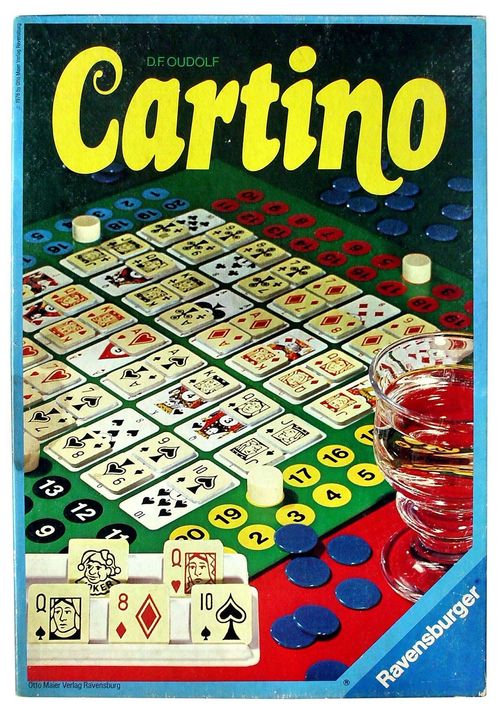
Cartino
Cartino Rulebook
Table of Contents
Table of Contents
Directions
For 2, 3 or 4 players
Cardino is a game requiring plenty of concentration and a bit of luck. It is fascinating and provides a great variety of possibilities which causes eager players at the completion of a game to say, "Let's play it again."
Cardino is played on a board with 66 tiles (64 with playing card type faces and 2 Jokers with an "MB" on them). A running score is kept on each player's scoreboard, with a pawn and chips, which are earned as the game progresses.
OBJECT OF THE GAME: To place tiles on the board strategically and in combinations to score the most points to win the game.
Setup
TO SET UP THE GAME:
-
Players position themselves around the board so each has a scoreboard (circles numbered 1-20) in front of him.
-
Each player takes a pawn and places it near the score board, by the circle Number 1. This pawn is moved around the 20 scoring circles on the scoreboard and represents player's total score.
-
The round poker chips are placed in a pile off the board and are doled out by one player. These chips are worth 20 points each and one is given to a player each time his pawn passes the numbered 20 circle on his scoreboard. It is possible for each player to collect several chips during a game.
-
The 66 tiles are placed face down off the board and thoroughly mixed. They constitute the "Draw Pile."
-
TILE POINT VALUES:
- Ace 5 points
- King 4 points
- Queen 3 points
- Jack 2 points
- 10's, 9's, 8's and 7's: 1 point each
To Play the Game
- Each player draws 5 tiles and stands them up facing him, but not in view of other players.
- The player with the lowest valued tile (starting with the 7 of clubs, to the 7 of diamonds, 7 of hearts, 7 of spades, 8 of clubs, etc.) plays first and play then continues clockwise.
- A player must play at least ONE TILE in each turn. However, if he wishes he may play more than one tile in the same turn, but they must be of the same suit. (all spades, all hearts etc.) The suits divide the board into four sections.
- A tile is placed face up, flat down, on the board over its MATCHING FACE SPACE; either at the top or bottom half of the space. NOTE: Two identical tiles eventually occupy each space on the board. Once a tile has been placed it cannot be moved.
- After each turn, a player records his score and then draws from the Draw Pile the number of tiles he has played, as all players must always start their turn with 5 tiles in front of them (until the Draw Pile is exhausted).
- After the Draw Pile is exhausted, play continues without drawing tiles until one player is out of tiles, ending the game.
- To determine the winner all players who have tiles left are penalized at their tile value as shown under "Tile Point Values." A Joker counts 6 points as a penalty. Players add up these penalty points and deduct them from their scores, leaving a net total score.
- The player then having the greatest score IS THE WINNER.
Untitled Section (heading cut off in the scan)
Note: the heading printed at the top of this section is cut off in the scanned page and is not legible, so no heading is supplied. The rules below are the scoring rules that follow "To Play the Game" and precede "Keeping Score".
- A tile has no scoring value the moment it is placed on the board. The score value is only made from any adjoining tile (or tiles) it is placed NEXT TO. However, if in the player's same turn, or any player's future turn it can score for the player placing a tile NEXT TO it.
- For tiles to score points sideways they must be in the same top or bottom adjacent board space. For tiles to score points in a vertical row one tile must be at the bottom half and the other at the top half of the adjacent board spaces.
- A tile may be placed next to 1, 2, 3, or 4 other tiles and score points equalling the total of all their values.
- The adjacent tiles can be different suits.
- A bonus of 10 points is added to a player's score when he can, and so desires, play 5 tiles of the same suit in one turn.
- The two "Joker" tiles (2 plain tiles with "MB") can be placed in any turn as any value and suit, but must be placed on a VACANT half space only, like other tiles.
- A player may, if he wishes, place a tile on the space of a previously placed Joker tile if it matches the space value and suit of that space. The Joker is then permanently removed from the game.
Keeping Score
- Each turn, as a player scores points he moves his pawn around his scoreboard, 1-20, and rests it on the number of his total score as of the end of that turn.
- When a player's total score goes over 20 points, he continues his count starting the circle #1 again and receives a Poker Chip worth 20 points, which he places on the board in front of him. He then continues moving his pawn around his scoreboard collecting a chip each time he passes circle 20.
Example 1: If a player had 17 points and in his turn scored 5 points, his pawn would move to 20; he would collect a Poker Chip to show his pawn had reached 20 and then continue his pawn to 2 to finish recording his 5 points.
Example 2: If a player had 4 chips in front of him and his pawn on 8, his score would be 88. 4 chips x 20 points = 80 points plus 8 = 88 points.
Scoring Diagrams
Examples diagramed below show various forms of scoring possibilities. Each diagram shows playing-card tiles on the board; the arrows and labels mark the tile played and any tile previously played.
Diagram No. 1
Diagram: tile played with arrow labelled TILE PLAYED.
NO SCORE
The tile played was not placed next to any other tile, therefore no score.
Diagram No. 2
Diagram: TILE PLAYED and TILE PREVIOUSLY PLAYED marked by arrows.
SCORE: 1 POINT
The tile was played next to one previously placed with a value of 1-point.
Diagram No. 3
Diagram: TILE PLAYED and TILE PREVIOUSLY PLAYED marked by arrows.
NO SCORE
The tile played was not placed next to any other tile, therefore no score.
Diagram No. 4
Diagram: TILE PREVIOUSLY PLAYED and TILE PLAYED marked by arrows.
SCORE: 4 POINTS
The tile played was placed next to one previously placed with a value of 4 points.
Diagram No. 5
Diagram: TILE PREVIOUSLY PLAYED and TILE PLAYED marked by arrows.
NO SCORE
The tile played was not placed next to any other tile, therefore no score.
Diagram No. 6
Diagram: TILE PLAYED and TILE PREVIOUSLY PLAYED marked by arrows.
NO SCORE
The tile played was not placed next to any other tile, therefore no score.
Diagram No. 7
Diagram: TILE PLAYED and TILE PREVIOUSLY PLAYED marked by arrows.
NO SCORE
The tile played was not placed next to any other tile, therefore no score.
Diagram No. 8
Diagram: 1ST TILE PLAYED, 2ND TILE PLAYED and 3RD TILE PLAYED marked by arrows.
SCORE: 7 POINTS
Multiple tiles played in one turn. The 1st tile was not played next to any other tile, therefore no score. The 2nd tile was placed next to the Diamond Queen and scores 3 points. The 3rd tile was placed next to the Diamond King and scores 4 points. Total 7 points.