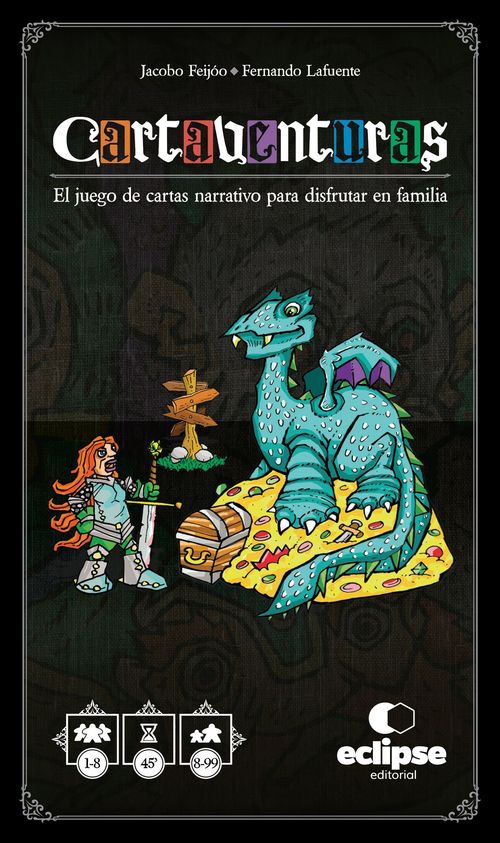
Cartaventuras
Cartaventuras Rulebook
Table of Contents
Table of Contents
Components
- 20 cards with green back
- 20 cards with red back
- 20 cards with blue back
- 20 cards with purple back
- 45 cards with orange back
- 4 character cards
- 4 life cards
- 1 start card and 1 final card
- 4 characters (standing tokens) and 1 dragon
- 2 six-sided dice
- 4 heart markers
- 10 coins of value 5
- 20 coins of value 1
- 32 tokens in 4 colours
- 1 instruction manual
The cards are numbered consecutively so you can check that none is missing.
Objective
The players embody novice adventurers who seek the legendary treasure of the Great Dragon.
The player who manages to defeat it and take its riches wins.
Setup
Each player takes, at random or by agreement, a character card and its corresponding standing token, a life card, a heart marker and 8 tokens of the character's colour. Place everything in front of you in view of the other players.
Place the heart marker on space 10 of your life card. Each player takes the amount of coins indicated on their character card. Throughout the game no player may have more than 10 life points, nor exceed a value of 12 in attack.
Take the start card (titled "¡Empiezas!") and place it at the top centre of the table, bearing in mind that from it, and downward, the "mosaic" of cards that will dictate the adventure will be generated (see the next section: The Kingdom). With 4 players this card is placed in the second row. This allows the first row to be used for placing cards.
The card titled "¡El tesoro!" is set aside, since it will come into play much later.
Form 4 decks with the green, red, blue and purple cards. These decks correspond to zones of the Kingdom where the adventure will take place and are called Zone Decks, made up of Zone Cards. The Zone Decks are shuffled and placed face down, next to one another, for the players to draw from.
The orange cards are divided into 3 decks, according to the icon on their back:
- Purchase Deck: with a tankard on the back.
- Exploration Deck: with a compass on the back.
- Forge Deck: with the fragment-fusion icon on the back.
These three decks are left face down so that the players can have them available at any time.
The Kingdom
The Kingdom is the setting in which the adventure takes place. It consists of four zones represented by the Zone Decks.
- Countryside Region (Región de Campaña): green cards. This zone mainly comprises plains, roads, forests and mountains.
- Maritime Region (Región Marítima): blue cards. This zone is linked to the sea and its coasts: islands, pirates, storms, ports, aquatic beings...
- Epic Region (Región Épica): red cards. This is the epic zone, with vast landscapes where castles, knights and fantastic beings appear everywhere.
- Gloomy Region (Región Tenebrosa): purple cards. This zone corresponds to swamps, wastelands and rugged corners inhabited by supernatural and terrifying beings.
Zone Cards
Zone Cards have a title, a text and an illustration that detail how the card is resolved. They also incorporate direction arrows that indicate the colour of the card you may draw on your next turn and in which direction you must continue. They may also contain certain icons, explained below.
Card anatomy: Zone, Title, Narrative text, Zone type, Direction arrows, and the Back with the icon and colour of the zone.
Cartaventuras has no physical board as such; it is formed as the game advances by placing Zone Cards in the rounds the players take. This makes each adventure different.
The play area is rectangular, with a maximum limit of 8 cards for the long side of the rectangle (vertical) and 7 cards for the short side (horizontal).
The Icons
- Non-magic weapon of strength 6 (example value: 6).
- Magic weapon of strength 4 (example value: 4).
- Life points (example: 3 life points).
- Price in number of coins (example: 1 coin).
- Card that multiplies the result by two (x2).
- Card that adds 2 to the attack (+2).
- Double number of coins (x2).
- Two dice rolls (2).
- Fragment fusion.
- Single use per adventurer (1). Afterwards it becomes a mere pass-through card for that adventurer.
Start of the Game
The players place their Character (the standing token) on top of the start card. One of them is designated to begin, and clockwise order is followed for the whole game.
Since the arrows of the start card have a question mark, the first player may choose the direction he prefers to place his card, but everyone must begin with a card of the same colour as their character. In games of 1 to 3 players the upper arrow is disregarded.
The starting player chooses a direction and takes a card from the corresponding deck (for example, the red player chooses to go down and takes a card of the same colour). He reads its content aloud and, unless the text says otherwise, places it adjacent to the start card according to the chosen direction. Two cards are considered adjacent if they share a side orthogonally (see image).
The player moves his character to the new card and resolves it according to the text he has just read.
After that, the second player (for example, green) chooses another direction and acts in the same way. All players proceed thus.
In solo mode you must defeat the Great Dragon within 40 minutes (easy mode), 30 minutes (intermediate mode) or 20 minutes (hard mode).
Turn Sequence
Once the initial turn is finished, the game proceeds according to these steps:
The player chooses between these 2 options:
- Explore a new zone: the player chooses one of the arrows on the card where his character stands and draws a Zone Card of the same colour as the chosen arrow. If there is more than one possibility for the same colour, he declares in which position he will place the card. He reads it aloud and places it adjacent to the previous card in the chosen direction, moves his character to the new card and resolves it. Arrows with the multicolour symbol allow any colour to be used.
- Move to another zone: he may go to an adjacent card that has already been revealed (including the one above). After moving, he reads and resolves the card he has arrived at.
Once one of these two actions is done, the turn passes to the next player clockwise.
(Illustrated in the manual as steps 1, 2, 3.)
Weapons and Equipment
Players can obtain various weapons and objects by purchase, exchange or discovery. These cards, with exceptions, will be orange and each player places them under his character card, in view of everyone. They represent the player's backpack. Object cards may be used at any moment of the turn (if applicable) and as many of them as desired.
A player may wield at most one non-magic weapon (sword, mace, bow, etc.) and one magic one (staff, spell, etc.). The rest of the weapons or objects must be kept in his backpack up to a maximum of 5 cards. Beyond that limit, both Purchase and Forge cards are added to the Purchase Deck and the rest are discarded. The same procedure is followed if the player removes or uses up an object or if he loses the game.
Weapons have unlimited uses while objects can generally be used only once (for example, drinking a healing potion). For cards whose effect can be applied two or more times before running out, it is recommended to turn the card 90 degrees for the first use, another 90 degrees for the second, if applicable, and discard it for the last use.
A special case is the orange cards that contain fragments of a complete object (Forge cards). There are 2 map pieces, 2 magic pieces and 2 pieces of non-magic weapon. Each of these cards is useless by itself and takes up a space in the backpack. The moment a player gathers the two parts, he must search the Forge deck for the complete object (Complete Map, Divine Staff or Dragonslayer Sword) and replace the fragments with that card, which will occupy a single space.
Combat
In the game you must fight enemies and, frequently, defeating them lets you obtain a weapon or object. All opponents, except the Great Dragon, have a single life point, so it is enough to beat them once.
Suppose that in our exploration we have come across a Witch, who has 3 (magic) and 2 (non-magic). We have a magic staff (2 magic), a mace (2 non-magic), and 6 life points.
We will always fight like this:
-
Type of weapon: we decide whether we want to fight with magic or non-magic weapons. If we have no weapon cards, we use the predefined values of our character. The attack value of a weapon replaces the initial value and is never added to it. In this example our attack value is 2, whether we attack with magic or with a non-magic weapon. The witch has 3 in magic and 2 in non-magic. We choose to fight with non-magic.
Important: If you must face an adversary who has only one type of weapon, magic or not, you must fight compulsorily with a weapon of the same type as the rival's. If in that case your attack value is zero, you automatically lose one life point and must flee (see below).
-
Dice roll: you roll one die of one colour for yourself and another die of a different colour for your enemy, adding the results that come up to the respective attack values.
If your total is greater than theirs, you have won and you take the reward (in this case, a flail that you would take from the Exploration Deck). If the total is lower, you subtract 1 life point. If the total attacks are equal, you have tied and nothing happens.
Suppose your die shows a 3 and the witch's a 4, so you lose the round (3+2=5 is less than 4+2=6) and you subtract 1 life point (you have 5 left).
Once the first round is resolved you may:
-
Keep fighting: in consecutive rounds, within the same turn, until you win, your character dies or you flee.
-
Flee: you may choose to flee only from the second round on; that is, each combat consists of at least one round. However, this action is not free: you must roll a die and, if you roll 3 or less, you must subtract 1 life point, being wounded in your escape. Logically, when you flee, your enemy remains alive and the card is not flipped. If another player reaches this zone he must defeat it and proceed as explained above. It is not necessary to roll the die to flee in combats that take place in a zone of the same colour as the character (but always from the second round on). If you flee, on your next turn you will move around the map in the usual way.
We roll the dice again and now we get a 5 and the witch a 2. You win the round (5+2=7 greater than 2+2=4) and therefore the combat. You take as a reward the flail from the orange Exploration deck.
-
Win: the enemy's card is not removed until your next turn, but it is turned over, showing its back. While it remains so, no other player may enter this zone. When your turn comes again, the flipped card is discarded and another card of the same colour is drawn from the deck to replace it. If it is a new enemy, the process above is repeated; otherwise, the card is resolved.
If a card indicates that an object must be taken which is not available (because it is discarded or in the possession of another player), ignore that instruction.
Trading Places
In the game there are temples, taverns, cities, etc. In them you can buy (not sell) weapons and objects from the Purchase Deck if you have enough coins. As an exception, object pieces (fragments) can be exchanged for 3 coins and added to the Purchase Deck. Once there they can be acquired by any player at a price of 4 coins.
If you land in a trading place or on a card with the icon indicating a single use, you must mark it with a token of your colour in order to remember that you have already been there and to indicate it to the other players.
Trading Between Players
You can trade with the other players at any time (except in combat) to exchange objects and weapons, whether by barter or by purchase.
Trading does not consume a turn and can be done as many times as you like.
A good use of trading can make you win.
Portals and Passages
Portals and Passages are Zone Cards that allow you, if you wish, to move to cards located elsewhere on the board, avoiding the usual restriction dictated by the arrows and/or distance. They are useful for getting weapons, objects or restoring life. Used well, they can tip the outcome of the game.
If you draw one of these cards, you may make use of that feature on the next turn you get to play.
Combat Against the Great Dragon
The Great Dragon is an adversary with the highest attack values of all the creatures in the Kingdom. Facing it prematurely is an invitation to failure, so you must acquire weapons and objects throughout the adventure to increase your chances of success.
When you consider that you are ready to face the final enemy, you declare it at the start of your turn. You take only the Great Dragon card and place it in a space adjacent to that of your character and according to the arrow you wish (colour does not matter). If you are surrounded by four cards you cannot face the Dragon because there is no space to place the card.
The Great Dragon is the only adversary that must be defeated twice, with a magic weapon and with a non-magic weapon. Combats with it are to the death and do not allow fleeing. After all, defeating it means winning the game.
Choose which of the modes you begin with and fight normally. Since you cannot flee, there are only two results: you defeat the Dragon and automatically win the game, or you perish in the attempt.
If you lose (and you are not playing solo), the game continues for the others.
The Great Dragon card stays where it is for the rest of the game and the other players will have to get there to defeat it and proceed in the same way as you.
Winning and Losing the Game
The only way to win is to defeat the Great Dragon. You automatically lose if your life points reach zero or less. In this case, remove your character from the Kingdom, return both the Purchase and Forge cards to the Purchase Deck and discard the rest.
If no one is able to defeat the dragon, you all lose.
Icon Summary
- Non-magic weapon of strength 6.
- Magic weapon of strength 4.
- 3 life points.
- Price in number of coins.
- Card that multiplies by two the result (x2).
- Card that adds 2 to the attack (+2).
- Double number of coins (x2).
- Two dice rolls.
- Fragment fusion.
- Single use per adventurer. Afterwards it becomes a mere pass-through card for that adventurer.
Zone and Colour Reference
- Countryside Region: green
- Maritime Region: blue
- Epic Region: red
- Gloomy Region: purple