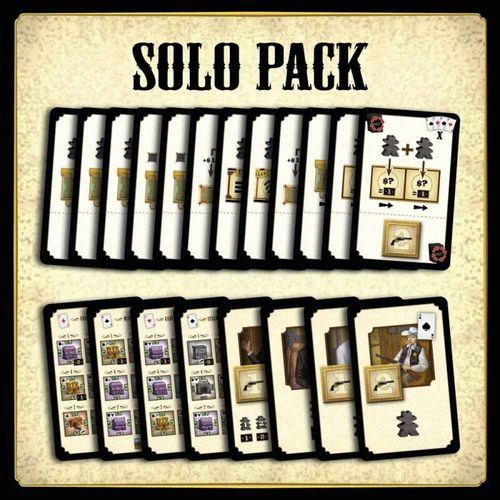
Carson City: Solo Pack
Carson City: Solo Pack Rulebook
Table of Contents
Table of Contents
The Solo Variant
Game Materials
- 4 strategy cards
- 4 solo character cards
- 18 cowboy cards
Compatibility with Variants
The solitaire game may only be played with certain variants, as stated below:
- A New Beginning: Yes. You cannot bid to be first player. Nothing changes for Standish.
- Carson River: Yes. Standish is only able to build one bridge during the game; he will do so as soon as it is needed.
- The might is Right: Yes. Setup is the same as it is for a two-player game. Nothing changes for Standish.
- Kit Carson: No.
- Outlaws: No.
- Horses: No.
Level of Difficulty
During the game your opponent will adopt one of four strategies, each with a different level of difficulty:
- Rancher: Almost Easy
- Miner: Average
- Strength: Hard
- Urban: Expert
Your game's level of difficulty will be tempered or aggravated by the randomness of cards drawn, the map, the buildings, and which characters are available.
Setup
Choose a player color for Standish, your virtual opponent. Standish has all his cowboys, does not use revolver tokens, and always has the money and the roads necessary to carry out his actions.
Setup is the same as for a normal two-player game, with the following changes:
- Step 3: The following buildings are not used: Church, School, City Hall, and Train Station. Remove them from the black bag before setup step 3.
- Step 9: Place the Standish marker on the first space of the turn order track and your marker on the second space.
- Step 10: Standish does not receive any parcels during setup. Only you will perform setup step 10.
- Step 11: In place of step 11, find the following 11 character tiles: 2. The Banker, 3. The Grocer, 4. The Chinese Worker, 5. The Settler, 6. The Captain, 7. The Mercenary, 8. The Indian, 9. The Prospector, 10. The Gunsmith, 11. The Singer, 16. The Heroes. Select 7 of those characters at random, then randomly determine which side of each of those characters will be visible during the game. Return the remaining character tiles to the box.
- Step 12: Select 1 of the 4 strategy cards according to your desired difficulty, and place it face-up near the board. This is Standish's strategy card. Return the remaining strategy cards to the box.
- Step 13: Find the solo character card that matches Standish's strategy card. This is Standish's character card. Place it next to Standish's strategy card:
- The Doctor, with a heart symbol, works with the Rancher strategy,
- The Governor, with a club symbol, works with the Miner strategy,
- The Sheriff, with a spade symbol, works with the Strength strategy,
- The Lawyer, with a diamond symbol, works with the Urban strategy.
- Step 14: Find the 12 cowboy cards noted on Standish's strategy card (with the matching symbol: heart, club, spade, or diamond) and shuffle them to form a face-down deck.
How Does Standish Play?
Standish always has the money to pay for his parcels and buildings, as well as any roads necessary to carry out his actions.
Standish does not receive revolver tokens from buildings or the "Ammunition" action, and only the firepower depicted on the cards Standish plays counts towards his strength.
You will have to make certain choices for Standish. You will be given instructions on how to make the best choices, but in some cases, you will find several options equivalent. In this case, roll the white die to determine what Standish does.
If you are in a situation not described in these rules, or if the rules are not precise enough because Standish has multiple options, ask yourself: "What don't I want Standish to do?" Your answer is Standish's next move.
The following instructions may seem tricky, but everything should go smoothly once you understand Standish's actions. It's normal to have trouble beating Standish – he's very strong! To win, you will have to be creative and patient, and make the best use of the city's characters. You can also find some game tips at the end of these rules.
If you can beat Standish, you will surely be a formidable opponent against actual players!
Playing the Game
The rules are the same as those for the normal game, with the following changes:
Phase 1: Choice of Personality
Standish is considered a dishonest and unscrupulous businessman, and is not very popular. He receives little help from city officials or politicians.
You may therefore choose 1 of the 7 city personalities on your first turn. However, you may only call on each personality once. Any personality you call on will be discarded at the end of the round, and may not be played again in this game.
Phase 2: Placement of Cowboys
Standish is faster than you – he plays first in each round.
Standish plays as many cowboy cards as you receive cowboy meeples: 3 cards for the first round, 4 cards for the second, and 5 cards for each of the last two rounds.
You must alternate between:
a) drawing a cowboy card for Standish, and
b) placing one of your cowboys, until you have drawn all of Standish's cards and passed. It is possible to finish your turn before or after Standish (e.g., placing additional cowboys after all of Standish's cards have been drawn). As in a normal game, you may not place a cowboy after you have passed.
On Standish's turn, draw a card and place it face-up next to any other Standish cards you've already drawn. Then, apply the effects of the drawn card as explained below.
Most often Standish will be indifferent to the placement of your cowboys, and he will place his own cowboys without trying to avoid duels. The only exception is for the purchase of a parcel: in this case, if Standish is weaker than you (sum of firepower on Standish's cards < your firepower), he will not try to purchase a parcel where you have already placed a cowboy.
If the deck is empty and you must still draw cards for Standish, shuffle his discard pile into a new deck without touching any of the cards drawn during the current round.
Phase 3: Resolution of Actions
Resolve actions in the same order as you would in a normal game. As normal, remove cowboys from the board as their actions are resolved.
Standish will only take actions to purchase parcels and buildings. If Standish places a cowboy on a different type of action, he will not perform that action – he is only trying to provoke you into a duel.
Parcel Purchase: When Standish purchases a parcel, he places his property tile without paying anything. You may duel one of Standish's cowboys who wants to purchase a parcel in an attempt to defeat him. When multiple duels for parcels take place in the same round, you choose the order of resolution.
Building Purchase: When Standish purchases a building, he places that building on one of his parcels without paying anything. You may attack a Standish cowboy who wants to buy a building.
If Standish lacks the parcel to place a building, he will keep that building for later placement.
Deferred Placement: If Standish has any buildings waiting to be placed, place them for him at the end of any "Building Purchase" action.
If necessary, Standish will also place a new House or transform a House into a Townhouse. To do this, apply the following criteria:
-
Standish first chooses the solution that gives him maximum additional income (if he can create a Townhouse from a House on a parcel that belongs to him, he does so as a priority);
-
then, he avoids increasing your income;
-
next, he places the new House as close as possible to his other empty parcels;
-
and finally, he places as few new roads as possible.
Source note: the printed booklet numbers this list 3) to 6); items 1) and 2) are not printed in the source and are not supplied here.
Income: Calculate Standish's income during the income calculation phase. Take into account any income he stole from you if he attacked any of your buildings, then immediately convert all of his income into VP at the exchange rate shown below:
- Round 1: 1 point for $2
- Round 2: 1 point for $3
- Round 3: 1 point for $4
- Final Round: 1 point for $5
Standish converts all of his money (rounded down) into VP, even if he does not have a cowboy on the action "Purchase of VP."
Duel Resolution
Standish's firepower is equal to the sum of the power values of this round's drawn cowboy cards. This is his total – you don't roll a combat die for Standish. To beat Standish, you must score higher than his strength (Standish always wins ties). If you win a duel, place the defeated cowboy on Standish's character card.
The Doctor: Each Standish cowboy on the Doctor card increases Standish's firepower by 1. This means that whenever you win a duel against Standish, he becomes stronger.
The Governor: The Governor wants to discourage violence, so any Standish cowboys on the Governor card won't increase Standish's firepower. However, at the end of the round, each Standish cowboy on the Governor card gives Standish 1 VP.
The Sheriff: The Sheriff and Standish are old friends, but it's hard to tell if that friendship is coupled with corruption. Each Standish cowboy on the Sheriff card increases Standish's firepower by 2. You might want to think twice before trying to beat them more than once in a round!
Example: The total of Standish's cowboy cards is 9. In a previous duel, you beat Standish. This beaten cowboy adds 2 to his firepower because he received help from the Sheriff (9 + 2 = 11). You must reach 12 to beat it, adding together a combat die + your firepower.
The Lawyer: The Lawyer will defend Standish in proportion to the damage suffered. Each Standish cowboy on the Lawyer card increases Standish's firepower by 1. Standish cowboys on the Lawyer score VP for Standish at the end of each round:
- 1 cowboy is worth 1 VP,
- 2 cowboys are worth 2 VP,
- 3 cowboys are worth 4 VP,
- 4 cowboys are worth 6 VP, and
- 5 or more cowboys are worth 10 VP.
Phase 4: Round End
Perform end-of-round operations as in a normal game, with the following exceptions:
- Discard the personality card you chose at the start of the round. It can no longer be chosen during this game.
- Return to the general supply any Standish cowboys that were placed on his character card. If applicable, award Standish VP scored from the Governor or the Lawyer.
- If Card X was drawn this round, reshuffle all of the cowboy cards and reform a new deck.
End of Game
Calculate VP as you would in a normal game.
Standish scores 2 VP for each building, House (or Townhouse) and mountain he owns, plus the VP bonus indicated on his strategy card.
Example: Standish ends the game with 33 VP and 6 parcels occupied by buildings and Houses. The Urban strategy card gives him 5 additional points because he has a Saloon, a General Store, and a Bank. Therefore, his total score is 33 + 12 + 5 = 50 points.
Tips from the Sheriff
The best way to beat Standish is to keep his income low, fight his cowboys, and keep him from buying buildings or parcels. To do so, you must maximize your own firepower. You will certainly need to keep cowboys in your reserve and buy mines, ranches, or a prison.
There is also a more-pacifistic (and possibly more difficult) strategy: the VP race. Try to maximize your own income and VP while avoiding dueling with Standish.
Before choosing a strategy, have a good look at the characters available at the start of the game – some may be more useful than others.
Solo Cards Overview
Card A
Place 2 Standish cowboys: 1 on the "Ammunition" action space and 1 on the "Cowboy Victory Points" action space.
Card B
Place 2 Standish cowboys: 1 on the first "Roads" action space and 1 on the "Buildings Victory Points" action space.
Card C
Place 2 Standish cowboys:
-
The 1st cowboy is placed on the best "Building Purchase" action space possible:
- If Standish owns an empty parcel and does not have a building to place on it (or a building whose purchase has been planned by placing a cowboy), he chooses the best available building to place on the empty parcel;
- In other cases, the building is chosen according to Standish's strategy card. Standish first tries to buy building #1. If this type of building is not available, he tries to buy #2, and so on;
- If several buildings of the required type are available for purchase, Standish chooses the cheapest one.
-
The 2nd cowboy is placed on the best "Parcel Purchase" action space possible:
- If this purchase is linked to the purchase of a building (chosen during step 1, above), or you intend to place a building Standish purchased in a previous round, you must choose the parcel according to the following order of priority: a. the parcel that will earn Standish the most money for this type of building; b. as close as possible to Standish's other parcels; c. with free space around (thus offering the best possible progression when other Houses are added); d. Exception: when Standish buys a parcel for the placement of a Prison or a Blacksmith, he chooses a parcel close to one owned by his opponent, adding as few new roads as possible.
Precision: If Standish has several buildings to place, he follows the order of priority indicated on his strategy card, and chooses a parcel accordingly.
- In other cases, Standish chooses a parcel to build the best building available on the "Building Purchase" action spaces. In this case, "the best" means going by the order of priority indicated on his strategy card.
Card D
If Standish has a number of empty parcels that is equal to or greater than the number of buildings he has to place (taking into account any parcels and buildings he hopes to buy this round), place 1 Standish cowboy on the "Building Purchase" action space (see card C, step 1).
If Standish's unplaced buildings outnumber his empty parcels (taking into account any parcels and buildings he hopes to buy this round), place 1 Standish cowboy on the "Parcel Purchase" action space (see card C, step 2).
Card E
Building Attack: If you have a building with an income of at least $12, place 1 Standish cowboy on the building that gives you the most income. During the income phase, Standish will take half of the income from this building (rounded down), unless you beat that cowboy in a duel. If Standish has a choice of buildings, he chooses the one with the income most likely to grow (e.g., most free space for placing Houses).
Cowboy Attack: If you don't have a building with income at least $12, or if all of these buildings are already under attack, place 1 Standish cowboy on an action space where you have already placed a cowboy. If there are several possibilities, place the Standish cowboy on the action space closest to the round marker (end of the sequence on the board).
If neither of these is possible, Standish gets 2 VP.
Card F
Duel: Standish is trying to prevent you from investing in the city.
-
Place 1 Standish cowboy on a "Building Purchase" action space where you have already placed a cowboy. If there are several possibilities, place the Standish cowboy on the cheapest building.
-
If 1) is not possible, place 1 Standish cowboy on the most expensive parcel you want to buy, where you have already placed a cowboy. Choose at random in case of a tie.
-
If 2) is not possible, place 1 Standish cowboy on the purchase of a parcel (see card C, step 2).
Card G
If Standish follows the Urban strategy (diamond), place 1 Standish cowboy on an ownerless (Town)House. Standish will choose to buy the parcel with the (Town)House that most penalizes the income from your buildings, or, in event of a tie, the (Town)House which best protects his own income. If there aren't any ownerless (Town)Houses, place the cowboy on the character card.
If Standish follows the Miner strategy (club), place 1 Standish cowboy on an ownerless mountain. Standish will choose to buy the parcel with the mountain that most penalizes income from your Mines, or, in event of a tie, the mountain that best protects the income from his Mines. If there aren't any ownerless mountains, place the cowboy on the character card.
Card H
Place 1 Standish cowboy on the purchase of a parcel (see card C, step 2).
Card I
Place 2 Standish cowboys on the two rightmost actions of the "Town Council of Carson City." If an action is already occupied by a Standish cowboy, choose the rightmost Town Council action that is not already occupied by a Standish cowboy.
Card X
Same as the "I" card. In addition, you must reshuffle the 12 cowboy cards and reform a new deck at the end of the round.