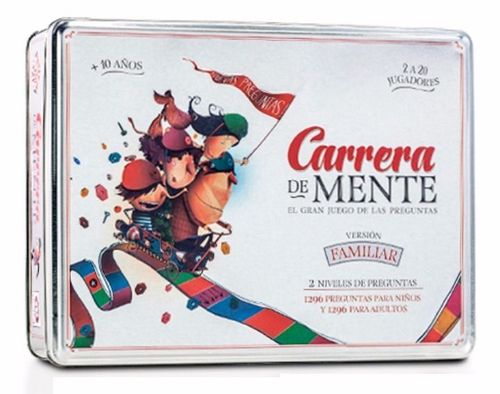
Carrera de Mente
Carrera de Mente Rulebook
Table of Contents
Table of Contents
Components
- A board
- 6 question booklets with questions and their answers
- 36 hexagonal prize tokens
- 6 pegs
- 1 die
Objective
Be the first to collect six hexagonal prize tokens, one of each colour.
Number of Players
2 to 6 players, each playing individually. With more players, the game is played by 2 to 6 teams.
Setup
Each player chooses any peg (from the tall pegs with a round base). That peg is theirs for the whole game. At the start, all pegs are placed on the square marked with arrows.
Turn order is decided by rolling the die. The player with the highest roll begins, and play continues to the left.
Movement
The player whose turn it is rolls the die and moves their peg forward as many squares as the die shows, in the direction of the arrows. For example, if they roll a 4, they move to the pink square. The colour of the square where the move ends sets the topic the player must answer on:
- GREEN: Sports
- YELLOW: Nature and Science
- SKY BLUE: History and Geography
- PINK: Entertainment and Shows
- BROWN: The Arts
- ORANGE: Cambalache
- GREY: Free topic (the player chooses the booklet they prefer)
The topic name "Cambalache" is kept as printed in the source.
The player then rolls three more times. The three dice results, in the order they came up, give the question number. For example, if the player rolls a 3, a 2 and a 5, the question number is 325. The player to the right of the current player then takes the booklet of the topic colour (in the example, the "pink" booklet, Entertainment and Shows) and asks the first question numbered 325. The answer to each question is printed below it in capital letters (or underlined, if the answer is a number).
Answering a Question
The player who answers correctly moves forward five squares and keeps answering, now on the new topic indicated by the colour of the square they landed on (in our example, the sky blue square, topic: History and Geography). They must roll the die three times to establish the question number. As long as they keep answering correctly, they keep moving forward. When they answer incorrectly, the turn passes to the player on their left. The questions are asked by the player to the right of the one answering.
Options: Some questions come with several options (a, b, c). When the player who is to answer does not remember the answer, they may ask for the options to be read out. If the question has options and the player picks the correct one (the one written in capital letters), they move forward, but one square only. While they keep answering correctly, they continue moving forward accordingly: five squares for a direct answer, one square for an answer after appealing to the options.
The turn is only interrupted when a player gets an answer wrong.
Prizes
When a player lands on a square with a star, they may only answer directly. If the answer is correct, the player wins a prize token of the colour of the square and moves forward five squares and continues playing. Prize tokens won are kept on the player's own peg.
Full Lap
When a player completes a full lap, passing back over the starting square (the square with arrows), they win a prize token of the colour of their choice. Each further full lap wins one more prize token of the player's choice.
Stealing
When a player lands on a square occupied by another player, they must also answer the question indicated by the colour of the square, without appealing to the options. If the answer is correct, the player may "steal" one prize token from the other player's peg and place it on their own peg. They then move forward five squares as usual and continue answering. If the answer is not correct, the turn ends without a capture.
Winner
The winner is the first player to collect the six prize tokens of the six different colours. The last prize token, the one that gives victory, cannot be obtained by completing a lap: it can only be won on the corresponding star square, or by stealing it.
The Questions
- Sometimes the correct answer (in capitals) is accompanied by a short explanation (in brackets). What is required to give a participant's answer as correct is the content in capitals, not the explanation.
- The rules do not set a time limit for answering, nor the level of exactness the answers must have. Before starting the game, the participants may agree how long they consider reasonable for the person answering to take. They may also decide whether, when a name is asked for, the surname alone is enough. Also, when a description is asked for, the players may decide on the spot that an answer is correct if the idea is correct, even if it does not match the wording in the booklet. What can never be required is answering with more than what is in the booklet.
- When a number that has already come up appears again in the same game, the next question of that same number is asked. If all three questions of a number have been used up, the player moves on to the first question of the following number. The third question of each number is normally harder than the others.
Some Clarifications
1. What happens if I land on a prize square of a colour I already have?
You must answer directly, but only to keep moving forward. You cannot collect more than one prize of each colour.
2. What happens if I land on a square occupied by another player who only has prizes I already have?
You must answer directly. If you answer correctly, you take a token of your choice from them, but you do not place it on your own peg; you return it to where the other tokens are, waiting to be won. Then you move forward five squares if you answered directly, or one square if you answered by appealing to the options.
3. What happens if I land on a square occupied by another player whose peg is empty?
You must answer directly, but only to keep moving forward.
4. When I land on a square occupied by another player, must I answer on the topic I want to steal a prize from?
No. You must always answer on the topic indicated by the colour of the square. If you answer correctly, you take a prize of the colour you choose from the other player.
5. What if I land on a square occupied by two or more players?
If you answer correctly, you may take one token from each of them.
6. If I land on a star square, which would give me a prize, and it is occupied by another player, and I answer correctly, which prize do I win?
You win one, because the square indicates it, and you may also take another from the player who was there.
7. If I land exactly on the grey arrow square, what must I do?
The grey arrow square works like the other grey squares. Choose a topic, roll the dice, and the corresponding question from the booklet you chose is asked. If you answer correctly directly, you move forward five; if you do so by appealing to the options, you move forward one. Remember that whenever you move past the arrow square you collect a prize of your choice, not because that square gives a prize, but because you completed a lap and started another (players who pass over the arrow square also collect a prize).
8. If I land on a star square, answer incorrectly and lose the turn, do I answer for a prize on my next turn?
No. On the next turn, it works as always: roll the die, move what it indicates, and answer on the topic indicated by the colour of the new square you landed on.
Variants
1. To shorten a game: If you want a shorter game, allow the last prize, the one that makes someone complete the six prizes and win the game, to also be obtained by passing the arrow square.
2. To play "between experts": If you want the game to be harder, the options may never be appealed to.
3. To play with younger children: Allow them to appeal to the options, both to win prizes and to "steal". If the question has no invented options, one other option besides the correct one may be made up for them to try to guess.