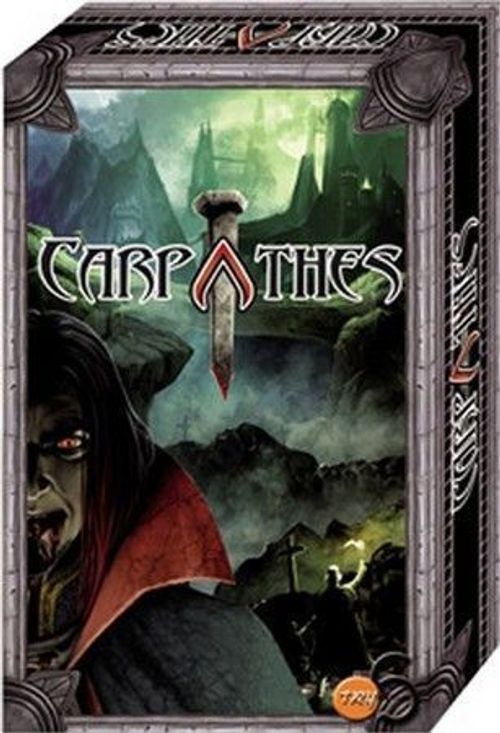
Carpathes
Carpathes Rulebook
Table of Contents
Table of Contents
Goal of the Game
In Carpathes, each player embodies a Vampire. The first player to dominate all of his opponents wins the game.
Game Description
Card game for ages 10 and up. Average game length: 45 to 60 minutes. Number of players: 3 to 5.
Components List
- Rulebook.
- 5 "Character" cards.
- 40 "Human" cards (red title background).
- 7 "Special Power" cards (blue title background).
- 36 "Attack Power" cards (yellow title background).
- 14 "Help" cards (mauve title background).
- 7 "Event" cards (green title background).
- 1 "Cycle" card: Black Moon / White Moon.
- 20 cubes in 5 colours.
Setup
Each player:
- takes a "Character" card (a card fitted with a blood dose and grace counter);
- chooses a colour and takes as many cubes as he has opponents;
- places one of his cubes on the "100" space of the blood dose counter on his "Character" card. His other cubes will be used during domination and are called "Domination cubes".
Take the other cards and separate them into 3 decks:
- Deck no. 1: the "Human" cards (red title background).
- Deck no. 2: the "Event" cards (green title background).
- Deck no. 3: the "Power" cards: "Attack Power" (yellow title background), "Special Power" (blue title background) and "Help" (mauve title background).
Shuffle each deck and place them in the centre of the table, face down.
During the game, if a deck runs out, take the cards of the corresponding discard pile, shuffle them and form a new deck.
The "Cycle" card is placed on the table in front of the first player, with the "White Moon" side visible and the number 1 pointing up.
Each player draws:
- 5 "Human" cards from deck no. 1. He keeps 3 and discards 2 onto discard pile no. 1.
- 3 "Power" cards from deck no. 3.
Example with 5 Players
Each player takes a "Character" card and chooses 4 cubes of one colour, one of which he places on the "100" space of his blood dose counter.
The youngest vampire takes the "Cycle" card and places it face up with the "White Moon" side visible and the number 1 pointing up. Afterwards he turns the card in turn to show the 3 turns of the cycle.
At the end of the 3 turns, an "Event" card is drawn and the "Cycle" card is turned over to the "Black Moon" side for 3 new turns.
Figure captions: the three draw decks are no. 1 "Human", no. 2 "Event" and no. 3 "Power"; the three discard piles are no. 1 "Human", no. 2 "Event" and no. 3 "Power". On the illustrated "Human" card in discard pile no. 1, a callout marks the "blood doses gained" (the number shown on the card). On the illustrated "Power" card in discard pile no. 3, a callout marks the "cost of cards in blood doses" (the blood-dose symbol on the card).
Course of the Game
The game proceeds clockwise and is paced by cycles (White Moon / Black Moon) of 3 turns each.
The youngest vampire is the first player.
On his turn, each player has 3 actions (different or identical) chosen from the following:
-
1) Draw a card from the "Human" deck no. 1 or from the "Power" deck no. 3. A player may not have more than 10 cards in hand at the end of his turn. Surplus cards are discarded.
-
2) Activate (place in front of oneself) a "Power" or "Help" card, paying the cost printed on the card, immediately applying its effect, and then discarding it onto the corresponding discard pile. The cost to activate a card, and the losses it causes, may be paid either in blood doses (DS) deducted from the blood dose counter, or by discarding one or more "Human" cards, or by a combination of both. Any excess from "Human" cards is lost.
Certain "Help" cards may be activated outside the player's own turn. In that case they do not count as one action.
-
3) Place a "Special Power" card (card with the blue title background) next to his "Character" card. It stays in play until the end of the game, unless it is removed by a "Destruction" card. The printed cost is paid only at the moment of placement. Afterwards, activating the card (only once per turn and per card, depending on the cycle) does not count as an action, and does not require paying its blood dose cost. There is no limit to the number of "Special Power" cards that may be placed next to a "Character".
NB: A player may never activate or place a card if he does not have the necessary blood doses (DS).
-
4) Recover up to 20 DS on his blood dose counter by discarding one or more "Human" cards.
-
5) Dominate a sufficiently weak Vampire (see Domination).
-
6) For a Slave, feed its Master if asked (see Effects of Domination).
Example of a 3-Player Turn (Dracula, Lamia and Elisabeth)
Card titles are given in English, with the printed French title in brackets where it first appears. Human card names are given as printed: "Femme" (Woman), "Homme" (Man), "Vieil homme" (Old Man).
As his 1st action, Dracula, the first player, draws a card from the "Power" deck. He looks at it (it is a Swarm of Crows, "Nuée de corbeaux") and decides on his 2nd action to activate it. To do so he discards a "Femme" card (15 DS) and attacks Lamia and Elisabeth, inflicting 15 DS of loss on each. After this attack, Lamia discards 2 "Vieil homme" cards and 5 DS from her counter, while Elisabeth discards 1 "Homme" card but does not recover the 5 surplus DS.
To finish his turn, Dracula has one action left, which he uses to draw a card from the "Human" deck.
It is Lamia's turn. She draws a "Human" card as her 1st action. Then, as her 2nd action, she discards the "Homme" card she has just drawn, which lets her recover 20 DS on her counter. She has a 3rd action left, which she uses to draw a "Power" card.
Elisabeth uses her 1st action to place the "Special Power" card "Bloodletting" ("Saignée") and pays its cost. As the "Cycle" card shows the "White Moon" side, its effect applies to Dracula, who immediately loses 5 DS. At this stage of the turn she still has 2 actions. She then targets Dracula by activating a "Hand of the Devil" ("Main du diable") and inflicts 30 DS of loss on him. Dracula discards a "Homme" card and tops up with 10 DS from his counter, bringing him below the fatal 20 DS threshold. Finally, with her 3rd action, Elisabeth spends 10 DS from her counter and dominates Dracula. Having become Mistress, she places a "domination cube" of her colour on the "0" space of Dracula's "Grace" counter to show her domination.
Dracula, the first player, turns the "Cycle" card so that the number 2 points up, and begins the 2nd turn.
End of a Cycle (3 Turns)
At the end of the 3 turns of a cycle, the current first player turns over, in view of everyone, the top card of the "Event" deck no. 2. Then, starting with him, a one-turn auction begins, to determine the first player of the next cycle.
If no bid is made, he remains first player.
A player may not bid more than the value of the "Human" cards he holds in his hand.
The bid is paid only in discarded "Human" card(s). Only the winner of the auction discards the "Human" cards bid. He thus becomes the first player of the new cycle, taking into account the effects of the "Event" card, which apply to all players.
Example of the end of a cycle:
When the 3 players have finished their 3 turns, Dracula, the first player, turns over an "Event" card and places it face up in front of him (it is the card "Pandemonium"). Dracula, being dominated, decides not to bid. Lamia, seeing an opportunity to dominate Elisabeth, bids 20 DS. Elisabeth cannot outbid her, so Lamia discards a "Homme" card, takes the "Cycle" card, turns it to the "Black Moon" side with the number 1 pointing up, and becomes first player and begins her 1st turn with her 3 actions, benefiting from the effects of the "Pandemonium" card.
Figure caption, "Pandemonium" card: losses inflicted by "Attack Power" cards (yellow) are doubled during its turn.
Domination Rules
A player can never be eliminated from the game. He never drops below 5 DS. If he finds himself in this situation, he does not suffer any loss on his blood dose (DS) counter, but discards "Human" cards if he has any.
A player can find himself dominated by another if the cube on his blood dose (DS) counter reaches the space 20 or lower. In this case, the player who wishes to dominate him must pay 10 DS, deducted from his counter, during his turn. However, after paying, he may not himself drop below 25 DS. He then becomes the dominated player's "Master" and places a "domination cube" of his colour on the "0" space of the "Grace" counter of the dominated player, who becomes his "Slave".
Effects of Domination
For the dominator (Master):
- When he addresses the players he dominates, he calls them "Slaves".
- He cannot be attacked by his Slaves.
- At the start of the turn of each of his Slaves, and only once per turn, the Master may ask his Slave:
- to be fed, if his DS counter is at or below 30 DS; or
- to attack a specific opponent.
- When a player dominates a Master who has Slaves, he places a "domination cube" of his colour on the "0" space of the "Grace" counter of the dominated player, and replaces the "domination cubes" of the other Slaves with cubes of his own colour. The new "domination cubes" are placed at the same place on the counter as the previous ones, which are returned to the former Master.
Figure caption: Dracula (red player), dominated by Elisabeth (blue player), ends up with the domination cube on space 0.
For the dominated player (Slave):
- When he addresses the player who dominates him, he must call him "Master".
- If he succeeds in dominating another player, his Master takes that player as a Slave and places a "domination cube" of his colour on the "0" space of the "Grace" counter of the new Slave.
- He cannot attack his Master or the players dominated by him (except with the "Supreme Punishment" card, "Châtiment suprême").
- He plays normally and, each time he activates an "Attack Power" card (yellow) or a "Special Power" card (blue) against a player (not dominated by his Master), he advances the "domination cube" one space on his "Grace" counter.
- He must feed his Master if the Master asks him to. He then uses one of his 3 actions and pays 20 DS, either in discarded "Human" cards, or in DS deducted from his counter, or a compromise between the two. These 20 DS are added to his Master's counter. In this case, the Slave advances the "domination cube" two spaces on his "Grace" counter. In a case of real impossibility, the Slave moves the "domination cube" back two spaces on his "Grace" counter.
- He may activate an "Attack Power" card against the opponent designated by his Master. If he carries out the attack, he advances the "domination cube" one space on his "Grace" counter. If he refuses, he moves it back one space.
Example of Domination
At the start of Dracula's turn, Elisabeth, being his "Mistress", asks him to attack Lamia. Dracula agrees by activating a "Hypnosis" ("Hypnose") card against Lamia. Having carried out the requested attack, he thus advances his "Grace" counter by moving the "domination cube" from space 0 to space 1.
Next, he activates his "Special Power" card "Paralysis" (which he had earlier placed beside his "Character" card), again increasing his "Grace" counter by advancing the "domination cube" from 1 to 2. He still has 2 actions, which he uses to draw a "Human" card and activate a "Swarm of Crows". As he cannot attack Elisabeth, he inflicts 25 DS of loss on Lamia. He increases his "Grace" counter once more by advancing the "domination cube" from 2 to 3.
On the following turn Elisabeth, now at 30 DS, asks Dracula at the start of his turn to feed her. He draws a "Human" card as one action. As his 2nd action he gives Elisabeth a "Woman" card and 5 DS from his counter, so that her counter goes from 30 DS to 50 DS. As a reward for this action, Dracula advances the "domination cube" 2 spaces on his "Grace" counter, which allows him to free himself and give the "domination cube" back to Elisabeth.
Liberation
To end his domination, the Slave must exceed the 4 points of his "Grace" counter.
The "domination cube" advances on the "Grace" counter when actions are carried out for his Master, when he voluntarily attacks an opponent of his Master, or when the "Devotion" card is activated.
Under no circumstances does exceeding 20 DS on a Slave's blood counter end his domination.
Figure caption, "Devotion" card: the card's printed text reads "Advance the domination cube one space on your Grace counter."
End of the Game
When a player manages to dominate all the other players, the game ends immediately, even if the turn is not finished. He is then declared the winner and becomes the "Lord of the Vampires" ("Seigneur des Vampires").
Variant
At the start of the game you may decide to inflict a loss of 5 DS each time a player forgets to address his master as "Master" ("Maître") or his slaves as "Slave" ("Esclave").
Rules Points
"Supreme Punishment" card ("Châtiment suprême"): This is the only card that cannot be countered. Even if you are invisible (with an "Invisibility" card) you suffer the loss of the 20 DS. The card's printed text reads: "Inflicts a loss of 20 DS on all players, including yourself. This card cannot be countered."
"Invisibility" card ("Invisibilité"): When you activate this card, you place it beside your "Character" and do not discard it until the end of the cycle. While invisible, your only possible actions are drawing cards ("Human" or "Power") and recovering blood doses on your counter.
"Conversion" card: Example: you may discard a "Hand of the Devil" ("Main du diable") card to recover the 15 blood doses printed on it.
"Destruction" card: Placing this card beside your character costs no DS but uses one of your 3 actions. Once placed, you may activate it to remove a "Special Power" (blue) card from an opponent by paying the cost of the destroyed card. Example: pay 10 DS to remove the "Conversion" card.
Note on this transcription: the small printed text on the illustrations of the "Invisibility", "Conversion" and "Destruction" cards is not legible in the scan, so only the rules text printed beside them is transcribed above.