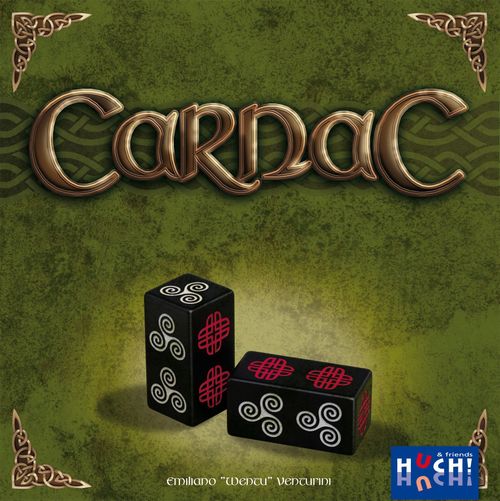
Carnac
Carnac Rulebook
Table of Contents
Table of Contents
Contents
- 28 black megaliths
- 1 game board with three sections of varying sizes:
- small section (I): 8 x 5 squares
- medium section (II): 10 x 7 squares
- large section (III): 14 x 9 squares
Aim of the Game
The player who has built the most dolmens at the end of the game is the winner.
Stones in Carnac
- The 28 black stones are the megaliths in Carnac.
- A dolmen is a group of megaliths (standing upright or tilted), whereby at least 3 symbols of any one colour of play, pointing upwards, border on each other. Megaliths border on each other, if they are touching on at least one side. Diagonally neighbouring megaliths do not count as bordering on each other.
Important: scoring is done from a bird's eye view. Only symbols pointing upwards count!
- Scoring from a bird's eye view: 6 white symbols bordering on each other.
- Smallest possible dolmen: 3 white symbols bordering on each other.
- No dolmen: diagonally neighbouring symbols but not bordering on each other.
Preparation
Before the game starts, both players agree on one of the three game board sections. The 28 megaliths are placed in readiness, in a common stockpile, beside the board.
Each player chooses his colour of play. The game board is now placed between the two players in such a way that they sit at the long sides of the board with their colour.
The eldest player begins.
Tips for the Game Board Sections
CARNAC can be played on three different-sized sections. All three sizes confront the players with individual challenges. To begin with, it is recommended that a few games are played on the middle section (II) and then later play on the other two sections.
How to Play
The first player (A) begins by placing a megalith on any one square. His opponent (player B) now decides, whether he wants to (i) tilt the megalith just positioned and place a new one or whether he (ii) does not want to tilt the megalith.
(i) Tilting and placing: if player B decides on step (i), then he tilts the last megalith positioned by his fellow player, to a lying position. Following this, he places a further megalith out of the stockpile, in a standing position, on any free square on the board.
After this, player A takes his turn again. It is now up to him to decide between (i) tilting and placing, and (ii) not tilting.
(ii) Not tilting: if a player (A) decides on step (ii) and does not want to tilt the megalith last placed by his opponent (B), then it is his opponent's (B) turn again. He then places a further megalith in an upright position, on any empty square. Now player A must choose between action (i) and (ii) again.
Rules for Placing and Tilting
Placing
- Megaliths may only be placed on the board in an upright position. A megalith is considered to be in an upright position when one of its two short square sides is standing on the board.
- When placing megaliths on the board, both the player's own colour and that of his opponent may face upwards.
- Once positioned, the megaliths may only be tilted, but otherwise may not be moved or removed.
Tilting
A megalith can only be tilted if there are enough empty squares in the tilt direction. A megalith is always tilted onto two neighbouring empty squares, so that the square originally occupied then becomes empty again. After being tilted, the megalith is considered to be in a lying position. Consequently, it is lying on the board on one of its four long, rectangular sides.
Sequence: newly placed, then correctly tilted, then lying position.
- After tilting, the square originally occupied must be free again.
- Megaliths may not be tilted so that they are protruding over the edge of the game area.
- Megaliths may not be tilted in a diagonal direction.
- Your opponent's turn can not be prevented by tactical placing of the stones: if your opponent is not able to tilt the last placed megalith, then it is still his turn and he may place a new megalith onto the board.
- Megaliths which have already been tilted may no longer be moved or removed.
Game Tips
The colour of play showing uppermost determines the colour of the stone. Since scoring in CARNAC is done from a bird's eye view, it is advisable to stand up from time to time and view the game board from above.
In CARNAC the number of dolmens is decisive, and not necessarily their size. Winning points already scored are minimized by dolmens of the same colour growing together. Therefore, in some situations it may be strategically clever, to position stones with the opponent's colour uppermost, or to tilt megaliths onto the opponent's colour of play. By doing so in certain situations you can ensure that (i) your own dolmens will not be joined together or that (ii) your opponent's dolmens can not combine to form a large area.
End of Game
The game ends as soon as the common stockpile of megaliths has been used up or when there are no more empty squares on the board.
The player with the most dolmens wins the game. In the case of a tie, the player with the largest dolmen wins. Further ties are decided by the next largest dolmens.
Example of Final Scoring
The red player and the white player have each built 5 dolmens in this game. In the case of an equal number of dolmens, the player with the largest dolmen wins.
- Largest white dolmen = 8 symbols.
- Largest red dolmen = 8 symbols.
In the case of a further tie, the next largest dolmens decide.
- Second largest white dolmen = 6 symbols.
- Second largest red dolmen = 5 symbols.
White wins the game.