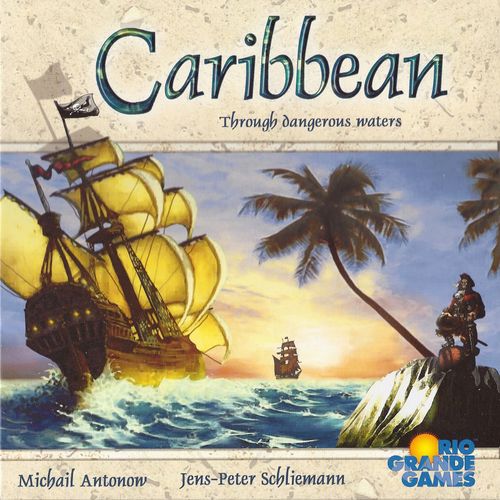
Caribbean
Caribbean Rulebook
Table of Contents
Table of Contents
Contents
- Game board
- 35 coins (doubloons)
- 4 x 7 bribing cards
- 16 treasure chests
- 6 pirate ships (carefully assemble them before the first game)
- 4 card holders (carefully assemble them before the first game)
The game board shows the treasure chest supply, harbor cities, the starting space for each pirate ship, sea spaces, and safe havens.
Preparation
Each player takes a card holder and a set of 7 bribing cards in his color. He places the card holder so he can see the ship names.
Shuffle the 16 treasure chests face down. Choose 6 treasure chests at random and place them face up on the ports indicated on them.
Place the remaining 10 treasure chests face down in piles of two each on the five special spaces in the upper right corner of the board.
Place the coins next to the board. They have the following values:
- gold = 10.000 doubloons
- silver = 5.000 doubloons
- copper = 1.000 doubloons
Place the 6 pirate ships randomly on the starting spaces marked with the ship symbols. These symbols are of no further importance during the game.
The pirate ships do not belong to any player. Thus, the players must bribe the pirates to act on their behalf according to their strategies.
For each capture of a harbor city and for each treasure chest brought to a player's safe haven, the player earns doubloons.
At game end, the player with the most doubloons is the winner!
Playing the Game
Bribing pirate ships
At the start of each round, each player allocates six of their seven bribing cards to the names of the six ships on their card holders. Each places he seventh card (intended as tie-breaker in case of a draw) face down next to the card holder. When all players have completed placing their bidding cards, they give their OK, and, then can no longer change their bidding cards for this round.
Move the ships in alphabetical order
First, each player reveals his bidding card for Arriba by placing it face up in front of his card holder so all can see it. The player who bid the most barrels, immediately moves the Arriba, moving it a number of sea spaces equal to the number of barrels in his bid. However, each thief card played by an opponent subtracts one space from the ship's movement. The player need not use his full movement allowance when moving a ship. Only one ship may occupy a sea space. Players must move ships around occupied sea spaces. Ships may move through all safe havens and ships may stop at safe havens.
After the Arriba has been moved, the players reveal their bids for the Bravo and the player with the highest bid move it in the same way. Then come the Caribic, the Diabolo, the Evita, and, at last, the Fuego.
Ties in bidding: in case of a draw, the highest bidders must decide if they want to use their tie-breaker cards. To this end, they lay their hands flat over their tie-breaker cards and then, simultaneously, lift their hands. A face up card means the player is bidding some more (note: zero is more than -1). The winner gets to move the ship, but only as far as the number of barrels on the original card allows, subtracting any thief cards from the original bids. The number of barrels on the tie-breaker card does not influence the number of spaces moved. If there are any thieves on any of the tie-breaker cards, the number of spaces is reduced accordingly. Once revealed, a tie-breaker card cannot be used a second time until the next round. If the result of the tie-breaker is another tie, the ship is not moved in this round and remains where it is. Tie-breaker cards revealed face down can be used to break another tie.
Getting treasure chests
When a player wins the bid and moves a ship, he is the active player and can capture a harbor city to steal the treasure chest there, or steal a treasure chest from another ship, swap a treasure chest with another ship, or deliver a treasure chest to a safe haven. Each ship may only carry one chest at a time and the value of the chest must be visible on the deck of the ship. The active player may take these actions in any order he chooses, whenever he chooses during the ship's movement, including before and after he moves the ship.
- capture: when the ship being moved is in a sea space with a harbor city with a treasure chest, it can steal the treasure chest, loading. The active player puts the treasure chest on the ship and takes 2,000 doubloons for his effort.
- steal: when the ship being moved is in an adjacent sea space to a ship carrying a treasure chest, it may steal the treasure chest. The active player moves the treasure chest to the moving ship.
- swap: when the ship being moved has a treasure chest and is in an adjacent sea space to a ship carrying a treasure chest, the active player may swap the two treasure chests between the two ships.
- deliver: when the ship being moved is in a space adjacent to a player's safe haven, the ship may deliver a treasure chest to the safe haven if it is carrying one. The active player moves the treasure chest from the ship to his safe haven.
Delivering treasure chests to safety
The active player can deliver a treasure chest to safety when:
- when the ship being moved moves through a safe harbor and unloads a treasure chest there,
- when the ship being moved stops at a safe harbor and unloads a treasure chest there,
- when the ship being moved is standing at a safe harbor and unloads a treasure chest there.
In all cases, the owner of the safe haven (normally, the active player, but it could be another player) earns the number of doubloons shown on the treasure chest (4,000 – 8,000 doubloons). The active player then places the treasure chest face down on the city names on the chest to show its chest has been taken and will not be available again in the game.
Important: a player may never throw a treasure chest overboard! Doubloons earned by players are public and must be displayed in the players' play areas for all to see.
The following rounds
When all 6 ships have been moved, including any that failed to move because of an absolute tie, the round ends. After each round, the players place the next two treasure chests from the treasure chest supply (going from left to right) on the names harbor cities until, after 5 rounds, all treasure chests have been placed on the board.
Each player takes his bidding cards back and a new round begins. The ships remain where they were at the end of the round.
Game End and the Winner
The game ends when at least one player has:
- 62.000 doubloons (2 players)
- 41.000 doubloons (3 players)
- 31.000 doubloons (4 players)
The current round is played to completion. The player at the end of the round is the winner!