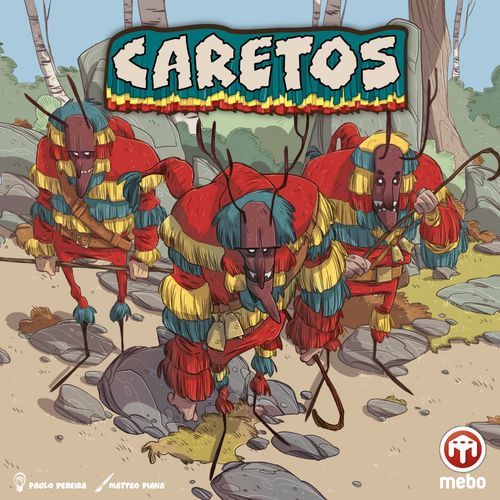
Caretos
Caretos Rulebook
Table of Contents
Table of Contents
Concept of the Game
- In this game you control a team of two Portuguese monsters that roam the region at night, hunting villagers.
- Your goal is to scare and capture more villagers than any of your opponents.
- On each of your turns, you will play a Night Card from your hand; these cards determine what types of actions your Monsters can take.
- The game ends when there are no more villagers to capture, or when the Night Cards deck is empty. Whoever has captured the most villagers and earned the most Victory Points (VP) will be the winner!
Specific Location Names
Some locations on the board have specific names: Dolmen, Village, Granary, Forest, Chapel, Well, Waterfall.
Components of the Game
- This rulebook
- 4 Player aids
- Game board — one side for 2 players; one side for 3-4 players.
- 8 Monster Cards
- 35 Villagers (7 red + 7 blue + 7 white + 7 green + 7 yellow)
- 16 Campfire tokens
- 9 Final Bonus Cards
- 19 Bonus Cards
- 1 Cauldron Card
- 48 Night Cards
- 8 Monster pieces
- 2 Careto pieces
- 10 plastic bases — if this is your first time playing, fit the Monster and Careto pieces to the stands.
Set-Up
- Place the game board in the center of the table, within reach of all players. Use the side of the board that matches the number of players in your game. Refer to the symbol at the board's top-left corner.
- Randomly distribute two Monster Cards to each player, along with the matching Monster pieces.
- Place the two Caretos on the game board, in the 2 places with a Caretos symbol.
- There are 8 places on the board that show these symbols. Each symbol appears in two locations on the board. Each player chooses one of these symbols and then places a Monster on each of those locations.
- Place 5 randomly-selected villagers in each of the 7 locations marked with this symbol.
- Note: In a 2-player game, there are only 5 locations marked with that symbol. Return 2 villagers of each type to the game box, and distribute the rest among those 5 locations.
- Shuffle the Night Cards into a face-down deck.
- With 2 players: Use only the 24 Night Cards marked with a specific symbol; return the remaining cards to the game box.
- With 3 players: Use only the 36 Night Cards marked with two specific symbols; return the remaining cards to the game box.
- With 4 players: Use all 48 Night Cards.
- Deal each player 3 Night Cards, face-down. Players may look at their own cards, but should not show them to anyone else.
- Shuffle the Bonus Cards to form a face-down draw pile near the game board. Draw 3 of these cards and place them face-up, in sight of all players.
- Shuffle the Final Bonus Cards and deal 1 to each player, face-down. Players should keep their cards secret from other players. Return the remaining Final Bonus Cards to the game box, face-down.
- Note: in games with experienced players, you can deal 2 Final Bonus Cards to each player. Each player should choose 1 and return the other to the box, face-down.
- Place a Campfire token near each group of Villagers. Any leftover Campfire tokens are put into a common pile within reach of all players.
- Place the Cauldron card near the game board.
The player who most recently saw a Careto will start the game.
How to Play
CARETOS is played over several rounds, going in clockwise order from the starting player. On your turn you must take a mandatory action; you may choose to take optional actions.
Mandatory action:
- Choose ONE Night Card from your hand and place it on top of your personal discard pile.
- After this mandatory action, perform the actions shown by the symbols on the card, from top to bottom. Some of the symbols represent mandatory actions; certain others are optional.
Optional action:
- You may use your Campfire tokens to perform other actions. For details on optional actions, see "Use Your Campfires" below.
End of Turn:
- Draw a new Night Card from the draw pile. There must always be 3 Night Cards in your hand.
- If the end of the game has not been triggered (see "End of Game"), play passes to the player on your left.
Types of Pieces / Tokens Found on the Board
- Monsters — Each player has 2 Monsters, which they use to move, scare, and capture Villagers.
- Caretos — Caretos don't belong to any player; they can be used by anyone.
- Campfires — Campfire tokens mark groups of Villagers - a group consists of 2 or more Villagers together in the same place. These tokens also allow you to take extra actions.
- Villagers — These are the pieces you want to capture during the game.
Night Cards
When you play a Night Card, place it face-up in front of you, on top of your personal discard pile. Take care not to cover the previously-played cards' Rune symbols (seen on cards' upper-left corners).
Each Night Card has a background color and a symbol that shows what kind of night (Moon, Storm, or Comet) will occur on your turn. These symbols determine the actions your Monsters can take.
Some cards have additional symbols: Move Caretos, Gather Villagers.
Most cards have a Rune in their upper-left corners. A Rune, played on top of a card with a matching Rune, will allow you to use both of your Monsters on the same turn (see "Activate Your Monster").
The actions shown on the cards are always performed from top to bottom.
Gather Villagers
If the Night Card you played shows this symbol, you must gather Villagers. Each Villager that is alone in a location must move along a path that is free of Monsters and/or Caretos until it finds at least one other Villager, at which point it will stop moving. If this Villager forms a NEW group (i.e., it joined another single Villager), you must place a Campfire token next to this new group.
If there are multiple paths a Villager can take, the active player chooses which path to use. If a Villager doesn't have any open paths (because they're blocked by Monsters or Caretos), it won't move.
Example: this shows 3 possible options for gathering Villagers. The active player decides which one(s) to take:
- Move the white Villager to the group at the Granary.
- Move the white Villager to the blue Villager at the Dolmen. In this case they will form a new group; you must add a Campfire token to that location.
- Move the blue Villager to the white Villager. In this case they will form a new group; you must add a Campfire token to that location.
Move Caretos
Some Night and Monster Cards have a symbol indicating that a Careto must be moved.
- If a card is played with this symbol, the Careto must be moved. You choose which Careto to move, and the location to which it is moved.
- The number on the card indicates how many moves the Careto must make.
- Each Careto is moved along the paths between two locations. These can be marked by simple circles, or by drawings of specific locations such as a Well or Dolmen.
- You cannot move a Careto into or through a location occupied by another Careto.
- If a Careto enters a location occupied by a Monster, stop immediately at that location and capture the Monster. Place it in the Cauldron (see "The Cauldron"). If the Careto has any movement remaining, it is lost.
- If a Careto enters a location occupied by a group of Villagers (2 or more), the Villagers disperse and flee (see "Scare, Disperse, and Flee"). That group's Campfire token is returned to the common pile (and is thus not awarded to any player). The Careto's movement ends immediately, and any remaining movement is lost.
- If the Careto enters a location occupied by only 1 Villager, it captures the lonely Villager and may then continue its movement (if any remains). Captured Villagers are returned to the game box (and not given to any player). If the Careto has additional movements, it MUST complete those moves.
Activate Your Monster
- Choose ONE of your Monsters to take an action that matches the symbol on your Night Card. Actions are described on Monster Cards. This action is optional.
- You can never activate a single Monster twice in the same turn.
Double-activate: You can use both of your Monsters on a turn if the Rune on your just-played Night Card matches the Rune on the card immediately below it in your discard pile. When you take an action with your 2nd Monster, its action must match the symbol on the Night Card you played this turn.
If you have 2 matching runes you must return all of your played Night Cards to the game box; you will start a new discard pile on your next turn. This means that you won't be able to take a double activation on your next turn, as you won't have any cards (and thus, no matching Runes) in your discard pile.
Move Monsters and Capture Villagers
This symbol is found on each Monster Card; the number indicates how many moves that Monster can make.
- Monsters move between locations on the board along the marked paths. Locations can be marked by simple circles, or by drawings of specific places such as the Well and the Village.
- Each "point" of Monster movement is the equivalent of moving between two neighboring locations, always along a path.
- You can move a Monster up to the number of locations indicated on the movement symbol; you do not have to use all your movement.
- No Monster can occupy or move through a location already occupied by a Careto or another Monster.
- The "Lost Soul" Monster, which uses this symbol, breaks this rule (see "Monster Cards").
- If the action type shows specific locations, it means that the Monster can "jump" between any of them as a normal part of his movement. For example, if you have a Dolmen and a Village on your card, the Monster can spend 1 move to jump between them, or between a Village and another Village, or any other combination of these locations.
- If your monster enters a location with only 1 Villager, it captures that Villager and can then normally continue its movement. Captured Villagers are placed on top of players' Monster Cards.
Scare, Disperse, and Flee
If your Monster enters a location occupied by a group of 2 or more Villagers, the Villagers become scared; they will disperse and flee.
- In this case, you must immediately stop your Monster's movement; any unused moves are lost.
- You receive the Campfire token from that location (see "Use Your Campfires").
- If there is only one adjacent location, all dispersed Villagers flee into it.
- If a Villager flees to a location occupied by a Monster or Careto, it is automatically captured by that Monster or Careto.
- IMPORTANT: Villagers flee individually. Even if they all flee to the same place, escapes are always made one-by-one. Thus, a Monster or Careto in a location that receives fleeing Villagers will capture them all, because each escape is an individual movement.
- Choose any adjacent location and move a Villager from the group to that location. Then, going clockwise one location at a time, do the same for each remaining Villager in the group.
Example
The player plays a "Comet" Night Card, which allows them to take 6 moves with that particular Monster (Maria Gancha).
The Monster spends 1 movement to enter the location occupied by 3 Villagers. Several things then happen: the player immediately stops their movement and takes the Campfire token from this location; their remaining 5 moves are lost. Then...
The player moves the green Villager to an adjacent location.
Then they move the red Villager to the next location in clockwise order; that location is occupied by a Monster, which immediately captures this Villager.
Finally, the white Villager is moved to the third location, which is already occupied by a blue Villager. As these 2 Villagers form a NEW group (2 or more villagers in the same place), a Campfire token is immediately placed at that location.
The Cauldron
How do Monsters get trapped in the Cauldron?
Whenever a Careto enters a location occupied by a Monster, the Monster is placed into the Cauldron. Place the Monster piece onto the Cauldron card.
IMPORTANT: Monsters trapped in the Cauldron cannot be activated.
How can I remove my Monster from the Cauldron?
There are 3 ways in which a Monster could escape from the Cauldron:
- The Cauldron can only hold one Monster at a time. Whenever a Monster is put into the Cauldron, return any Monster already in the Cauldron to the game board, ready to play (see "How do I return my Monster to the board?" below).
- Spend 3 Campfire tokens; return your Monster to play.
- If the Rune on your just-played Night Card matches the Rune on the card immediately below it in your discard pile, you can remove your Monster from the Cauldron and return it to play.
- Note: this is not the same as taking a double activation (see "Activate Your Monster"). You must still return all of your played Night Cards to the game box.
How do I return my Monster to the board?
- Each Monster Card indicates the specific locations where that Monster may return to play. A Monster must return to an unoccupied location.
- If all of those specific locations are occupied, your Monster can return to any unoccupied location with one of these symbols.
- If all of those locations are also occupied, your Monster can return to any unoccupied location on the board.
Use Your Campfires
- Every time you scare a group of Villagers, you receive a Campfire token.
- You can spend Campfire tokens at any point during your turn; return spent tokens to the supply.
- You may only spend Campfire tokens once per turn.
Ways to spend a Campfire token:
- Spend 1 Campfire to buy a Bonus Card. Choose one of the face-up Bonus Cards and place it face-up in front of you. See "Bonus Cards" below.
- Spend 1 Campfire to take 1 additional move with the Monster you just activated.
- Spend 3 Campfires to activate your second Monster; it must act according to the symbol on the Night card you just played.
- Spend 3 Campfires to pull your Monster out of the Cauldron and return it to play.
Bonus Cards
You can earn additional VP (victory points) by completing the goals shown on your Bonus Cards.
- Bonus Card goals are focused on scaring groups of Villagers (a group is 2 or more Villagers at the same location).
- When you purchase a Bonus Card (using a Campfire token), place it face-up in front of you. Draw a new Bonus Card to replace the one just purchased.
- If you complete a Bonus Card's goal, place that Bonus Card underneath your Monster Card; this indicates that you have earned the VP noted on that Bonus Card.
- You may have no more than 3 Bonus Cards with unfulfilled goals.
- You cannot buy a card and complete its goal in the same turn.
- Capturing Villagers does NOT accomplish Bonus Card goals.
- You cannot use Caretos to accomplish Bonus Card goals.
- You may accomplish multiple goals in a turn.
Examples of Bonus Card goals:
- Scare a group of Villagers in a location adjacent to the Caretos.
- Scare a group of Villagers in a location adjacent to any other Monster.
- Scare a group of Villagers that includes at least 2 Villagers of the color shown. The group may include Villagers of other colors. (In this example, scaring a group of Villagers that includes at least 2 red Villagers will earn you 2 VP.)
- Scare a group of Villagers in a location adjacent to the one illustrated.
- Scare a group of Villagers at the location illustrated.
- (In one example, scaring a group of Villagers who are adjacent to a Village will earn you 2 VP; scaring a group of Villagers who are located in a Village will earn you 1 VP.)
End of Game
The game ends as soon as the last Villager is captured OR the last Night Card is drawn. In the latter case each player takes one last turn before the game ends, finishing with the player who drew the last card from the deck.
Scoring
Sum all your Victory Points (VP):
- Each Villager your Monsters have captured is worth 1 VP.
- Add the points from any Bonus Cards whose goals you accomplished.
- Add any VP earned from your Final Bonus Card (see "Final Bonus Cards").
The player with the most VP wins the game. In the event of a tie, the tied player with the most Campfire tokens is the winner. If there is still a tie, the tied player who captured the most Villagers is the winner. If there is still a tie, the tied players share the victory.
Final Bonus Cards
- These cards are given to players during game setup.
- Final Bonus Card goals involve capturing certain types of Villagers.
- Final Bonus Cards are only revealed to your opponents at the end of the game. Add any VP earned from your Final Bonus Card to your final score.
Examples of Final Bonus Card goals:
- Earn 5 VP for each set of 5 different-colored Villagers that you captured during the game.
- Earn 9 VP for each set of 4 same-colored Villagers that you captured during the game.
- Earn 5 VP for each set of 3 same-colored Villagers that you captured during the game.
- Earn 2 VP for each Villager of a specific color that you captured during the game.
- Earn 3 VP for each set of 2 same-colored Villagers that you captured during the game.
Monster Cards
Each Monster has two possible actions, listed on its card, which are used depending on which Night symbol (Moon, Storm, or Comet) is shown on the Night Card you played.
Werewolf
- Make up to 5 moves with this Monster. When you are done moving, make 1 move with either Careto.
- Make up to 6 moves with this Monster. You can jump between Villages; each jump spends 1 movement.
- You can swap this Monster's location with that of your other Monster, or with that of a Careto. You may then make up to 3 moves with this Monster.
Enchanted Moira
- You can move a Villager or a group of Villagers from one location to another, unoccupied location. Villagers can only pass through unoccupied locations. If this move leaves an unattended Campfire in any location (or with only 1 Villager next to it), return the Campfire to the supply.
- Make up to 2 moves with this Monster. Then, make 3 moves with a single Careto.
- Make up to 3 moves with this Monster. You can jump between Waterfalls, Granaries, Dolmens, Forests, Chapels, and Villages. Each jump spends 1 movement.
The Shepherdess of Wolves
- Scare any group of Villagers. Because this power allows you to scare Villagers from a great distance, your Monster does not move. You receive the Campfire token from that location.
- Make up to 3 moves with this Monster. You can jump between Waterfalls, Granaries, Dolmens, Forests, and Chapels. Each jump spends 1 movement.
- Make up to 3 moves with this Monster. Then, you may make up to 3 moves with any other Monster. If the Monster is not yours, its owner receives any Villagers or Campfire gained by that Monster during this turn.
Trevor
- You can move two different Villagers up to 2 moves each. If this leaves an unattended campfire in any location (or with only 1 Villager next to it), return it to the supply.
- Make up to 2 moves with this Monster. Then, make 2 moves with a single Careto.
- Make up to 4 moves with this Monster. You can jump between Dolmens, Forests, Chapels, and Villages. Each jump spends 1 movement.
Lost Soul
- If you move through a location occupied by another Monster, you can send that Monster to the Cauldron.
- Make up to 3 moves with this Monster. You cannot stop at locations occupied by other Monsters or Caretos, but you can move through them.
- Make up to 3 moves with this Monster. You cannot stop at locations occupied by other Monsters or Caretos, but you can move through them. Then, move a Careto 1 move.
- Make up to 3 moves with this Monster. You cannot stop at locations occupied by other Monsters or Caretos, but you can move through them. You can jump between Forests, Granaries, Chapels, Villages, and Dolmens. Each jump spends 1 movement.
Witch
- Place this Monster in any location not occupied by a Monster or Caretos.
- Make up to 4 moves with this Monster. You can jump between Forests, Granaries, Villages, and Waterfalls. Each jump spends 1 movement.
- Make up to 3 moves with this Monster. Then, make 2 moves with a single Careto.
- Place this Monster in any location unoccupied by a Monster or Careto. If this location contains a Villager, capture it. If it contains a group of Villagers, they are scared away.
Bogeymen
- Make up to 3 moves with a group of Villagers. This group of Villagers behaves exactly as though it were a Careto.
- Make up to 3 moves with a group of Villagers. You must move the entire group (and the campfire) as a single unit. On this turn, this group of Villagers behaves exactly as though it were a Careto.
- Make up to 5 moves with this monster. You can jump between Dolmens, Granaries, and Chapels. Each jump spends 1 movement.
Maria Gancha
- If you scare a group of Villagers, you can make 1 additional move. You can only do this once per turn.
- Make up to 4 moves with this Monster. Then, make 1 move with a Careto.
- Make up to 6 moves with this Monster. You can jump between Wells; each jump spends 1 Movement.
- Make up to 7 moves. If you scare a group of Villagers, you can make 1 additional move. You can only do this once per turn.
- Make 2 moves with a Careto. Then, make 2 moves with the other Careto.