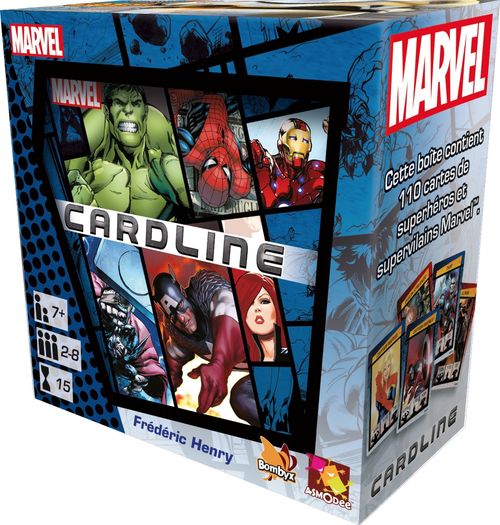
Cardline: Marvel
Cardline: Marvel Rulebook
Table of Contents
Table of Contents
Components
110 cards. Each card shows, on its front, the name of a character and its illustration; on its back, the same information plus the character's characteristics.
- Name.
- Drawing.
- Colour. The colour indicates whether the character is a Superhero (blue) or a Supervillain (red).
- Characteristics.
Front side: the character's name and illustration.
"Characteristics" side: the same name and illustration, plus the characteristics.
The characteristics
Strength. The character's pure strength: how hard the character can strike an enemy, or how much weight the character can lift, such as a car. Strength is expressed in kilograms (kg) or tonnes (t).
Intelligence. The character's intelligence. This characteristic is used to evaluate the character's ability to react to a given situation.
Combat power. The character's ability to win a fight by combining their powers, strength, intelligence, and so on.
Object of the game
Be the only player left holding no cards.
Setup
- The players sit around the table.
- They decide together who will be the first player and which characteristic will be used for the game (Strength, Intelligence, or Combat power).
- Shuffle the cards.
- Each player receives four cards, characteristics side face down. A player must never look at the back of these cards (the "characteristics" side). However, the players are free to agree on a different number of cards to deal, depending on their experience with the game.
- Leave the draw pile on the table, characteristics side face down.
- Place the first card of the draw pile in the centre of the table, turned characteristics side up. This card is called the initial card (carte initiale). The line in which players will place their cards will be built from this card.
- You may begin playing!
Setup diagram key:
- First player.
- Play area.
- Initial card.
- Draw pile.
- Cards dealt to the players.
Game flow
Players take turns in clockwise order.
The first player must place one of their cards next to the initial card:
- If they judge that the characteristic of the character on their card is lower than that of the initial card, they place their card to the left of the initial card.
- If they judge that the characteristic of the character on their card is higher than that of the initial card, they place their card to the right of the initial card.
Once placed, the player turns their card characteristics side up, to check that the value of its characteristic matches the position it occupies in the line:
- If the card is well placed, it stays where it is, characteristics side up.
- If the card is badly placed, it is put back in the box. The player must then draw the first card of the draw pile and place it in front of them, characteristics side down, with their other cards.
Example of the first player's turn.
Second player's turn. The second player is the player directly to the left of the first player.
- If the first player placed their card correctly, the second player now has a choice of three places to place one of their cards: to the left of the two cards already placed, to their right, or between the two.
- If the first player placed their card incorrectly, the second player only has a choice of two places (to the right or to the left of the initial card).
If the second player places their card correctly on their turn, it stays there, characteristics side up. The line is then simply rearranged so that there is a space between each card.
Example of the second player's turn.
Third player's turn. It is now the third player's turn to play.
- If the two players before them placed their cards correctly, they now have a choice of four places.
And so on.
End of game and victory
If a player is the only one to correctly place their last card during a turn, they are immediately declared the winner.
If several players correctly place their last card during the same turn, they all remain in the game and the others are eliminated. Each player who remains in the game receives one card from the draw pile, and continues playing with it until only one player is left who correctly places their card.
Special case
During the game, a player may have to place a card with the same characteristic value as a card already placed. In that case, the two cards must be placed side by side, in no particular order.