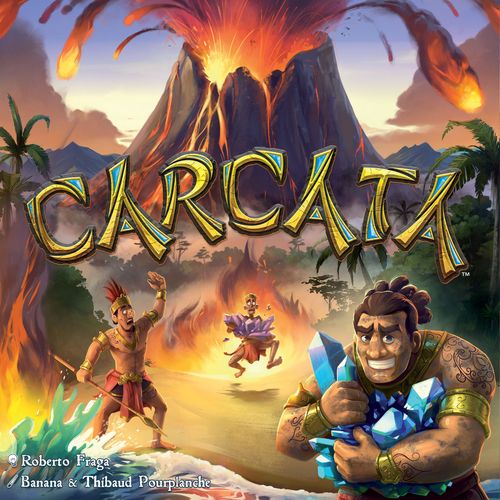
Carcata
Carcata Rulebook
Table of Contents
Table of Contents
Contents
A game board (a), an island made of 6 levels (a and II.), a catapult volcano (b), 5 special dice (c), 20 tribe pawns (5 per color) (d), 20 gems in 4 colors (e), 1 cloth bag (f), 4 statues (g), 60 Lava tokens (h), 1 Ancestral Turtle (i), the rulebook.
Object of the Game
Be the player with the most points at the end of the game.
Setup
A. Place the game board in the center of the table.
B. Place the island support structure in the center of the board, then stack the 6 levels of the island on top of one another, from largest to smallest. (II.)
C. Place the volcano on top. (II.)
D. Place the Ancestral Turtle pawn along its path, on the space marked by the large turtle. (III. i.)
E. Place the 4 statues on the 4 small islands off the coast of Carcata. (III. g.)
Players choose a color and take the 5 corresponding tribe pawns.
Course of the Game
Choose the player who starts the game. He places 1 of his pawns on a free beach space (at the water's edge). His left-hand neighbor does the same, and so on until all pawns have been placed. (III.)
Note: it is recommended to spread your pawns so as to have access to all parts of the island.
The game can then begin.
On his turn, the player takes the 5 dice and rolls them. According to his strategy, he may reroll all or some of his dice as many times as he wishes! But beware, trying to influence fate is not without danger! Dice that land on the Turtle face cannot be rerolled. They are set aside and will be used to advance the Ancestral Turtle, as explained below.
Once the player is satisfied with his result, he applies the effects of each die in the order of his choice, finishing with the turtle faces.
Movement
For each MOVEMENT face rolled, the player may move one of his pawns one space in any direction. He may go up, go down, or stay on the same level.
Example: if he rolls 3 movements, he may move one pawn 3 spaces or split the movements as he likes among several pawns.
A pawn cannot cross or stop on a space if it is occupied by a pawn, a statue or a lava token.
At the end of the game, tribe pawns score points according to the level they are on. 1 point on a beach space, 2 points on the second level, and so on up to the 6th level. (IV.)
When a pawn moves onto or stops on a space containing a gem, the gem is picked up. The player takes it and places it in front of him. The value of the gems thus collected will also be added to the player's score at the end of the game.
Lava
For each LAVA face rolled, the player receives a lava token which he must place while respecting the following rules:
- During his turn, the player must place all his lava tokens so as to form one single straight flow. Beware! Any excess lava tokens are lost.
- The starting point of this flow must be EITHER one of the spaces adjacent to the volcano OR any lava token of a previously played flow. In this second case, the new flow may continue the original flow or go in a different direction, but must remain straight. (V. c.)
- A lava flow must follow the direction of the slope. Thus, each token must be placed on a level lower than the preceding token. (VI.)
Only a STATUE can deflect a lava flow to its left or right (if the slope rule is respected). (VII.)
If a lava flow reaches a tribe pawn, that pawn is permanently removed from the game.
If a lava flow passes over a gem, the gem is destroyed and returns to the bag.
When a lava flow reaches the sea, it cuts the island into zones. From 2 flows reaching the sea, the island is cut into 2 distinct parts, and so on.
Tribe pawns cannot cross lava flows.
Eruption
For each ERUPTION face rolled, the player draws a gem at random from the bag and places it on top of the volcano. He then turns the volcano in the direction of his choice, judges the force he wishes to apply, and catapults the gem onto the board.
Example: if a player rolls 3 eruptions, he must draw 3 gems from the bag and catapult them one after the other.
- If the gem touches a tribe pawn, the pawn is removed from the game.
- If the gem touches a statue, the statue returns to one of the small islands.
- If the gem stops on a space covered with lava or falls into the sea, it is lost and returns to the bag.
- If the gem stops on an unoccupied space of the island, it stays in place.
- If the gem stops on a space occupied by a tribe pawn without touching it, the pawn's owner immediately wins the gem and places it in front of him.
Gems have different values:
- Emerald (green): 1 point
- Ruby (red): 2 points
- Sapphire (blue): 3 points
- Diamond (transparent): 5 points
To score these points, players must have picked up the gems or have tribe pawns present in the zones containing gems at the end of the game (see the LAVA paragraph).
Protective Totem
For each STATUE face rolled, you may either:
- Move a statue from the small islands to a free space on the island of Carcata.
- Send a statue from Carcata back to one of the small islands.
A statue already on Carcata cannot be moved to another space on Carcata.
Statues are shared by all players but limited in quantity (4).
If they are destroyed by an eruption, they are sent back to the small islands and can be used again.
Statues cannot be placed on the top level (around the volcano).
Reminder: statues can deflect lava flows as long as the slope rule is respected.
Turtle
When a player rolls a TURTLE face, he immediately sets that die aside and can no longer reroll it.
For each Turtle face, at the end of his turn the player must advance the Ancestral Turtle to the next symbol around the island.
The Ancestral Turtle is the guardian deity of the island and its treasures. If it completes 2 full laps of the island before the victory conditions are met, there is no winner. The volcano erupts and it is the island that wins the game!
Note: if a tribe pawn is near the Ancestral Turtle, it may use a movement to climb onto its back as if it were a space. It can enjoy its journey and disembark whenever it wishes. This is the only way to cross lava flows.
End of the Game
The game ends as soon as a player loses his last tribe pawn. That player is eliminated. The survivors count their points.
- Each surviving tribe pawn earns points for its owner: 1 point for a tribe pawn on the beach, 2 points if it is on the second level, and so on up to the 6th level... the most dangerous, but worth 6 points. (IV.)
- As explained previously, lava flows that reach the sea form closed territories. Each tribe pawn enclosed in a territory earns points for the uncollected gems found there. Example: Roberto has 2 tribe pawns in a closed territory containing 1 sapphire and 1 ruby. He scores 5 points (sapphire 3 pts + ruby 2 pts) for each of his pawns: a total of 10 points! (VIII.)
- Players also count the gems they collected during the game.
Note: the player who eliminated the last member of the vanished tribe takes its gems.
The player with the most points wins the game.
But beware! If the Ancestral Turtle completes 2 laps of the island before a tribe has been eliminated, a massive eruption destroys everything and the island wins the game!
Clarifications
- Lava tokens touched by a gem are not destroyed.
- If there are no more gems in the bag, there can no longer be any eruption.