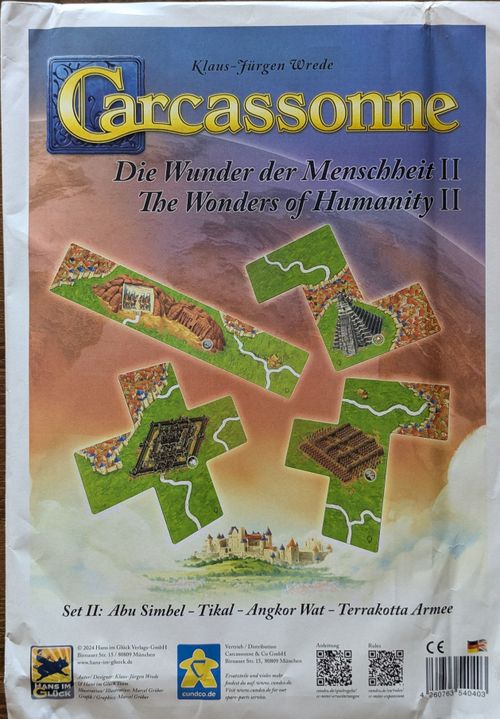
Carcassonne: The Wonders of Humanity Set II
Rulebook PDF: Hans im Glück (rules by Klaus-Jürgen Wrede), distributed by Cundco · PDF
Carcassonne: The Wonders of Humanity Set II Rulebook
Table of Contents
Table of Contents
Components
- 4 wonder tiles (Set II): Abu Simbel, Tikal, Angkor Wat, Terrakotta Armee
Note: All wonder tiles count as 5 connected normal tiles.
The source's component list prints "Terrakotta Armee"; the wonder's own description prints "Terracotta Armee". The latter spelling is used in this document.
Setup
This mini expansion was developed for the Carcassonne base game and its rules still apply.
You can combine The Wonders of Humanity with other expansions. However, there will be no official rules for these combinations.
We recommend you to play with at least 90 tiles and one additional meeple (e.g. Base game + 1. expansion). Ignore any additional expansion rules.
- Each player takes all 9 meeple of one color. Place 2 meeple of each color next to the space 10 of the scoring track. Note: One of these two meeple is used only to mark your wonder. You can use the big meeple of the 1st expansion or any other token of that color.
- Place a scoring meeple as usual on the space 0 on the scoring track. You start the game with 6 meeple in your supply.
- Pick 1 wonder tile per player. You can also combine wonders from different sets. Place them faceup next to the scoring track. Discard the remaining tiles, you do not need them for this game.
Alternatively, you can also prepare as many wonders as you like. You'll have a bigger selection of wonders and you can choose the right wonder for you, later in the game.
Get a wonder tile
There is one wonder for each player. So you can get a wonder tile only once (for a variation with two wonders per player see the Variation section below).
When your scoring meeple reaches or exceeds the space with the meeple pairs (the first time the space is 10), you perform the following steps one after the other:
-
Choose one of the wonder tiles and place it in front of you. You don't place it on the game board yet (see 1. Place a wonder tile).
-
Take your two meeple that are next to the scoring track and put them into your supply.
-
Move all remaining meeple next to the scoring track 5 spaces further (i.e. the first time next to the field 15, then 20 and then 25).
Attention: You must never move the meeple-pairs beyond the space 25, even if there are more than 4 players. The meeple remain at field 25 until they are reached by all other scoring meeple.
Special case: If several players reach the space with the meeple pairs on the same turn, the person whose turn it is chooses which of them will take a wonder tile. After that, the meeple pairs are moved 5 spaces forward as usual. If there are still scoring meeple of other players (who have not taken a wonder yet) on or further than the meeple-pair-space, the person whose turn it is decides again who will take the next wonder, and so on.
1. Place a wonder tile
If there is a wonder tile in front of you, you do not draw a tile, but instead place your wonder according to the usual placement rules. Once you have placed it, you have to mark your wonder with one of the 2 meeple you've unlocked before by placing it in the center of the wonder (not on a city, road or field). The marker meeple remains there until the end of the game. For a better distinction from other meeples you can put the marker meeple upside down.
Note: In the very rare case that you can't place the wonder correctly, you draw a tile that you must immediately place so that you can then place your wonder tile next to it. If this is also not possible, the normal tile is removed from the game and you draw another tile and place it, until you can place your wonder tile. You do not place a meeple on the additionally drawn tile.
Special case: If the game has already ended, but the wonder tile you just acquired in your previous turn is still in front of you, you may still place it (even if it is not your turn). After you have placed any meeples on the wonder tile, the game ends.
2. Place meeple on a wonder tile
After you have placed and marked your wonder, you may immediately place up to 2 meeple on different unoccupied features (city, road, monastery or field) of this wonder. You can also place only one or no meeple.
If you place 2 meeple, they may also be placed on the same tile-square.
3. Score with your wonder
Each wonder has its own function that can earn you points. Some wonders give you points during the game, while others give you points at the end of the game.
Scoring during the game
Abu Simbel
When it's your turn, you can choose from 2 tiles. The first time you draw 2 tiles. You choose one and place it as usual. Place the other one face down in front of you for a later turn.
When it's your turn again, you draw another tile and choose from 2 tiles again, and so on.
If there are no more tiles for you to draw at the end of the game, you draw a tile, look at it and place the one in front of you.
If your unchosen tile is the last one in the game, it goes to the next player for the last turn.
Example: You draw a tile, look at it and choose one. You decide which one you want to play now. You place the other one face down in front of you.
Tikal
If a city is scored that has at least 3 tiles and you have at least one meeple in it, you receive 2 points for each of your own meeple in a city on the playing field.
The following applies:
- You do not have to be the majority in the scored city.
- The meeple in the scored city also scores 2 points.
Example: Blue scores the city which is bigger than two tiles and in which you also have a meeple. Since blue has the majority there, he receives the points for the city, but you receive points for your Tikal wonder. You currently have a total of 4 meeples in cities on the board and therefore you receive (4x2=) 8 points.
Scoring at the end of the game
Angkor Wat
For each road (open or closed) that is at least 5 tiles long, you receive 5 points at the end of the game. It doesn't matter whether the roads have already been scored or are still open, whether there are meeple on them or not.
Example: At the end of the game, you first count all roads that are at least 5 tiles long. In this section, you count 2 relevant streets that give you (2x5=) 10 points.
Terracotta Armee
You receive 2 points for every at least 7 tiles that are in a row or column on the board at the end of the game.
The following applies:
- You may score identical tiles for the column and for the row.
- Each column and row is only scored once.
At the end of the game, go through column by column and row by row and count how many of them consist of at least 7 tiles that are adjacent to each other without a gap. In this section, there is one row and one column. You get (2x2=) 4 points for this.
Important!
At the end of the game, you first score the wonders that score at the end of the game. After that, you continue with the normal final scoring. Each wonder tile counts as 5 individual normal tiles. Accordingly, the roads and cities can consist of more than one tile. You must take this into account during the scoring.
Set II: Each wonder, except Tikal, has a road that extends over 2 tiles. Tikal has a road that even counts 3 tiles.
Variation - 2 wonders per player
If you are already familiar with The Wonders of Humanity, you can also try out the following variant, in which each player receives up to 2 wonders in the game. You now receive the effects of both wonders. Depending on the situation, you can also build interesting combinations.
Note: All the rules of the game remain the same. We are only listing the changes here.
Setup
We recommend that you play with at least 120 or more tiles and 2 additional meeple (e.g. base game + river, +1st expansion and any other tiles from (mini) expansions). But ignore the expansion rules.
- Each player takes 10 meeple of one color. Place 2 meeple of each color next to space 10 outside the scoring board, and 1 meeple next to the 0/50 starting space.
- Choose 2 or any number of wonders per player and place them next to the scoring board.
Receive the 2nd wonder tile
If your counting meeple reaches or exceeds the 50 space, you choose your 2nd wonder, place it in front of you and take the meeple next to the 0/50 starting space. After that, you use it to mark your 2nd wonder in your next turn, after you have placed it.