Carcassonne: The Peasant Revolts
Official rulebook: Carcassonne & Co (cundco.de) · PDF
Carcassonne: The Peasant Revolts Rulebook
Table of Contents
Table of Contents
Components
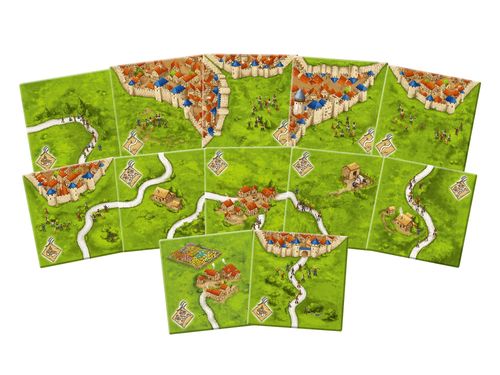
- 12 new land tiles for peasant revolts with symbols for the respective features
- 5 cities
- 4 roads
- 3 monasteries
Setup
Shuffle the 12 land tiles of this mini-expansion. Put 3 of them back into the box (without looking at them). Those tiles will not be used in this game. Shuffle the remaining 9 tiles and the other land tiles of the base game together.
This expansion has been developed for the Carcassonne base game. All of the rules remain the same.
You can combine The Peasant Revolts with other expansions - but at your own risk – i.e. there will be no official rules for these combinations.
1. Place a Land Tile
The Peasants Revolt
As soon as you draw a peasant revolt tile, a revolt takes place. Place the tile in front of you. Now check, if one or more of your meeple are standing on features shown on the symbol of the tile (city, road or monastery), and if those meeple are "unprotected" or "protected". (How you can protect your meeple, will be explained in 2. Place a meeple.)
Every protected meeple lying on respective features, scores 2 points. Protected meeple remain protected after the revolt.
All of your unprotected meeple standing on respective features, must be returned into your supply immediatly.
Note: As soon as you have had to return at least one meeple, the revolt is then over and you continue with your normal turn.
Example: You draw a land tile with the peasant revolt symbol for roads. Your protected meeple on the right stays on the tile and scores 2 points. Your unprotected meeple is standing on a road on the left. Put the meeple back into your supply. Therefore the revolt is over. The blue meeple has not been affected. Now, place the land tile according to the usual rules and continue your turn.
The Peasant Revolt Moves On to the Next Player
If you do not have to return a meeple to your supply, the peasant revolt moves on and hits the player to your left. They also check, in the same way as described before, whether or not the revolt affects them and if they score points for protected meeple. If the player doesn't have to take back a meeple, the next player in line checks meeple in these areas and so on.
This continues, until a player has to return at least 1 meeple to their supply, or none of the players have been affected. Now, place the land tile according to the usual rules and continue your turn.
Note! Only players, who have to check their meeple during the peasant revolt, score points for their protected meeple. Players who are not hit by the peasant revolt, cannot score any points for protected meeple.
Example: You draw a land tile with the peasant revolt symbol for cities. All of your meeple in cities are protected and you score 4 points. The peasant revolt moves on to blue. Blue is sitting to your left, and continues to check, if and how the peasant revolt affects them. Blue has 1 protected meeple in the city on the left, which scores 2 points. The unprotected meeple has to be returned into Blue's supply. The revolt ends and you place the land tile according to the usual rules and continue your turn.
2. Place a Meeple
Protecting a Meeple from a Peasant Revolt
- If you place a meeple on a tile, you may also protect this exact meeple, for the cost of 4 points. To do so, move your meeple on the score board back by 4 spaces. It is possible to score negative points. Next, "lay down" this meeple. (The meeple has now joined the farmers.) A meeple "lying down" is protected from a peasant revolt.
- Each time, you choose not to place a meeple on the tile you just have placed, you may protect one of your meeple already standing on tiles, for the cost of 2 points. Farmers cannot be protected, however they are never affected by peasant revolts.
Example: You place your meeple on the city. You protect your meeple and lay it down. This costs you 4 points. Move your meeple on the score board back by 4 spaces.
Example: You don't place a meeple on the city. Instead of that you protect an already placed meeple. This costs you 2 points: You have to move your meeple on the score board 2 spaces back.
3. Score Points
When scoring a feature, a protected meeple is treated like an unprotected meeple. It is returned into your supply after the feature has been scored. After that, it loses its protection from peasant revolts. This means, that if you place that meeple again, it is unprotected once again.
Example: This city has been completed. You have the majority of meeple (2 in his case) and score 12 points. Blue does not score any points. Return all meeple from the city back into your supplies. They are now unprotected once more.